Finland Tensile Testing Equipment Market Size (2020-2030)
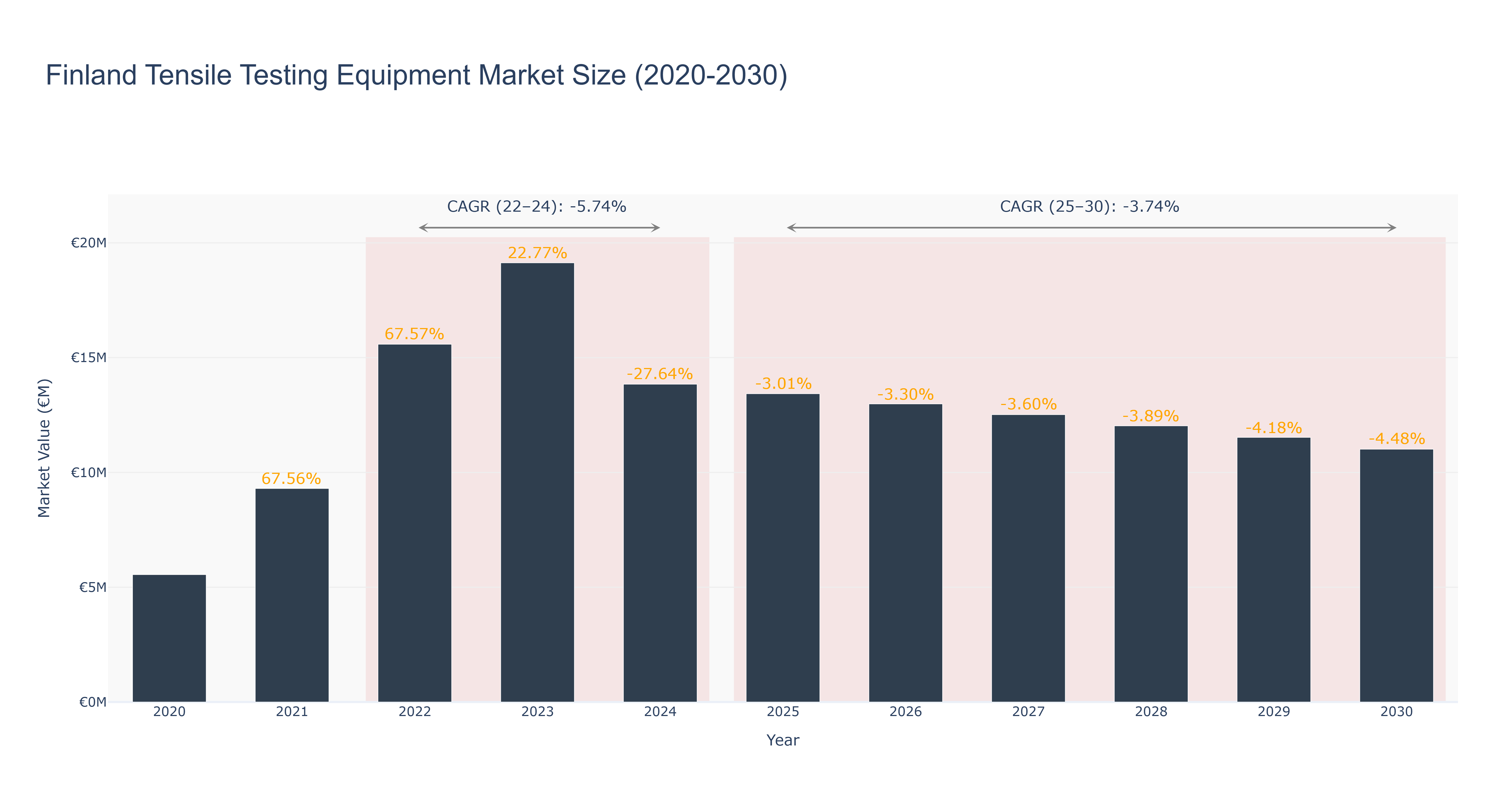
The Finland Tensile Testing Equipment Market experienced a peak market size of €19.13 million in 2023, followed by a decline to €13.84 million in 2024. The market is forecasted to continue its downward trend, with a projected size of €11.01 million in 2030. The CAGR from 2022 to 2024 was -5.74%, while the CAGR from 2025 to 2030 is expected to be -3.74%. The market's fluctuation can be attributed to various factors such as economic conditions, technological advancements, and changing consumer preferences. Despite the current challenges, upcoming infrastructure development projects in Finland are set to drive demand for testing equipment, offering growth opportunities for market players. Staying abreast of industry drivers and adapting to evolving market dynamics will be crucial for businesses to navigate the changing landscape effectively.
Finland Tensile Testing Equipment Market: Production & Trade Performance (2019-2025)
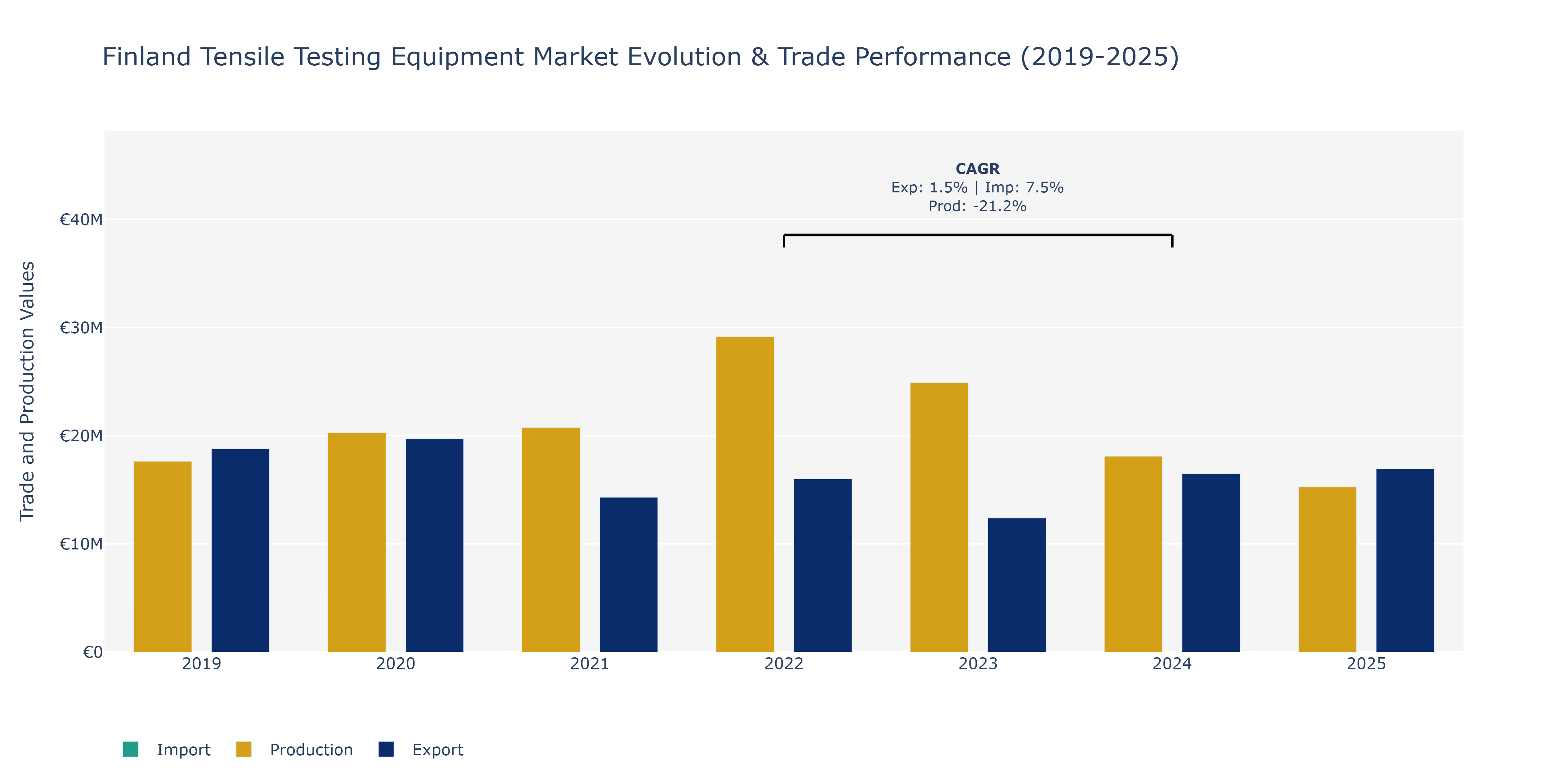
In the Finland Tensile Testing Equipment Market, from 2019 to 2025, Exports showed fluctuations, starting at €18.8 million in 2019, reaching a peak in 2022 at €16.02 million, and then gradually increasing to €16.97 million in 2025. Imports experienced a similar trend, with values starting at €4.44 million in 2019, peaking in 2025 at €6.54 million. Production, on the other hand, started at €17.7 million in 2019, saw a substantial increase to €29.2 million in 2022, and then declined to €15.3 million in 2025. These fluctuations could be attributed to various factors such as changes in demand for testing equipment in industries like manufacturing, automotive, and aerospace. External factors like economic conditions and technological advancements influencing the need for quality testing could have also played a role in shaping these trends in the market.
Key Highlights of the Report:
- Finland Tensile Testing Equipment Market Outlook
- Market Size of Finland Tensile Testing Equipment Market, 2024
- Forecast of Finland Tensile Testing Equipment Market, 2031
- Historical Data and Forecast of Finland Tensile Testing Equipment Revenues & Volume for the Period 2021-2031
- Finland Tensile Testing Equipment Market Trend Evolution
- Finland Tensile Testing Equipment Market Drivers and Challenges
- Finland Tensile Testing Equipment Price Trends
- Finland Tensile Testing Equipment Porter`s Five Forces
- Finland Tensile Testing Equipment Industry Life Cycle
- Historical Data and Forecast of Finland Tensile Testing Equipment Market Revenues & Volume By Equipment Type for the Period 2021-2031
- Historical Data and Forecast of Finland Tensile Testing Equipment Market Revenues & Volume By Universal Testing Machine for the Period 2021-2031
- Historical Data and Forecast of Finland Tensile Testing Equipment Market Revenues & Volume By Hydraulic for the Period 2021-2031
- Historical Data and Forecast of Finland Tensile Testing Equipment Market Revenues & Volume By Electromechanical for the Period 2021-2031
- Historical Data and Forecast of Finland Tensile Testing Equipment Market Revenues & Volume By Others for the Period 2021-2031
- Historical Data and Forecast of Finland Tensile Testing Equipment Market Revenues & Volume By End-User Industry for the Period 2021-2031
- Historical Data and Forecast of Finland Tensile Testing Equipment Market Revenues & Volume By Industrial Manufacturing for the Period 2021-2031
- Historical Data and Forecast of Finland Tensile Testing Equipment Market Revenues & Volume By Automotive for the Period 2021-2031
- Historical Data and Forecast of Finland Tensile Testing Equipment Market Revenues & Volume By Construction for the Period 2021-2031
- Historical Data and Forecast of Finland Tensile Testing Equipment Market Revenues & Volume By Others for the Period 2021-2031
- Finland Tensile Testing Equipment Import Export Trade Statistics
- Market Opportunity Assessment By Equipment Type
- Market Opportunity Assessment By End-User Industry
- Finland Tensile Testing Equipment Top Companies Market Share
- Finland Tensile Testing Equipment Competitive Benchmarking By Technical and Operational Parameters
- Finland Tensile Testing Equipment Company Profiles
- Finland Tensile Testing Equipment Key Strategic Recommendations






































