Finland Wax Market Size (2020-2030)
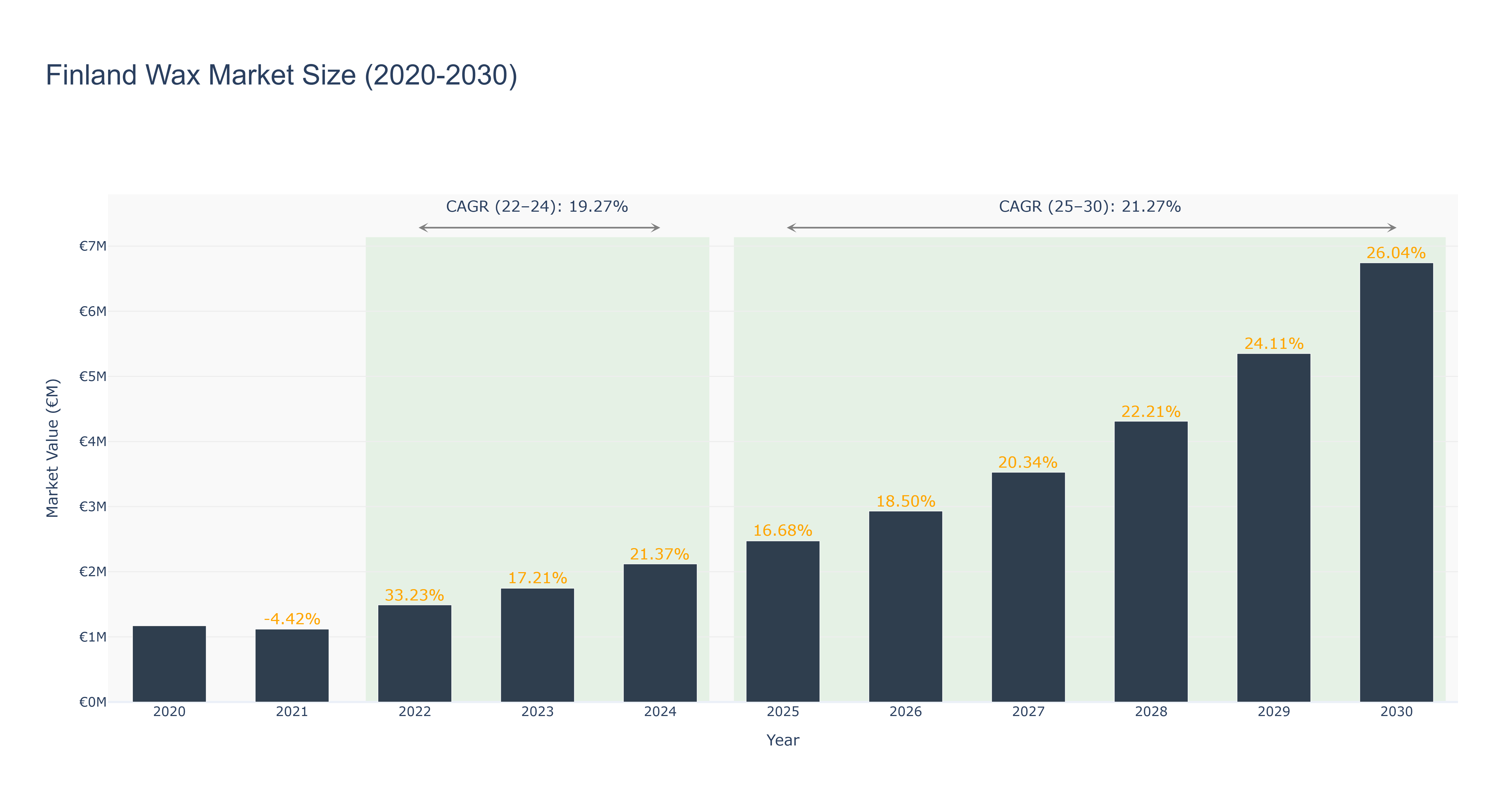
The Finland Wax Market has shown a consistent upward trend over the years. The market reached its peak in 2030 with a size of €6.74 million. From 2020 to 2024, the market size grew steadily, with the actual size increasing from €1.17 million in 2020 to €2.12 million in 2024. The forecasted market size from 2025 to 2030 is expected to continue this growth trajectory, with a CAGR of 21.27%. The market experienced a significant spike in growth from 2022 to 2024, attributed to increased demand for wax products in various industries. Looking ahead, recent developments in sustainable wax production methods and partnerships with eco-friendly brands are set to drive further growth in the Finland Wax Market.
Finland Wax Market: Production & Trade Performance (2019-2025)
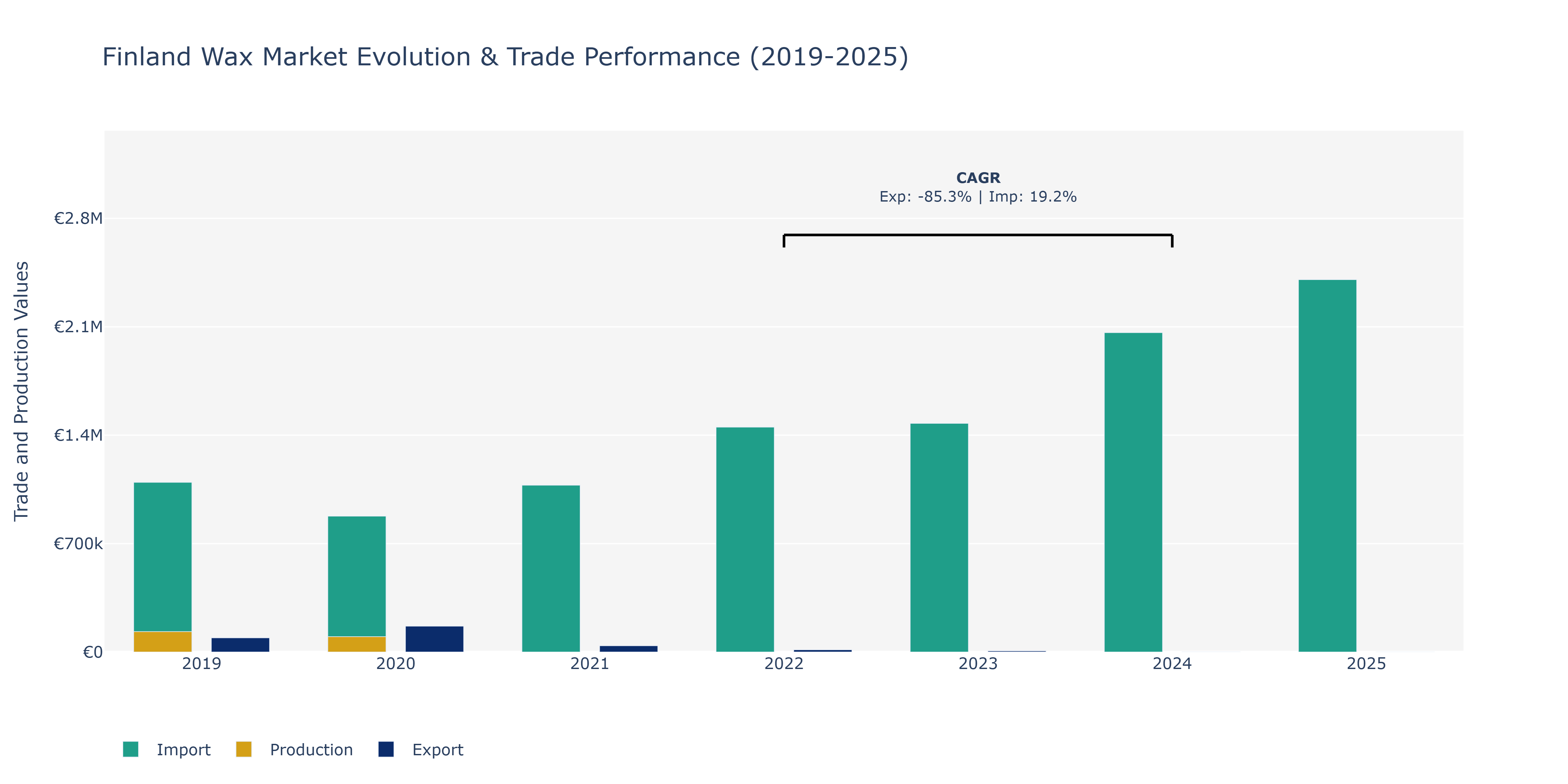
In the Finland Wax Market, from 2019 to 2025, exports exhibited a fluctuating trend. Starting at €91.51 thousand in 2019, exports peaked in 2020 at €167.22 thousand before declining sharply in subsequent years, reaching €0.25 million in 2025. This erratic pattern could be attributed to global economic uncertainties, affecting demand for wax products. Imports, on the other hand, showcased a consistent increase from €1.1 million in 2019 to €2.4 million in 2025. Such growth may indicate a rising need for raw materials or a shift in production capacities within the market. Production value also experienced a downward trajectory from €131.76 thousand in 2019 to €98.92 thousand in 2020, potentially reflecting changes in manufacturing output. The contrasting movements between exports, imports, and production underscore a dynamic market landscape, emphasizing the market's sensitivity to external factors impacting trade and production.
Finland Wax Market Overview
The wax market in Finland spans applications in candles, cosmetics, packaging, and industrial lubricants. Growth in eco-friendly and synthetic waxes reflects a shift toward sustainable materials and innovations in product formulations.
Drivers of the market
The Finland wax market is expanding due to the increasing use of wax in a variety of industries, including packaging, cosmetics, and automotive. In packaging, wax serves as a natural and eco-friendly alternative for coating and protecting products. The growing demand for sustainable packaging solutions is a significant driver. Additionally, the cosmetics sectors need for waxes in formulations like lip balms, lotions, and hair removal products further supports market growth. The automotive industrys demand for waxes used in car polish and protective coatings also contributes to the market`s expansion.
Challenges of the market
Finland`s wax market contends with fluctuating raw material costs and competition from synthetic wax alternatives. Environmental concerns about wax production and disposal also pose significant challenges for the market.
Government Policy of the market
The Wax market in Finland is influenced by environmental and safety regulations that promote sustainable production practices and the use of eco-friendly materials. Government policies are focused on reducing the environmental footprint of manufacturing processes and ensuring that wax products meet high-quality standards for consumer safety. The Finnish market for waxes, including those used in cosmetics, packaging, and industrial applications, is evolving as consumer demand for natural and non-toxic products grows. These regulations play a crucial role in shaping the market, encouraging the adoption of innovative, eco-conscious alternatives to traditional wax products.
Key Highlights of the Report:
- Finland Wax Market Outlook
- Market Size of Finland Wax Market, 2024
- Forecast of Finland Wax Market, 2031
- Historical Data and Forecast of Finland Wax Revenues & Volume for the Period 2021-2031
- Finland Wax Market Trend Evolution
- Finland Wax Market Drivers and Challenges
- Finland Wax Price Trends
- Finland Wax Porter`s Five Forces
- Finland Wax Industry Life Cycle
- Historical Data and Forecast of Finland Wax Market Revenues & Volume By Product for the Period 2021-2031
- Historical Data and Forecast of Finland Wax Market Revenues & Volume By Mineral for the Period 2021-2031
- Historical Data and Forecast of Finland Wax Market Revenues & Volume By Synthetic for the Period 2021-2031
- Historical Data and Forecast of Finland Wax Market Revenues & Volume By Natural for the Period 2021-2031
- Historical Data and Forecast of Finland Wax Market Revenues & Volume By Applications for the Period 2021-2031
- Historical Data and Forecast of Finland Wax Market Revenues & Volume By Candles for the Period 2021-2031
- Historical Data and Forecast of Finland Wax Market Revenues & Volume By Packaging for the Period 2021-2031
- Historical Data and Forecast of Finland Wax Market Revenues & Volume By Plastic & Rubber for the Period 2021-2031
- Historical Data and Forecast of Finland Wax Market Revenues & Volume By Cosmetics & Toiletries for the Period 2021-2031
- Historical Data and Forecast of Finland Wax Market Revenues & Volume By Fire Logs for the Period 2021-2031
- Historical Data and Forecast of Finland Wax Market Revenues & Volume By Adhesives for the Period 2021-2031
- Historical Data and Forecast of Finland Wax Market Revenues & Volume By Others for the Period 2021-2031
- Finland Wax Import Export Trade Statistics
- Market Opportunity Assessment By Product
- Market Opportunity Assessment By Applications
- Finland Wax Top Companies Market Share
- Finland Wax Competitive Benchmarking By Technical and Operational Parameters
- Finland Wax Company Profiles
- Finland Wax Key Strategic Recommendations






































