Finland Wine Production Machinery Market Size (2020-2030)
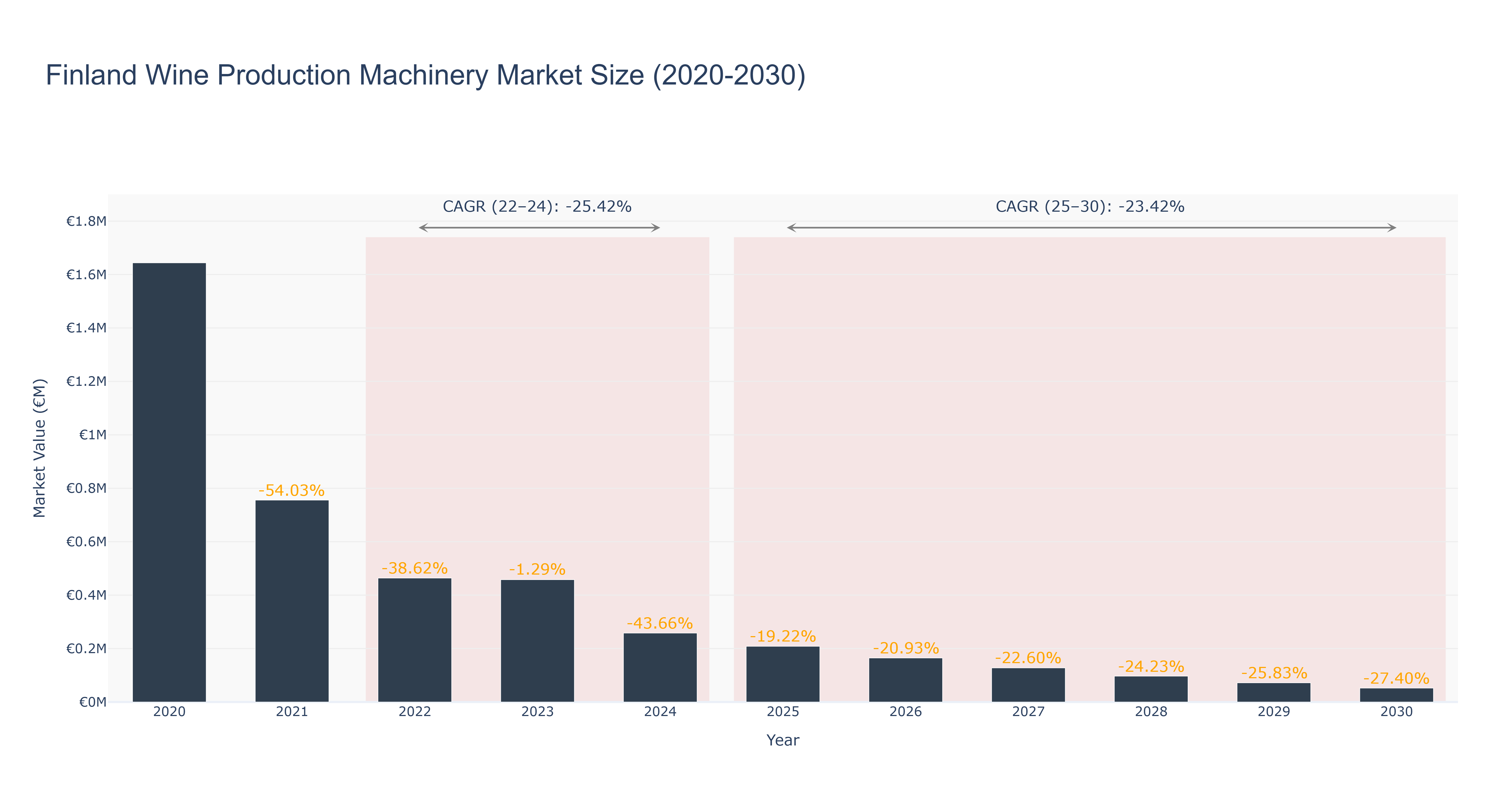
The Finland Wine Production Machinery Market has experienced a significant decline since its peak market size of €1.64 million in 2020. The actual market size decreased sharply to €463.87 thousand in 2022, with subsequent years showing further contraction, culminating at €258.00 thousand in 2024, representing a compounded annual growth rate (CAGR) of -25.42% for the period. The forecasted outlook from 2025 to 2030 suggests continued challenges, with projected market sizes declining to €52.03 thousand by 2030, indicating a CAGR of -23.42%. This ongoing downturn may be attributed to factors such as reduced domestic wine production, shifting consumer preferences, and economic constraints impacting investment in machinery. While there are no specific upcoming projects noted, the overall market dynamics indicate a need for innovation and adaptation within the industry to reverse this declining trend and capitalize on potential growth opportunities in sustainable practices and technology advancements.
Finland Wine Production Machinery Market: Production & Trade Performance (2019-2025)
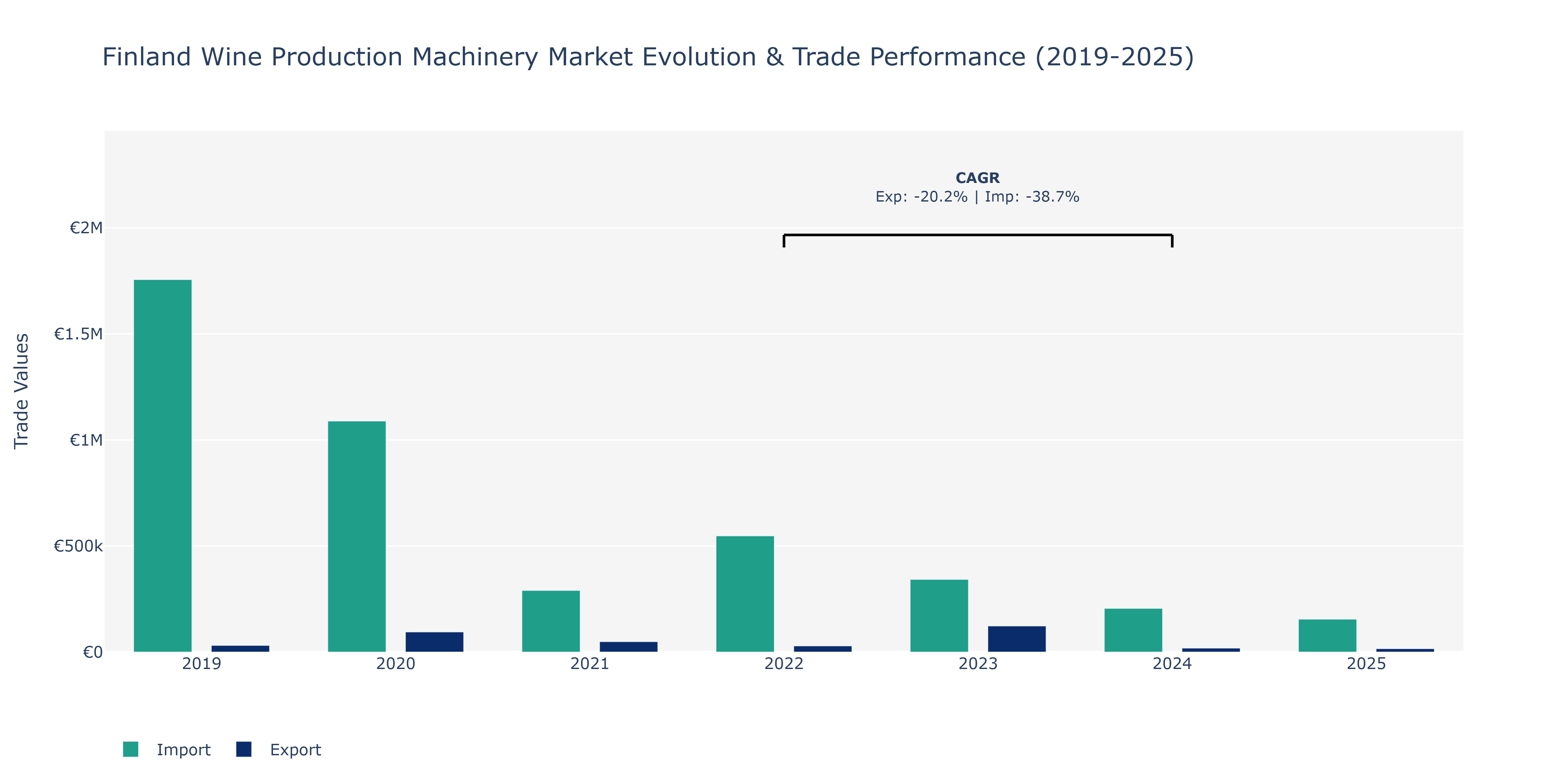
The Finland Wine Production Machinery Market saw fluctuations in both exports and imports from 2019 to 2025. In 2019, exports were at €31.08 thousand, showing a substantial increase in 2020 to €94.64 thousand, and then declining to €48.96 thousand in 2021. The exports further dropped to €28.97 thousand in 2022, before experiencing a significant surge to €122.99 thousand in 2023, followed by a decline to €18.47 thousand in 2024 and a slight decrease in 2025 to approximately €15.73 thousand. On the other hand, imports started at €1.76 million in 2019, decreased to €1.09 million in 2020, and further dropped to €290.47 thousand in 2021. Subsequently, imports increased to €547.58 thousand in 2022, then decreased to €342.23 thousand in 2023, and slightly dropped to around €205.66 thousand in 2024, and finally to approximately €154.6 thousand in 2025. The fluctuations in both exports and imports can be attributed to global economic conditions, trade agreements, and technological advancements impacting the wine production machinery market in Finland. For instance, changes in international trade policies and evolving consumer preferences could have influenced these trends.
Key Highlights of the Report:
- Finland Wine production Machinery Market Outlook
- Market Size of Finland Wine production Machinery Market, 2024
- Forecast of Finland Wine production Machinery Market, 2031
- Historical Data and Forecast of Finland Wine production Machinery Revenues & Volume for the Period 2021-2031
- Finland Wine production Machinery Market Trend Evolution
- Finland Wine production Machinery Market Drivers and Challenges
- Finland Wine production Machinery Price Trends
- Finland Wine production Machinery Porter`s Five Forces
- Finland Wine production Machinery Industry Life Cycle
- Historical Data and Forecast of Finland Wine production Machinery Market Revenues & Volume By Type for the Period 2021-2031
- Historical Data and Forecast of Finland Wine production Machinery Market Revenues & Volume By Tanks & fermenters for the Period 2021-2031
- Historical Data and Forecast of Finland Wine production Machinery Market Revenues & Volume By Crushing & Pressing Equipment for the Period 2021-2031
- Historical Data and Forecast of Finland Wine production Machinery Market Revenues & Volume By Temperature Control Equipment for the Period 2021-2031
- Historical Data and Forecast of Finland Wine production Machinery Market Revenues & Volume By Filtration Equipment for the Period 2021-2031
- Historical Data and Forecast of Finland Wine production Machinery Market Revenues & Volume By Others for the Period 2021-2031
- Finland Wine production Machinery Import Export Trade Statistics
- Market Opportunity Assessment By Type
- Finland Wine production Machinery Top Companies Market Share
- Finland Wine production Machinery Competitive Benchmarking By Technical and Operational Parameters
- Finland Wine production Machinery Company Profiles
- Finland Wine production Machinery Key Strategic Recommendations






































