France Aggregates Market Top 5 Importing Countries and Market Competition (HHI) Analysis
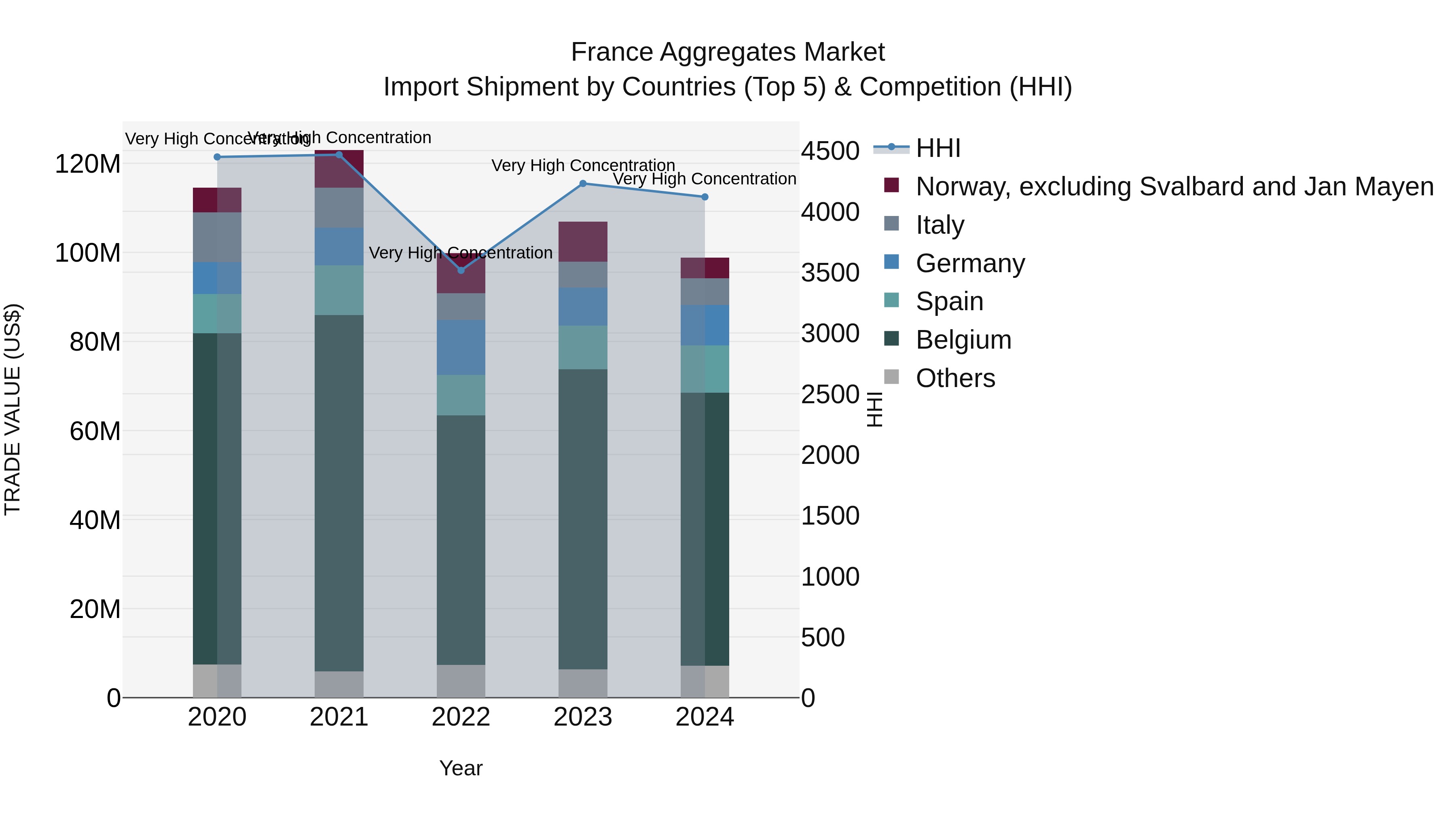
France continued to rely on key European partners for its aggregates imports in 2024, with Belgium, Spain, Germany, Italy, and Norway leading the way. Despite a negative compound annual growth rate (CAGR) from 2020 to 2024 and a further decline in growth rate from 2023 to 2024, the Herfindahl-Hirschman Index (HHI) indicated a high level of concentration within the market. This suggests that while the overall import volume may have decreased, the market remains dominated by a few major players, highlighting the importance of strategic partnerships and market dynamics in the aggregates sector.
France Aggregates Market Overview
The aggregates market in France is characterized by steady growth driven by infrastructure development projects, construction activities, and increasing demand for raw materials in various industries. Sand, gravel, and crushed stones are the primary types of aggregates used in the construction sector for concrete production, road construction, and other applications. The market is influenced by government investments in transportation infrastructure, residential construction, and commercial projects. Sustainable practices, such as recycling aggregates from demolition waste and promoting eco-friendly production methods, are gaining traction in the market. Key players in the France aggregates market include LafargeHolcim, HeidelbergCement, and CEMEX, among others, focusing on product innovation, market expansion, and strategic partnerships to maintain their competitive edge in the industry.
France Aggregates Market Trends
The France aggregates market is experiencing steady growth due to the increasing demand for construction materials in infrastructure development and urbanization projects. Sustainable practices and environmental considerations are driving the use of recycled aggregates and alternative materials in construction projects. There is a focus on technological advancements to improve production efficiency and reduce environmental impact, such as the use of advanced crushing and screening equipment. Additionally, the market is witnessing consolidation as larger companies acquire smaller players to expand their market presence and offerings. Overall, the France aggregates market is evolving towards greater sustainability, innovation, and efficiency to meet the growing demands of the construction industry.
France Aggregates Market Challenges
In the France aggregates market, some key challenges include strict regulations surrounding extraction and transportation of aggregates, leading to increased operational costs and permitting delays. Additionally, there is a growing concern over the environmental impact of aggregate mining, leading to pressure to adopt more sustainable practices. Competition among market players is also intense, driving down prices and margins. Furthermore, the industry faces the challenge of keeping up with the increasing demand for aggregates due to infrastructure development projects, which puts a strain on production capacities. Overall, navigating these challenges requires companies in the France aggregates market to innovate, streamline operations, and adapt to changing market dynamics to remain competitive and sustainable in the long run.
France Aggregates Market Investment Opportunities
The France aggregates market offers several investment opportunities due to the country`s ongoing infrastructure projects and construction activities. With a focus on sustainable development and environmental regulations driving demand for recycled aggregates, investing in companies that specialize in producing and supplying recycled aggregates could be lucrative. Additionally, the growing trend towards using aggregates in landscaping and decorative applications presents opportunities for companies catering to this niche market segment. Investing in technology and innovation within the aggregates sector, such as advanced crushing and screening equipment, could also prove to be a profitable venture as companies seek to improve efficiency and reduce environmental impact. Overall, the France aggregates market offers diverse investment opportunities catering to different segments of the industry and market trends.
France Aggregates Market Government Policy
In France, the aggregates market is regulated by government policies aimed at ensuring sustainable extraction practices and environmental protection. The country`s regulations require operators to obtain permits for quarrying activities, adhere to strict environmental standards, and undertake restoration measures post-extraction. Additionally, there are guidelines in place to promote the use of recycled aggregates and limit the environmental impact of the industry. The government also monitors the market to prevent monopolistic practices and ensure fair competition among operators. Overall, the regulatory framework in France`s aggregates market prioritizes sustainability, environmental responsibility, and fair competition to support the industry`s long-term viability.
France Aggregates Market Future Outlook
The future outlook for the France aggregates market appears positive, driven by ongoing infrastructure development projects, urbanization trends, and the increasing demand for construction materials. The market is expected to witness steady growth due to the rising investments in public infrastructure, residential construction, and commercial projects. Additionally, the emphasis on sustainable construction practices and the increasing adoption of recycled aggregates are likely to further propel market expansion. However, challenges such as regulatory constraints, environmental concerns, and fluctuating raw material prices may impact the market dynamics. Overall, the France aggregates market is anticipated to experience continued growth opportunities, supported by the construction industry`s robust demand for high-quality aggregates in the coming years.
Key Highlights of the Report:
- France Aggregates Market Outlook
- Market Size of France Aggregates Market, 2024
- Forecast of France Aggregates Market, 2031
- Historical Data and Forecast of France Aggregates Revenues & Volume for the Period 2021-2031
- France Aggregates Market Trend Evolution
- France Aggregates Market Drivers and Challenges
- France Aggregates Price Trends
- France Aggregates Porter's Five Forces
- France Aggregates Industry Life Cycle
- Historical Data and Forecast of France Aggregates Market Revenues & Volume By Product Type for the Period 2021-2031
- Historical Data and Forecast of France Aggregates Market Revenues & Volume By Crushed Stone for the Period 2021-2031
- Historical Data and Forecast of France Aggregates Market Revenues & Volume By Sand for the Period 2021-2031
- Historical Data and Forecast of France Aggregates Market Revenues & Volume By Gravel for the Period 2021-2031
- Historical Data and Forecast of France Aggregates Market Revenues & Volume By Recycled Aggregates for the Period 2021-2031
- Historical Data and Forecast of France Aggregates Market Revenues & Volume By Application for the Period 2021-2031
- Historical Data and Forecast of France Aggregates Market Revenues & Volume By Construction Materials for the Period 2021-2031
- Historical Data and Forecast of France Aggregates Market Revenues & Volume By Road Construction for the Period 2021-2031
- Historical Data and Forecast of France Aggregates Market Revenues & Volume By Concrete Production for the Period 2021-2031
- Historical Data and Forecast of France Aggregates Market Revenues & Volume By Landscaping for the Period 2021-2031
- Historical Data and Forecast of France Aggregates Market Revenues & Volume By End User for the Period 2021-2031
- Historical Data and Forecast of France Aggregates Market Revenues & Volume By Construction Industry for the Period 2021-2031
- Historical Data and Forecast of France Aggregates Market Revenues & Volume By Residential for the Period 2021-2031
- Historical Data and Forecast of France Aggregates Market Revenues & Volume By Commercial for the Period 2021-2031
- France Aggregates Import Export Trade Statistics
- Market Opportunity Assessment By Product Type
- Market Opportunity Assessment By Application
- Market Opportunity Assessment By End User
- France Aggregates Top Companies Market Share
- France Aggregates Competitive Benchmarking By Technical and Operational Parameters
- France Aggregates Company Profiles
- France Aggregates Key Strategic Recommendations






































