Vietnam Aggregates Market Growth Rate
According to 6Wresearch internal database and industry insights, the Vietnam Aggregates Market is projected to grow at a compound annual growth rate (CAGR) of 8.98% during the forecast period (2026-2032).
Vietnam Aggregates Market Year-wise Growth Rate and Key Drivers (2022-2032)
This graph illustrates the annual growth rates of the Vietnam Aggregates Market from 2022 to 2032, highlighting a steady upward trajectory and projected market expansion over the forecast period.
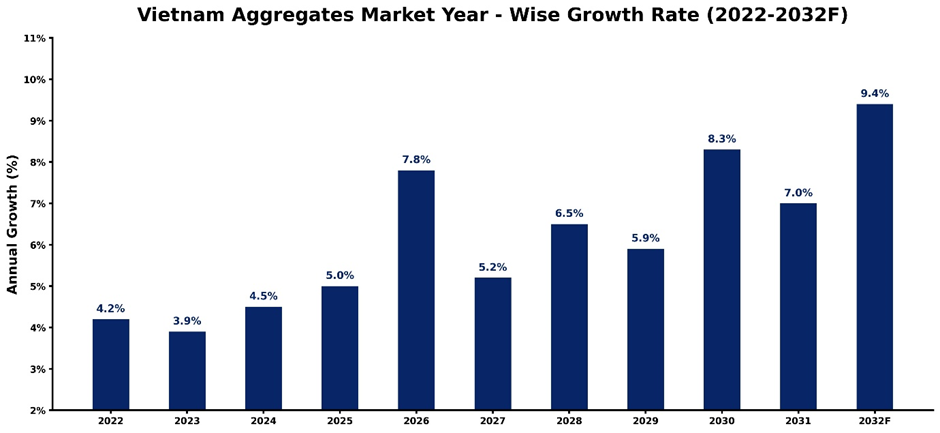
The following table presents the estimated annual growth rates of the market for each year, along with the key factors influencing market performance during the respective period. The values are intended to highlight year-wise drivers rather than provide a direct comparison between individual years.
| Year | Estimated Growth (%) | Market Rationale |
| 2022 | 4.2% | Urbanization and residential construction drove demand. |
| 2023 | 3.9% | Highway and infrastructure projects increased aggregate consumption. |
| 2024 | 4.5% | Industrial investment boosted concrete production. |
| 2025 | 5% | Modern mining and processed sand improved supply efficiency. |
| 2026 | 7.8% | Public transport and smart city spending increased procurement. |
| 2027 | 5.2% | Real estate and commercial construction supported demand. |
| 2028 | 6.5% | Eco-friendly development increased manufactured sand adoption. |
| 2029 | 5.9% | Road and coastal development raised material requirements. |
| 2030 | 8.3% | Rural infrastructure and logistics expansion drove demand. |
| 2031 | 7% | Commercial spaces and logistics parks sustained demand. |
| 2032 | 9.4% | Urban migration and housing needs supported long-term demand. |
Topics Covered in the Vietnam Aggregates Market Report
The Vietnam Aggregates Market Report provides a comprehensive analysis based on Product Type, Application, and End User. It offers detailed insights into key industry trends, growth drivers, emerging opportunities, competitive developments, and high-growth segments. The report presents an objective assessment of current dynamics and future prospects, enabling stakeholders to make informed business decisions and develop effective strategies aligned with the evolving industry landscape.
Vietnam Aggregates Market Highlights
| Report Name | Vietnam Aggregates Market |
| Forecast period | 2026-2032 |
| CAGR | 8.98% |
| Growing Sector | Concrete Production |
Vietnam Aggregates Market Synopsis
Vietnam Aggregates Market is expected to show considerable growth on account of rising urbanization, government expenditure on infrastructure, and growing real estate projects. Essentially, aggregates are foundational particulate materials like crushed stone, gravel, and sand mixed with cement to form durable concrete for modern structures. As foreign direct investments pour into industrial zones and coastal economic regions, the demand for these crucial structural components multiplies.
The shift towards artificial sand and recycled materials points out a key transformation that needs to be achieved in order to overcome the increasing shortage of natural resources. In this regard, the need of the hour is to strike a balance between ambitious growth objectives and strict regulation requirements in order to maintain the flow of materials for the country’s economic transition.
Evaluation of Growth Drivers in the Vietnam Aggregates Market (2026-2032)
Below mentioned are some prominent drivers and their influence on the market dynamics:
| Drivers | Primary Segments Affected | Why it Matters (Evidence) |
| Massive Infrastructure Spending | Construction Materials, Road Construction | Extensive highway and bridge projects elevate the continuous requirement for high-volume crushed stones and gravel. |
| Accelerated Urbanization Rates | Concrete Production, Residential | The influx of population into major cities requires vast housing projects, driving massive cement and aggregate mixing. |
| Foreign Industrial Investments | Construction Industry, Commercial | New manufacturing plants and logistics hubs necessitate strong structural foundations built with premium construction aggregates. |
| Shift Towards Manufactured Sand | Crushed Stone, Concrete Production | River sand depletion has accelerated the adoption of manufactured alternatives, ensuring consistent material supply for builders. |
| Tourism and Hospitality Boom | Landscaping, Commercial | The construction of high-end resorts and coastal hotels boosts the specialized use of aesthetic and structural aggregates. |
Vietnam Aggregates Market is projected to witness massive expansion, registering a CAGR of 8.98% during the forecast period (2026-2032). Sustained infrastructure investment, rapid urbanisation, and expanding transportation and construction activity are the main forces behind this market's growth. Continued disbursement of public investment capital toward major infrastructure projects, including nationwide expressway development, road upgrades, and the Long Thanh International Airport, remains a key catalyst.
Transportation infrastructure accounts for a significant share of overall infrastructure spending, which should keep demand for crushed stone, sand, gravel, and road-base materials fairly robust going forward. At the same time, urban development, residential and commercial construction, industrial parks, and logistics infrastructure are all adding to aggregate demand from a different direction.
Overall, large-scale government infrastructure spending, expanding construction activity, and rising connectivity requirements point to sustained volume growth in the Vietnam Aggregates Industry through 2032.
Evaluation of Restraints in the Vietnam Aggregates Market
Below mentioned are some major restraints and their influence on the market dynamics:
| Restraints | Primary Segments Affected | What This Means (Evidence) |
| Depletion of River Sand | Sand, Concrete Production | Strict environmental regulations on natural sand dredging limit supply and force builders to seek alternatives. |
| High Cost of Transportation | Aggregate of All Kinds, Construction Industry | The heavy and cumbersome nature of materials increases transportation cost due to long distance. |
| Unpredictable Cost of Fuel Consumption | Road Construction, Crushed Stone | The fluctuation of fuel prices affects the cost of operation of mining machinery. |
| Elaborate License Application Procedures | Gravel, Residential | The lengthy process of obtaining mining permit hinders the operation of mines. |
| Unauthorized Mining | Sand, Landscaping | The lack of regulation causes the disruption of the supply chain of aggregates. |
Vietnam Aggregates Market Challenges
Vietnam Aggregates Market growth confronts supply-side bottlenecks, primarily characterized by an acute scarcity of natural river sand and volatile material costs. As of 2025, construction sand prices have spiked by roughly 140%, reaching up to 550,000 VND per cubic meter, while standard crushed stone experienced a staggering 100% price surge due to peak infrastructure demands.
With the rapid exhaustion of the existing quarries along with stringent license renewals, almost 30% of the construction projects in the region are experiencing a shortage of quality construction materials. The increasing costs associated with production due to the energy and transportation expenses place further burden on the suppliers who cannot afford to increase prices.
Vietnam Aggregates Market Trends
Significant trends driving the Vietnam Aggregates Market are presented below:
- Adoption of Manufactured Sand (M-Sand): Construction firms are actively transitioning from natural river sand to crushed rock fines due to strict environmental protections. M-Sand provides better concrete strength while reducing the ecological damage caused by traditional riverbed dredging.
- Integration of Smart Quarrying: The application of automatic crushing systems and the use of IoT sensors that would help to automate the process of extraction. Such technology optimizes the blasting process, checks the performance of equipment in real-time mode, and greatly increases the amount of high-quality crushed stone.
- Mobile Crushing Innovations: Nowadays, the use of track-mounted mobile crushers in the construction industry is becoming more common. Such equipment is transported to the construction site and helps to avoid the dependence on the third-party haulage.
Investment Opportunities in the Vietnam Aggregates Market
Promising investment avenues in the Vietnam Aggregates Market are presented below:
- Manufactured Sand Facilities: Securing strategic locations near major urban centers to develop high-capacity rock crushing and sand manufacturing plants. Investment will be critical for advanced screening technologies, washing systems, and sustainable water recycling infrastructure.
- Machinery in Quarry Operations: Purchase of automated machines that use smart technology for doing jobs such as drilling, blasting, and loading of material. The use of such machines would increase the production efficiency of quarries with the assurance of safety of labor.
- Transport and Hauling Fleets: Building efficient, environmentally-friendly transport systems designed to move bulky construction materials. Investment in large-scale truck fleets and distribution centers will help overcome important logistics barriers between provinces.
Top Players in the Vietnam Aggregates Market
A list of leading companies operating in the Vietnam Aggregates Market is presented below:
1. Vicostone Joint Stock Company
| Company Name | Vicostone Joint Stock Company |
|---|---|
| Established Year | 2002 |
| Headquarters | Hanoi, Vietnam |
| Official Website | - |
Vicostone manufactures engineered quartz surfaces and quartz-based products, serving residential, commercial, and architectural markets across international destinations.
2. Minh Phuong Company Limited
| Company Name | Minh Phuong Company Limited |
|---|---|
| Established Year | 2011 |
| Headquarters | Ho Chi Minh City, Vietnam |
| Official Website | Click Here |
Minh Phuong supplies and exports mineral and stone aggregates, supporting Vietnam’s construction materials sector through domestic and international distribution activities.
3. Hoang Gia Mineral Group JSC
| Company Name | Hoang Gia Mineral Group JSC |
|---|---|
| Established Year | 1996 |
| Headquarters | Nghe An, Vietnam |
| Official Website | Click Here |
Hoang Gia Mineral Group extracts, processes, and exports natural stone and mineral products, including marble blocks, slabs, tiles, and related construction materials.
4. Viglacera Corporation
| Company Name | Viglacera Corporation |
|---|---|
| Established Year | 1974 |
| Headquarters | Hanoi, Vietnam |
| Official Website | Click Here |
Viglacera produces construction materials including ceramic tiles, stone surfaces, glass, sanitary ware, and other building products for domestic and international markets.
Government Initiatives Being Implemented in the Vietnam Aggregates Market
The government is backing the Vietnam aggregates industry through initiatives aimed at ensuring adequate construction-material supplies, improving mineral resource management, and accelerating infrastructure development. Authorities have been expanding and streamlining approvals for licensed aggregate mines, largely to keep pace with demand from major projects such as expressways, airports, and urban road networks.
The Ring Road 3 project in Ho Chi Minh City is a good example of this in practice, having generated substantial demand for crushed stone, sand, and other construction materials. Alongside this, the government is pushing for more efficient and environmentally responsible mineral extraction, while tightening monitoring to curb illegal mining and help keep aggregate supplies stable.
Future Insights of the Vietnam Aggregates Market
The Vietnam Aggregates Industry is expected to experience a transformative shift by 2032, driven by an intense wave of urbanization and modernized construction techniques. According to current projections, public infrastructure will continue to consume over 72% of heavy construction materials, fundamentally altering supply chain dynamics. By 2032, there will be an increase in the requirement of artificial sand and recycled concrete aggregates of about 35% due to depletion of natural river sand resources. In addition, with the help of modern machinery, there will be an improvement in the process of extraction by about 20%, which will enable the extraction of necessary materials that comply with strict quality standards for new-age transport, rail, and eco-cities.
Market Segmentation Analysis
This report presents a detailed analysis of the market segments along with their leading categories:
By Product Type – Dominated by Crushed Stone, Recycled Aggregates Set for Rapid Expansion
According to Sachin Kumar Rai, Senior Research Analyst, 6Wresearch, Crushed Stone accounted for 54.20% of the Vietnam Aggregates Market Share in 2025. This dominance is driven by immense material demand in road base preparations, railway ballasts, and foundational concrete formulations across widespread national infrastructure upgrades. Meanwhile, Recycled Aggregates are anticipated to register the fastest CAGR of 8.95% during 2026–2032, supported by stringent government environmental regulations and circular economy adoption.
By End User – Dominated by Construction Industry, Commercial Set for Rapid Expansion
The Construction Industry secured the commanding market share of 58.11% in the year 2025, fueled by government investments in major infrastructure, bridge construction activities, and extensive structural upgrades. In contrast, the Commercial segment is expected to record an immense CAGR of 8.12% from 2026 to 2032 due to the rapid emergence of modern shopping malls, corporate offices, and logistics centers.
Note: Market size estimations and growth projections presented in this report are based on 6Wresearch's proprietary forecasting methodology, utilizing the latest available industry data, government publications, and primary research inputs.
Key Attractiveness of the Report
- 10 Years of Market Numbers.
- Historical Data Starting from 2022 to 2025.
- Base Year: 2025.
- Forecast Data until 2032.
- Key Performance Indicators Impacting the Market.
- Major Upcoming Developments and Projects.
Key Highlights of the Report:
- Vietnam Aggregates Market Outlook
- Market Size of Vietnam Aggregates Market, 2025
- Forecast of Vietnam Aggregates Market, 2032
- Historical Data and Forecast of Vietnam Aggregates Revenues & Volume for the Period 2022-2032
- Vietnam Aggregates Market Trend Evolution
- Vietnam Aggregates Market Drivers and Challenges
- Vietnam Aggregates Price Trends
- Vietnam Aggregates Porter's Five Forces
- Vietnam Aggregates Industry Life Cycle
- Historical Data and Forecast of Vietnam Aggregates Market Revenues & Volume By Product Type for the Period 2022-2032
- Historical Data and Forecast of Vietnam Aggregates Market Revenues & Volume By Crushed Stone for the Period 2022-2032
- Historical Data and Forecast of Vietnam Aggregates Market Revenues & Volume By Sand for the Period 2022-2032
- Historical Data and Forecast of Vietnam Aggregates Market Revenues & Volume By Gravel for the Period 2022-2032
- Historical Data and Forecast of Vietnam Aggregates Market Revenues & Volume By Recycled Aggregates for the Period 2022-2032
- Historical Data and Forecast of Vietnam Aggregates Market Revenues & Volume By Application for the Period 2022-2032
- Historical Data and Forecast of Vietnam Aggregates Market Revenues & Volume By Construction Materials for the Period 2022-2032
- Historical Data and Forecast of Vietnam Aggregates Market Revenues & Volume By Road Construction for the Period 2022-2032
- Historical Data and Forecast of Vietnam Aggregates Market Revenues & Volume By Concrete Production for the Period 2022-2032
- Historical Data and Forecast of Vietnam Aggregates Market Revenues & Volume By Landscaping for the Period 2022-2032
- Historical Data and Forecast of Vietnam Aggregates Market Revenues & Volume By End User for the Period 2022-2032
- Historical Data and Forecast of Vietnam Aggregates Market Revenues & Volume By Construction Industry for the Period 2022-2032
- Historical Data and Forecast of Vietnam Aggregates Market Revenues & Volume By Residential for the Period 2022-2032
- Historical Data and Forecast of Vietnam Aggregates Market Revenues & Volume By Commercial for the Period 2022-2032
- Vietnam Aggregates Import Export Trade Statistics
- Market Opportunity Assessment By Product Type
- Market Opportunity Assessment By Application
- Market Opportunity Assessment By End User
- Vietnam Aggregates Top Companies Market Share
- Vietnam Aggregates Competitive Benchmarking By Technical and Operational Parameters
- Vietnam Aggregates Company Profiles
- Vietnam Aggregates Key Strategic Recommendations
Market Covered
The report offers a comprehensive study of the subsequent market segments:
By Product Type
- Crushed Stone
- Sand
- Gravel
- Recycled Aggregates
By Application
- Construction Materials
- Road Construction
- Concrete Production
- Landscaping
By End User
- Construction Industry
- Residential
- Commercial






































