France AI in Education Market Size & Growth Rate (2026-2032)
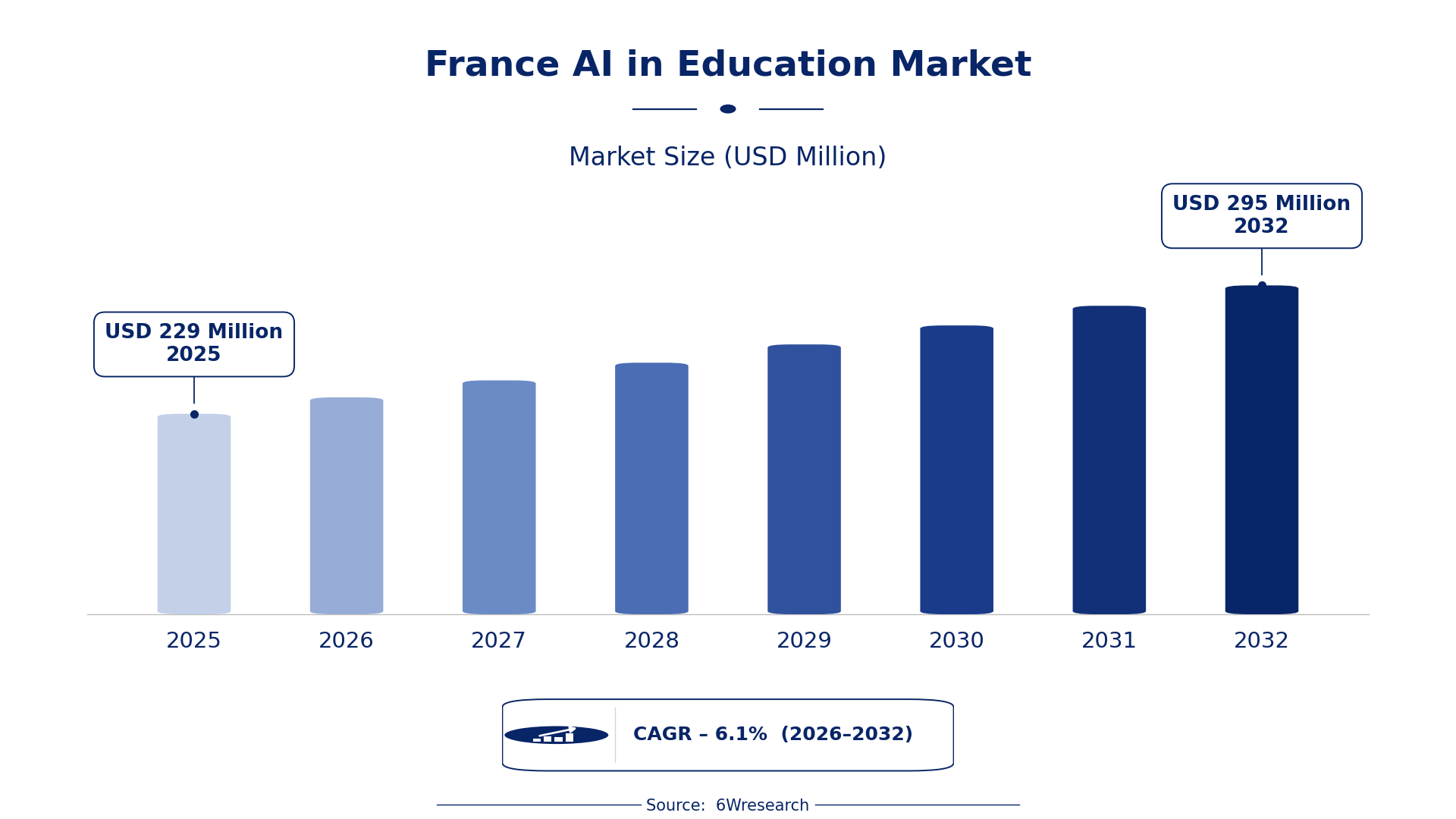
The France AI in Education Market was estimated at USD 229 Million in 2025 and is projected to reach USD 295 Million by 2032, growing at a CAGR of 6.1% from 2026 to 2032.
France AI in Education Market Synopsis
The strongest force currently shaping the France AI in Education Market is the government’s commitment to digital transformation in the education sector. This initiative fosters an environment where innovative educational technologies can thrive, directly impacting how institutions approach teaching and learning.
As educational institutions increasingly embrace AI technologies such as personalized learning and virtual tutoring, demand for these solutions is surging. This shift not only enhances educational outcomes but also positions France at the forefront of global education technology trends.
France AI in Education Market Year-wise Growth Rate and Key Drivers
This graph illustrates the annual growth rates of the France AI in Education Market from 2021 to 2032, highlighting a steady upward trajectory and projected expansion over the forecast period.
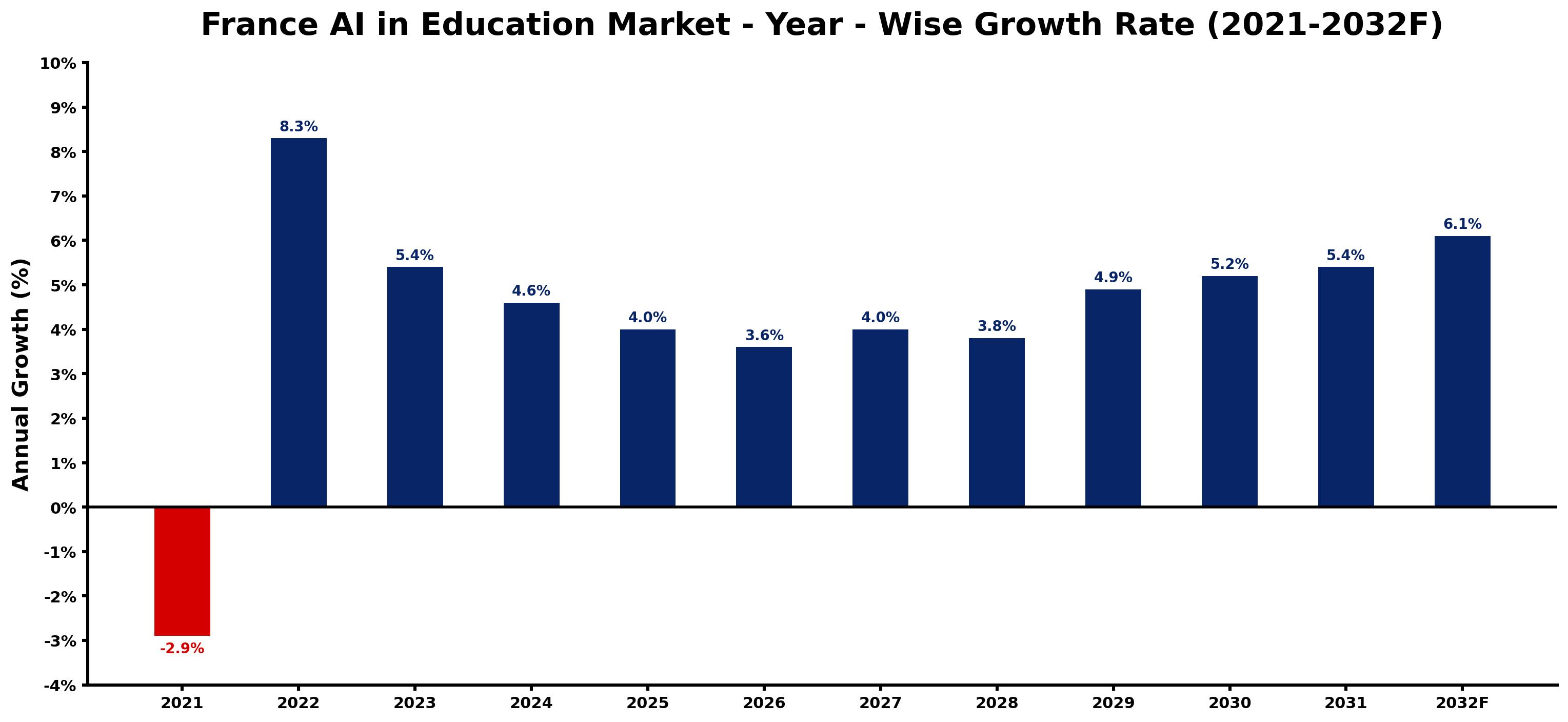
The table below presents the year‑wise growth rates along with the key drivers influencing the market
| Year | Growth Rate | Major Drivers |
| 2021 | -2.9% | Budget cuts by French Ministry of Education implemented |
| 2022 | 8.3% | French government promoting AI integration in schools. |
| 2023 | 5.4% | Increased funding for digital education initiatives from France. |
| 2024 | 4.6% | Growth of EdTech startups in Paris emerging rapidly. |
| 2025 | 4.0% | Regulatory frameworks supporting AI ethics in education. |
| 2026 | 3.6% | Rising collaboration between universities and tech companies. |
| 2027 | 4.0% | Public awareness campaigns about AI benefits in learning. |
| 2028 | 3.8% | Initiatives enhancing teacher training in AI tools. |
| 2029 | 4.9% | Government subsidies for AI-based educational resources. |
| 2030 | 5.2% | Incorporation of AI in national curriculum reforms. |
| 2031 | 5.4% | Rising student interest in STEM and AI subjects. |
| 2032 | 6.1% | Partnerships between academia and AI research institutions. |
Note: Market size estimations and growth projections presented in this report are based on 6Wresearch's proprietary forecasting methodology, utilizing the latest available industry data, government publications, and primary research inputs.
France AI in Education Market Key Takeaways
Below are some of the specific key takeaways from the market, including:
- The market is experiencing a steady growth trajectory, with the government actively promoting AI integration in educational institutions.
- Personalized learning solutions are leading the charge, helping to tailor educational experiences to individual student needs.
- Collaborations between edtech firms and schools are becoming increasingly common as institutions seek innovative solutions.
- The COVID-19 pandemic has significantly accelerated digital adoption, driving demand for AI technologies in the education sector.
- Challenges related to data privacy and educator training must be addressed to realize the full potential of AI in education.
Evaluation of Restraints in France AI in Education Market
Despite the promising growth prospects, the France AI in Education Market faces notable restraints. Integrating AI into existing educational systems presents a complex challenge, often met with resistance from traditional teaching frameworks. on top of that, ensuring data privacy and security remains a priority, as institutions must safeguard sensitive student information. The digital divide also poses a significant barrier, with disparities in access to technology affecting student engagement and learning outcomes.
France AI in Education Market Trends
Emerging trends in the France AI in Education Market are reshaping how educational content is delivered. The rise of AI-powered chatbots for student support has transformed the way learners interact with educational resources, providing immediate assistance and enhancing engagement. Additionally, virtual classrooms are becoming more commonplace, driven by the need for flexible learning environments. As educators seek better insights into student performance, data analytics tools are gaining traction, enabling tailored instructional approaches.
France AI in Education Market Opportunities
The market is ripe with investment opportunities, particularly in areas like intelligent tutoring systems and personalized learning platforms. Companies focusing on developing immersive technologies such as virtual and augmented reality applications are positioned to capitalize on the growing demand for interactive learning experiences. on top of that, the shift towards smart content delivery systems presents avenues for innovation, catering to the evolving needs of both students and educators.
Government Initiatives in the France AI in Education Market
Government initiatives play a crucial role in shaping the France AI in Education Market. The French government has established various programs aimed at fostering innovation and efficiency within educational institutions. These policies not only facilitate the integration of advanced technologies but also ensure that the educational framework aligns with contemporary digital demands.
- A national initiative launched in 2023 focusing on integrating AI technologies into primary and secondary education curricula.
- Current efforts include ongoing funding for research and development in educational AI tools, aiming to enhance teaching methodologies.
- A planned initiative expected to commence in 2026 will aim to bridge the digital divide, ensuring equitable access to technology for all students.
- Recent regulations introduced in 2024 emphasize data privacy and security for AI applications in education, reinforcing trust in these technologies.
- An ongoing program aimed at upskilling educators to effectively utilize AI tools in their teaching practices has been in place since 2022.
Future Insights of the France AI in Education Market
Looking ahead to 2026-2032, the France AI in Education Market is set for substantial growth. The continued integration of AI technologies will not only enhance personalized learning experiences but also streamline administrative processes within educational institutions. As collaboration between technology providers and educational stakeholders intensifies, expect to see innovative solutions that address the diverse needs of learners, ultimately fostering improved educational outcomes.
France AI in Education Market Latest Developments
Recent activity in the France AI in Education Market indicates a dynamic and rapidly evolving sector. Over the past 12-14 months, there has been a noticeable increase in partnerships between edtech companies and educational institutions, aimed at developing tailored AI solutions.
- A major technology vendor launched a new personalized learning platform in early 2025, which has received positive feedback from educators.
- An initiative that began in mid-2025 focuses on integrating AI-driven analytics tools into university curriculums, enhancing student engagement.
- A partnership between several regional schools and an edtech firm is currently underway, aimed at creating virtual tutoring programs for students.
- A rollout expected to begin in late 2026 will introduce AI-enhanced administrative tools to streamline operations within schools.
- Ongoing research into AI ethics in education is being conducted, with findings expected to inform policy adjustments by mid-2026.
France AI in Education Market - Key Attractiveness of the Report
- 10 Years of Market Numbers
- Historical Data Starting from 2022 to 2025
- Base Year: 2025
- Forecast Data until 2032
- Key Performance Indicators Impacting the Market
- Major Upcoming Developments and Projects
Key Highlights of the Report:
- France AI in Education Market Outlook
- Market Size of France AI in Education Market, 2025
- Forecast of France AI in Education Market, 2032
- Historical Data and Forecast of France AI in Education Revenues & Volume for the Period 2022-2032F
- France AI in Education Market Trend Evolution
- France AI in Education Market Drivers and Challenges
- France AI in Education Price Trends
- France AI in Education Porter's Five Forces
- France AI in Education Industry Life Cycle
- Historical Data and Forecast of France AI in Education Market Revenues & Volume By Technology for the Period 2022-2032F
- Historical Data and Forecast of France AI in Education Market Revenues & Volume By Deep Learning and Machine Learning for the Period 2022-2032F
- Historical Data and Forecast of France AI in Education Market Revenues & Volume By Natural Language Processing (NLP) for the Period 2022-2032F
- Historical Data and Forecast of France AI in Education Market Revenues & Volume By Component for the Period 2022-2032F
- Historical Data and Forecast of France AI in Education Market Revenues & Volume By Solutions for the Period 2022-2032F
- Historical Data and Forecast of France AI in Education Market Revenues & Volume By Services for the Period 2022-2032F
- Historical Data and Forecast of France AI in Education Market Revenues & Volume By Application for the Period 2022-2032F
- Historical Data and Forecast of France AI in Education Market Revenues & Volume By Virtual Facilitators and Learning Environments for the Period 2022-2032F
- Historical Data and Forecast of France AI in Education Market Revenues & Volume By Intelligent Tutoring Systems (ITS) for the Period 2022-2032F
- Historical Data and Forecast of France AI in Education Market Revenues & Volume By Content Delivery Systems for the Period 2022-2032F
- Historical Data and Forecast of France AI in Education Market Revenues & Volume By Fraud and Risk Management for the Period 2022-2032F
- Historical Data and Forecast of France AI in Education Market Revenues & Volume By Student-initiated learning for the Period 2022-2032F
- Historical Data and Forecast of France AI in Education Market Revenues & Volume By Others for the Period 2022-2032F
- Historical Data and Forecast of France AI in Education Market Revenues & Volume By Deployment for the Period 2022-2032F
- Historical Data and Forecast of France AI in Education Market Revenues & Volume By Cloud for the Period 2022-2032F
- Historical Data and Forecast of France AI in Education Market Revenues & Volume By On-premises for the Period 2022-2032F
- Historical Data and Forecast of France AI in Education Market Revenues & Volume By End for the Period 2022-2032F
- Historical Data and Forecast of France AI in Education Market Revenues & Volume By Educational Institutes for the Period 2022-2032F
- Historical Data and Forecast of France AI in Education Market Revenues & Volume By Educational Publishers for the Period 2022-2032F
- Historical Data and Forecast of France AI in Education Market Revenues & Volume By Others for the Period 2022-2032F
- France AI in Education Import Export Trade Statistics
- Market Opportunity Assessment By Technology
- Market Opportunity Assessment By Component
- Market Opportunity Assessment By Application
- Market Opportunity Assessment By Deployment
- Market Opportunity Assessment By End
- France AI in Education Top Companies Market Share
- France AI in Education Competitive Benchmarking By Technical and Operational Parameters
- France AI in Education Company Profiles
- France AI in Education Key Strategic Recommendations






































