France AI in IoT Market Size & Growth Rate (2026-2032)
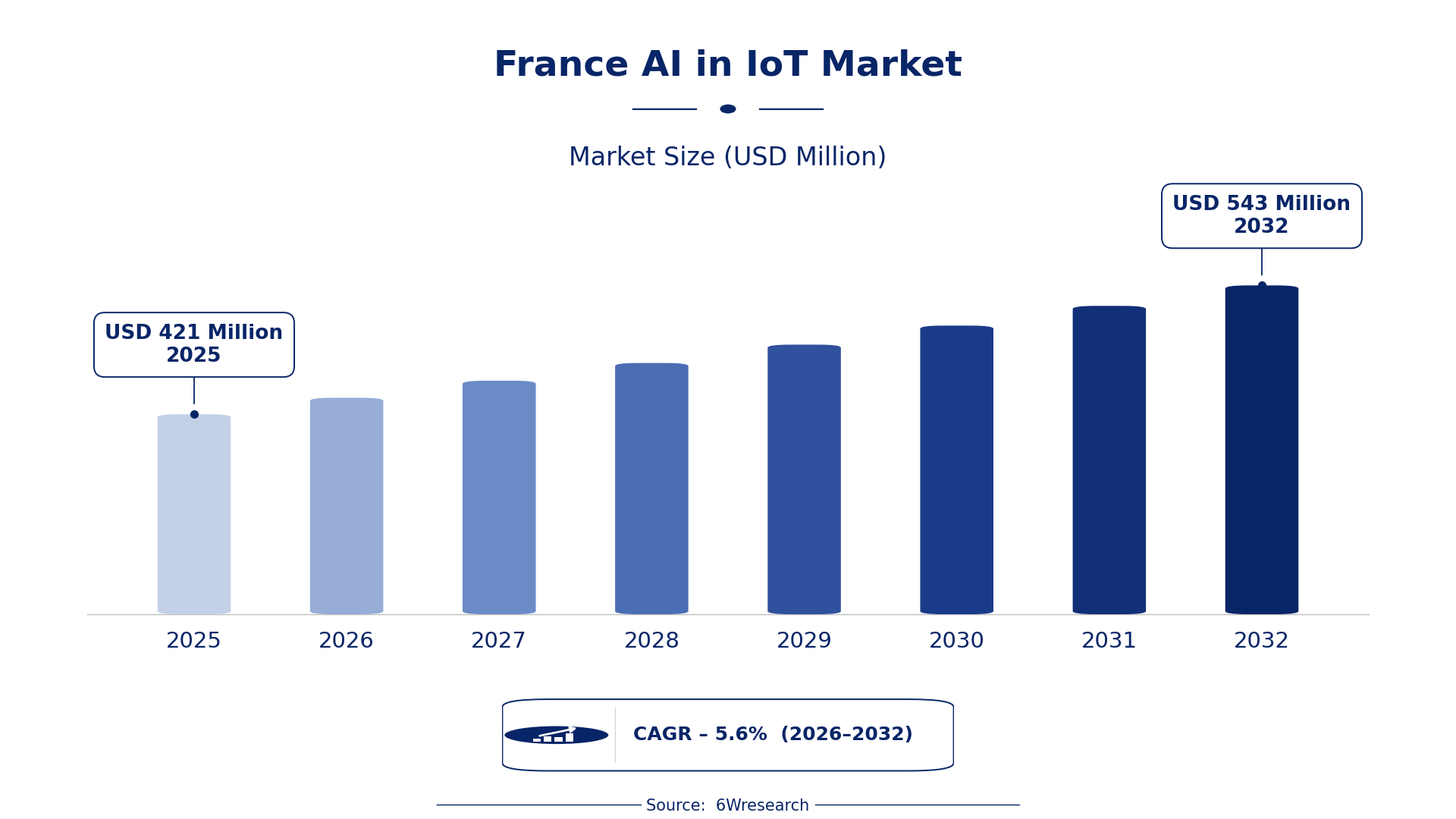
The France AI in IoT Market was estimated at USD 421 Million in 2025 and is projected to reach USD 543 Million by 2032, growing at a CAGR of 5.6% from 2026 to 2032.
France AI in IoT Market Synopsis
The France AI in IoT market is rapidly gaining traction, fueled by the convergence of advanced artificial intelligence technologies and the Internet of Things. Industries across the board—from manufacturing to agriculture—are harnessing AI capabilities to streamline operations and drive efficiency. As organizations embrace data-driven decision-making, the integration of AI into IoT systems is becoming a cornerstone for innovation.
Government initiatives and funding aimed at digital transformation are playing a crucial role in propelling this market forward. As France positions itself at the forefront of technological advancement, the ecosystem is thriving with collaborations among startups, established enterprises, and academic institutions. This synergy is not only enhancing operational efficiencies but also setting the stage for the next wave of AI in IoT solutions.
France AI in IoT Market Year-wise Growth Rate and Key Drivers
This graph illustrates the annual growth rates of the France AI in IoT Market from 2021 to 2032, highlighting a steady upward trajectory and projected expansion over the forecast period.
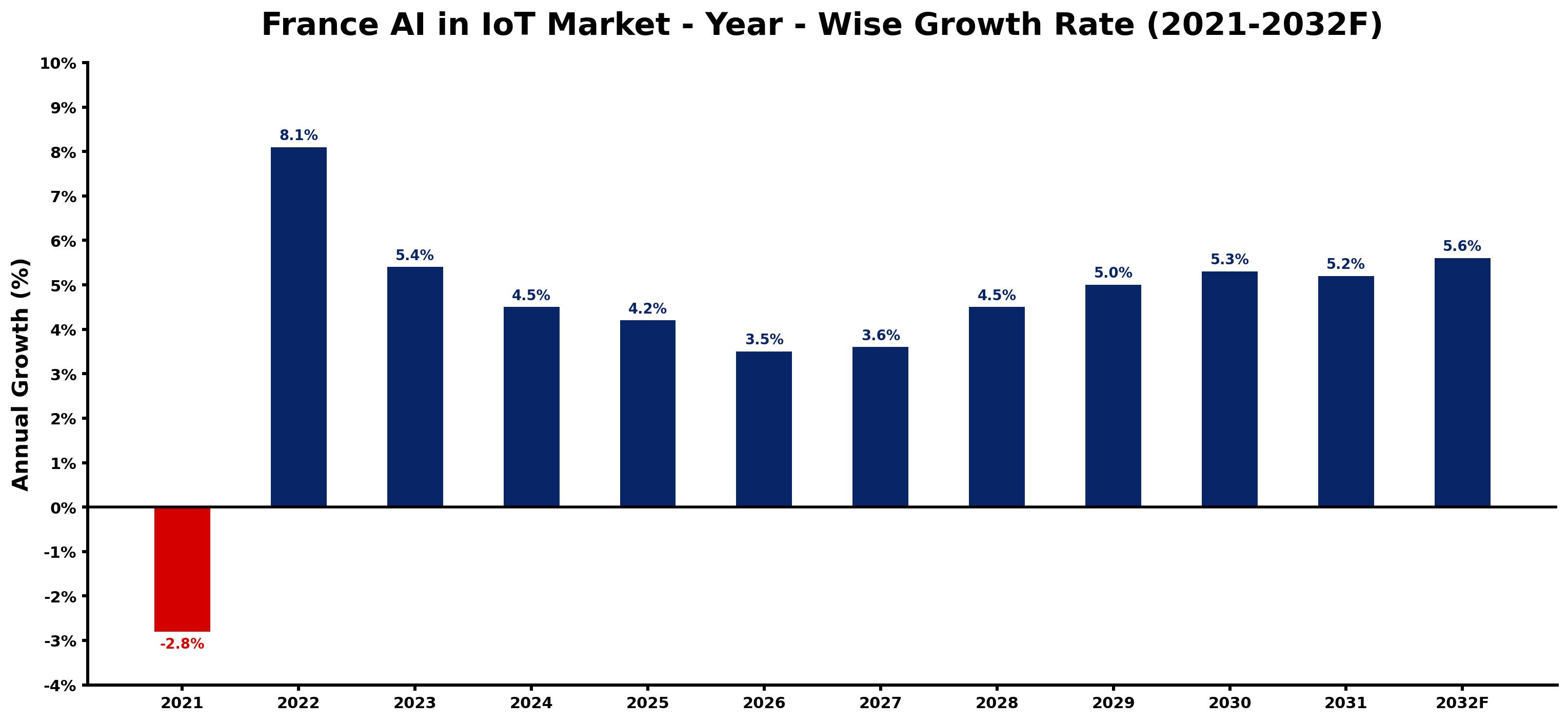
The table below presents the year‑wise growth rates along with the key drivers influencing the market
| Year | Growth Rate | Major Drivers |
| 2021 | -2.8% | EU GDPR compliance hindering AI adoption in IoT. |
| 2022 | 8.1% | AI regulation from CNIL boosts trust in IoT solutions. |
| 2023 | 5.4% | Adoption of AI-driven smart meters improves energy management. |
| 2024 | 4.5% | Increased IoT integration in French agricultural practices. |
| 2025 | 4.2% | Supportive government grants for AI IoT innovation projects. |
| 2026 | 3.5% | Growing AI-based surveillance systems in urban security. |
| 2027 | 3.6% | Local startups innovate AI solutions for smart cities. |
| 2028 | 4.5% | Investment in AI for predictive maintenance in manufacturing. |
| 2029 | 5.0% | France's climate policy drives smart IoT for sustainability. |
| 2030 | 5.3% | Collaborations with universities enhance AI research in IoT. |
| 2031 | 5.2% | Focus on AI-enhanced telecommunications supports IoT growth. |
| 2032 | 5.6% | Integration of smart IoT devices in healthcare initiatives. |
Note: Market size estimations and growth projections presented in this report are based on 6Wresearch's proprietary forecasting methodology, utilizing the latest available industry data, government publications, and primary research inputs.
France AI in IoT Market Key Takeaways
Below are some of the specific key takeaways from the market, including:
- Integration of AI is enhancing predictive maintenance and automation across key industries.
- Growing emphasis on data security is driving investments in cybersecurity measures for IoT devices.
- The rise of edge computing is facilitating real-time data processing and analysis.
- Government policies are actively promoting the digital transformation of industries.
- Investment opportunities are burgeoning in sectors like smart cities and agriculture.
Evaluation of Restraints in France AI in IoT Market
Several factors are currently constraining the growth of the France AI in IoT market. Chief among these is the complexity involved in integrating AI technologies with existing IoT systems. This integration requires specialized knowledge and expertise, which can be a barrier for many companies. on top of that, data privacy concerns remain a significant hurdle, especially in light of stringent regulations such as the GDPR. The lack of standardized protocols and interoperability between various IoT devices further complicates the landscape, making it challenging for organizations to implement cohesive AI-driven IoT strategies.
France AI in IoT Market Trends
Several trends are shaping the France AI in IoT market today. One of the most notable is the increasing reliance on AI-powered solutions for operational efficiency. Companies are not only enhancing traditional processes but also enabling smarter decision-making through data analytics. The focus on cybersecurity has intensified, with organizations prioritizing the protection of sensitive data in their IoT deployments.
Another emerging trend is the integration of edge computing capabilities, allowing for faster data processing and reducing latency. As industries demand quicker insights, this trend is likely to gain momentum, transforming how IoT devices operate in real-time scenarios. Together, these trends illustrate a market in transition towards intelligence and efficiency, driven by innovative technology.
France AI in IoT Market Opportunities
The opportunities in the France AI in IoT market are extensive and span various sectors. In healthcare, the potential for AI to improve patient monitoring and predictive analytics is enormous. Manufacturing stands to benefit from AI-enhanced automation and efficiency, while agriculture can leverage these technologies for precision farming practices. on top of that, the smart cities initiative is creating a fertile ground for investment in intelligent infrastructure and IoT applications. Companies and investors who can align with these growth areas are likely to experience significant returns as the market matures.
Government Initiatives in the France AI in IoT Market
The French government is actively shaping the AI in IoT market through a variety of strategic initiatives. These policies are designed to foster innovation and ensure the country remains competitive in the global digital economy. By allocating funding for research and development, the government is encouraging partnerships between academia and industry, which is crucial for advancing AI and IoT technologies.
- A recently completed initiative includes significant funding for AI research projects aimed at enhancing IoT capabilities in various sectors.
- A currently ongoing program focuses on building a national digital infrastructure to support the seamless integration of AI and IoT technologies.
- Upcoming initiatives aim to establish a regulatory framework that promotes data privacy while encouraging innovation in AI applications.
- The government is also launching a public-private partnership to advance smart city projects, enhancing urban living through AI and IoT.
- A national strategy to promote AI literacy and training in IoT is set to roll out in the coming years, ensuring a skilled workforce for the future.
Future Insights of the France AI in IoT Market
Looking ahead to 2026-2032, the France AI in IoT market is expected to see substantial growth driven by continued technological advancements and increased adoption across various industries. The strong focus on digital transformation will likely spur innovations in AI algorithms and IoT applications, particularly in sectors like healthcare and manufacturing. As organizations seek to improve efficiencies and customer experiences through AI, the demand for integrated IoT solutions will only intensify.
France AI in IoT Market Latest Developments
Recent months have seen a flurry of activity in the France AI in IoT market, reflecting a vibrant ecosystem poised for growth. Companies are increasingly launching innovative AI solutions tailored for IoT applications, while partnerships are forming to enhance technological capabilities. The drive for efficiency and smarter operations remains a key theme as various sectors adapt to the digital age.
- A major technology vendor launched a new AI-driven IoT platform in early 2025, aimed at improving asset tracking and predictive analytics.
- In mid-2025, a leading regional operator initiated a collaborative project to enhance cybersecurity measures for IoT devices, ensuring data integrity.
- A planned rollout in the second half of 2026 aims to integrate edge computing solutions into existing IoT frameworks, enhancing real-time data processing capabilities.
- By early 2026, a consortium of technology firms is expected to unveil a groundbreaking initiative focused on smart agriculture, utilizing AI to optimize crop yields.
- Ongoing discussions for a public-private partnership to upgrade IoT infrastructure across urban areas are expected to lead to actionable plans by late 2025.
France AI in IoT Market - Key Attractiveness of the Report
- 10 Years of Market Numbers
- Historical Data Starting from 2022 to 2025
- Base Year: 2025
- Forecast Data until 2032
- Key Performance Indicators Impacting the Market
- Major Upcoming Developments and Projects
Key Highlights of the Report:
- France AI in IoT Market Outlook
- Market Size of France AI in IoT Market, 2025
- Forecast of France AI in IoT Market, 2032
- Historical Data and Forecast of France AI in IoT Revenues & Volume for the Period 2022-2032F
- France AI in IoT Market Trend Evolution
- France AI in IoT Market Drivers and Challenges
- France AI in IoT Price Trends
- France AI in IoT Porter's Five Forces
- France AI in IoT Industry Life Cycle
- Historical Data and Forecast of France AI in IoT Market Revenues & Volume By Component for the Period 2022-2032F
- Historical Data and Forecast of France AI in IoT Market Revenues & Volume By Platforms for the Period 2022-2032F
- Historical Data and Forecast of France AI in IoT Market Revenues & Volume By Software Solutions for the Period 2022-2032F
- Historical Data and Forecast of France AI in IoT Market Revenues & Volume By Services for the Period 2022-2032F
- Historical Data and Forecast of France AI in IoT Market Revenues & Volume By Vertical for the Period 2022-2032F
- Historical Data and Forecast of France AI in IoT Market Revenues & Volume By Manufacturing for the Period 2022-2032F
- Historical Data and Forecast of France AI in IoT Market Revenues & Volume By Energy and Utilities for the Period 2022-2032F
- Historical Data and Forecast of France AI in IoT Market Revenues & Volume By Transportation and Mobility for the Period 2022-2032F
- Historical Data and Forecast of France AI in IoT Market Revenues & Volume By BFSI for the Period 2022-2032F
- Historical Data and Forecast of France AI in IoT Market Revenues & Volume By Government and Defense for the Period 2022-2032F
- Historical Data and Forecast of France AI in IoT Market Revenues & Volume By Retail for the Period 2022-2032F
- Historical Data and Forecast of France AI in IoT Market Revenues & Volume By Healthcare and Life Sciences for the Period 2022-2032F
- Historical Data and Forecast of France AI in IoT Market Revenues & Volume By Telecom for the Period 2022-2032F
- Historical Data and Forecast of France AI in IoT Market Revenues & Volume By Technology for the Period 2022-2032F
- Historical Data and Forecast of France AI in IoT Market Revenues & Volume By ML and Deep Learning for the Period 2022-2032F
- Historical Data and Forecast of France AI in IoT Market Revenues & Volume By NLP for the Period 2022-2032F
- France AI in IoT Import Export Trade Statistics
- Market Opportunity Assessment By Component
- Market Opportunity Assessment By Vertical
- Market Opportunity Assessment By Technology
- France AI in IoT Top Companies Market Share
- France AI in IoT Competitive Benchmarking By Technical and Operational Parameters
- France AI in IoT Company Profiles
- France AI in IoT Key Strategic Recommendations






































