France Artificial Intelligence in Retail Market Size & Growth Rate (2026-2032)
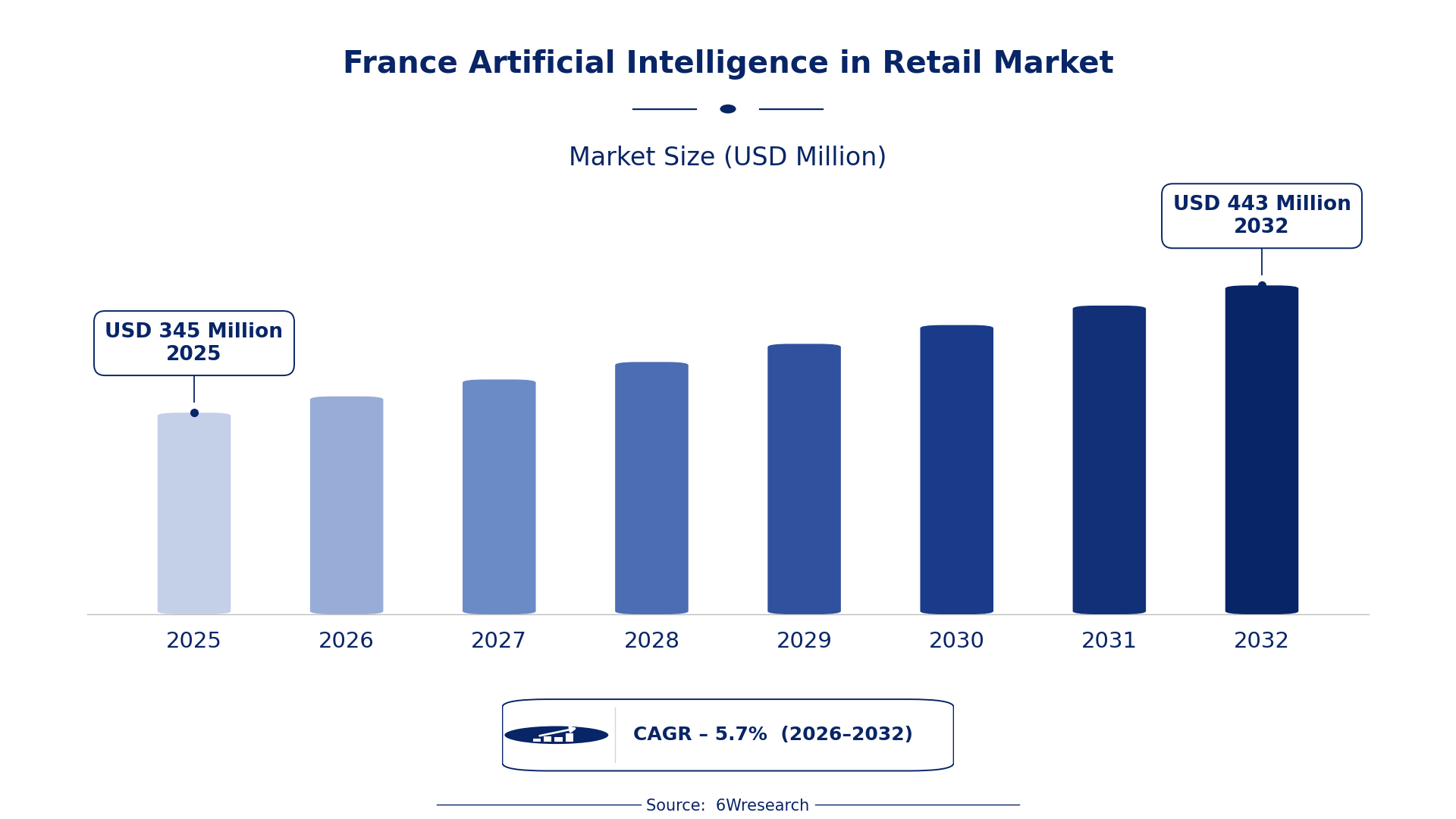
The France Artificial Intelligence in Retail Market was estimated at USD 345 Million in 2025 and is projected to reach USD 443 Million by 2032, growing at a CAGR of 5.7% from 2026 to 2032.
France Artificial Intelligence in Retail Market Synopsis
The France Artificial Intelligence in Retail Market is gaining momentum as retailers embrace AI technologies to enhance operational efficiency and customer engagement. Recent investments in AI solutions are transforming traditional retail practices, yet the market is just beginning to tap into its full potential.
Looking ahead, the focus on personalization, predictive analytics, and automation is set to drive further growth. As competition intensifies, French retailers will increasingly rely on AI to not only meet consumer expectations but also to streamline operations and maximize profitability.
France Artificial Intelligence in Retail Market Year-wise Growth Rate and Key Drivers
This graph illustrates the annual growth rates of the France Artificial Intelligence in Retail Market from 2021 to 2032, highlighting a steady upward trajectory and projected expansion over the forecast period.
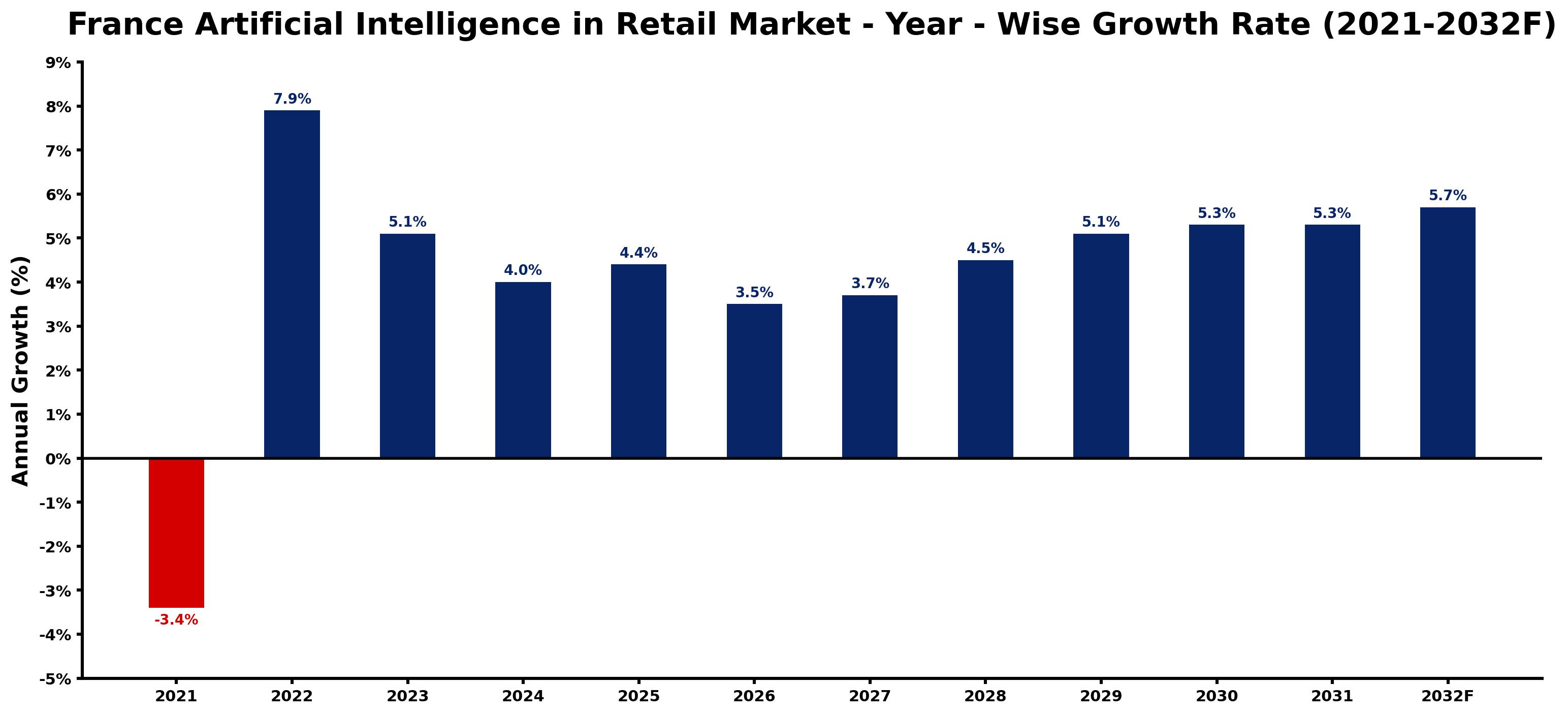
The table below presents the year‑wise growth rates along with the key drivers influencing the market
| Year | Growth Rate | Major Drivers |
| 2021 | -3.4% | EU GDPR compliance costs hindered AI implementation in retail. |
| 2022 | 7.9% | French government funding for AI innovation in retail. |
| 2023 | 5.1% | Implementation of France's digital strategy boosting retail AI. |
| 2024 | 4.0% | Local retailers adopting AI for inventory management solutions. |
| 2025 | 4.4% | Growing use of AI chatbots in French e-commerce. |
| 2026 | 3.5% | Increase in French consumer trust towards AI technologies. |
| 2027 | 3.7% | Rise in AI-driven customer engagement strategies in France. |
| 2028 | 4.5% | Support for AI integration from French retail associations. |
| 2029 | 5.1% | AI-enhanced loyalty programs gaining traction among French consumers. |
| 2030 | 5.3% | Collaboration between French tech firms and retail giants. |
| 2031 | 5.3% | Regulatory incentives promoting ethical AI use in retail. |
| 2032 | 5.7% | Investment in training programs for AI retail professionals. |
Note: Market size estimations and growth projections presented in this report are based on 6Wresearch's proprietary forecasting methodology, utilizing the latest available industry data, government publications, and primary research inputs.
France Artificial Intelligence in Retail Market Key Takeaways
Below are some of the specific key takeaways from the market, including:
- The integration of AI-driven recommendation engines is enhancing customer shopping experiences.
- Retailers are utilizing predictive analytics to optimize inventory and reduce operational costs.
- AI chatbots are becoming essential for 24/7 customer support, improving engagement rates.
- The French government's supportive policies are fostering AI innovation in retail.
- Emerging startups are driving innovations in AI applications tailored for the retail sector.
Evaluation of Restraints in France Artificial Intelligence in Retail Market
Despite the promising growth, several constraints are hindering the full realization of AI's potential in retail. Data privacy concerns loom large as retailers must comply with strict regulations like GDPR, which can complicate the collection and analysis of consumer data. on top of that, there is an ongoing apprehension among employees regarding job security, leading to resistance to AI adoption. These factors necessitate a careful balance between technological advancement and ethical considerations.
France Artificial Intelligence in Retail Market Trends
Several trends are emerging within the France Artificial Intelligence in Retail Market. Retailers are increasingly adopting AI for personalized marketing strategies that cater to individual consumer preferences, thereby enhancing customer loyalty. The use of AI in supply chain management is also gaining traction, with predictive analytics enabling retailers to forecast demand more accurately and optimize stock levels. Finally, the rise of AI-driven visual search technologies is changing how consumers interact with products, making shopping more intuitive and engaging.
France Artificial Intelligence in Retail Market Opportunities
Investment opportunities abound in the French AI retail sector. Retailers looking to enhance customer experiences through personalization are seeking innovative AI solutions, particularly in areas like chatbots and recommendation systems. Startups focused on developing AI tools tailored to the retail industry are attracting significant interest, with established retailers eager to partner with them. Additionally, the demand for data analytics tools will continue to surge as businesses strive to leverage insights for competitive advantage.
Government Initiatives in the France Artificial Intelligence in Retail Market
Government policy plays a crucial role in shaping the France Artificial Intelligence in Retail Market. The French administration is keen on fostering AI innovation while ensuring ethical standards are maintained. Initiatives aimed at supporting research and development are vital for the growth of AI technologies in retail.
- A national AI strategy launched in 2018, focusing on promoting innovation in retail and other sectors.
- Currently ongoing funding programs to support startups developing AI solutions tailored for the retail market.
- Plans for a regulatory framework expected to be introduced by 2026, aimed at enhancing transparency in AI algorithms.
- A public-private partnership initiative set to commence in 2025 to boost AI research specifically for retail applications.
Future Insights of the France Artificial Intelligence in Retail Market
The future of the France Artificial Intelligence in Retail Market looks bright, with increasing integration of AI technologies anticipated to reshape retail experiences. As consumers demand more personalized and efficient shopping options, retailers will turn to AI for innovative solutions. With the ongoing evolution of AI capabilities and the intersection of AI with other technologies like big data and IoT, the market is on the brink of a transformative phase that promises to redefine competitive dynamics in the retail sector.
France Artificial Intelligence in Retail Market Latest Developments
Recent developments in the France Artificial Intelligence in Retail Market illustrate a dynamic environment filled with innovation. Retailers are rapidly adopting AI tools to streamline operations and enhance customer engagement, reflecting a broader trend of digital transformation.
- A major technology vendor launched an advanced AI-driven inventory management system in early 2025, aimed at reducing waste and improving stock accuracy.
- In mid-2025, a leading regional operator began rolling out an AI-powered chatbot service, significantly enhancing customer service capabilities.
- By late 2025, several retailers are expected to implement predictive analytics tools for demand forecasting, aiming to optimize their supply chains.
- A planned initiative set for 2026 involves a collaboration between retailers and AI startups to develop next-gen shopping assistants that leverage augmented reality.
France Artificial Intelligence in Retail Market - Key Attractiveness of the Report
- 10 Years of Market Numbers
- Historical Data Starting from 2022 to 2025
- Base Year: 2025
- Forecast Data until 2032
- Key Performance Indicators Impacting the Market
- Major Upcoming Developments and Projects
Key Highlights of the Report:
- France Artificial Intelligence in Retail Market Outlook
- Market Size of France Artificial Intelligence in Retail Market, 2025
- Forecast of France Artificial Intelligence in Retail Market, 2032
- Historical Data and Forecast of France Artificial Intelligence in Retail Revenues & Volume for the Period 2022-2032F
- France Artificial Intelligence in Retail Market Trend Evolution
- France Artificial Intelligence in Retail Market Drivers and Challenges
- France Artificial Intelligence in Retail Price Trends
- France Artificial Intelligence in Retail Porter's Five Forces
- France Artificial Intelligence in Retail Industry Life Cycle
- Historical Data and Forecast of France Artificial Intelligence in Retail Market Revenues & Volume By Type for the Period 2022-2032F
- Historical Data and Forecast of France Artificial Intelligence in Retail Market Revenues & Volume By Online for the Period 2022-2032F
- Historical Data and Forecast of France Artificial Intelligence in Retail Market Revenues & Volume By Offline for the Period 2022-2032F
- Historical Data and Forecast of France Artificial Intelligence in Retail Market Revenues & Volume By Service for the Period 2022-2032F
- Historical Data and Forecast of France Artificial Intelligence in Retail Market Revenues & Volume By Professional for the Period 2022-2032F
- Historical Data and Forecast of France Artificial Intelligence in Retail Market Revenues & Volume By Managed for the Period 2022-2032F
- Historical Data and Forecast of France Artificial Intelligence in Retail Market Revenues & Volume By Technology for the Period 2022-2032F
- Historical Data and Forecast of France Artificial Intelligence in Retail Market Revenues & Volume By Machine Learning for the Period 2022-2032F
- Historical Data and Forecast of France Artificial Intelligence in Retail Market Revenues & Volume By Deep Learning for the Period 2022-2032F
- Historical Data and Forecast of France Artificial Intelligence in Retail Market Revenues & Volume By NLP for the Period 2022-2032F
- France Artificial Intelligence in Retail Import Export Trade Statistics
- Market Opportunity Assessment By Type
- Market Opportunity Assessment By Service
- Market Opportunity Assessment By Technology
- France Artificial Intelligence in Retail Top Companies Market Share
- France Artificial Intelligence in Retail Competitive Benchmarking By Technical and Operational Parameters
- France Artificial Intelligence in Retail Company Profiles
- France Artificial Intelligence in Retail Key Strategic Recommendations






































