France Automotive Aftermarket Market Size, Share & Growth Rate
The France Automotive Aftermarket Market was estimated at USD 248 Million in 2025 and is projected to reach USD 275 Million by 2032, growing at a CAGR of 1.5% from 2026 to 2032. This growth trajectory is underpinned by a large vehicle fleet and an increasing average age of vehicles, which drives the demand for maintenance and repair services. Additionally, the rising trend of vehicle customization and the expanding landscape of e-commerce are further fueling market expansion.
France Automotive Aftermarket Market Year-wise Growth Rate and Key Drivers
This graph highlights how the France Automotive Aftermarket Market has steadily grown over the years, supported by major growth factors.
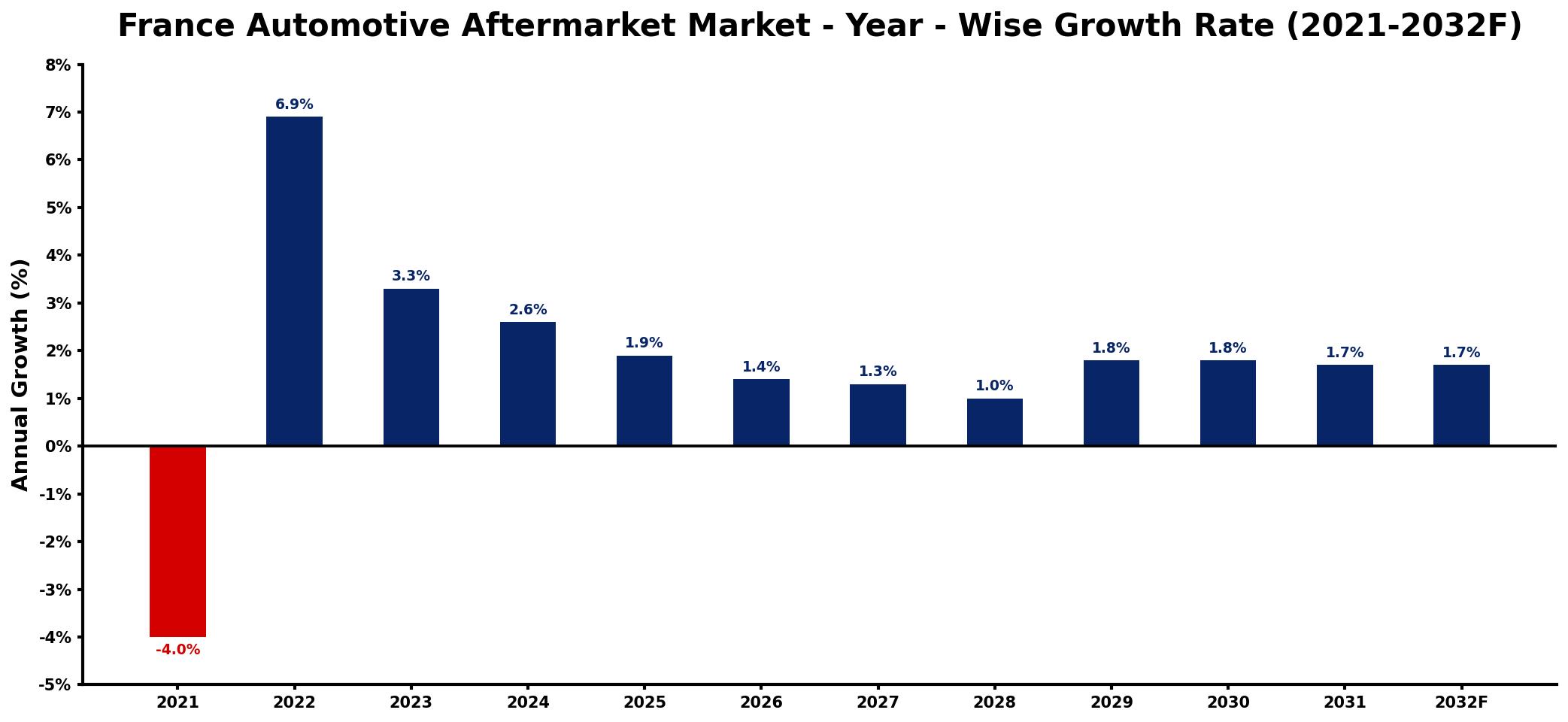
The table below presents the year‑wise growth rates along with the key drivers influencing the market
| Year | Growth Rate | Major Drivers |
| 2021 | -4.0% | decrease in consumer spending habits |
| 2022 | 6.9% | increase in vehicle maintenance demand |
| 2023 | 3.3% | growing popularity of electric vehicles |
| 2024 | 2.6% | rise in online service bookings |
| 2025 | 1.9% | expansion of vehicle repair networks |
| 2026 | 1.4% | increased investment in technology |
| 2027 | 1.3% | growth in DIY repair culture |
| 2028 | 1.0% | surge in vehicle customization trends |
| 2029 | 1.8% | rising awareness of sustainability practices |
| 2030 | 1.8% | enhanced focus on safety regulations |
| 2031 | 1.7% | growing demand for telematics solutions |
| 2032 | 1.7% | increased collaboration among service providers |
Note: Market size estimations and growth projections presented in this report are based on 6Wresearch's proprietary forecasting methodology, utilizing the latest available industry data, government publications, and primary research inputs.
France Automotive Aftermarket Market Synopsis
The French automotive aftermarket is currently thriving, with a vibrant mix of products and services catering to diverse consumer needs. With a robust automotive sector and a substantial vehicle population, the aftermarket is poised for sustained growth as vehicle owners seek reliable maintenance and high-quality parts.
In addition to traditional maintenance and repair services, there's a notable increase in the demand for customization and aftermarket accessories. The convergence of technological advancements and shifting consumer preferences toward sustainable practices also shapes this dynamic market, creating new avenues for growth.
France Automotive Aftermarket Market Key Takeaways
- The market is fueled by increasing vehicle ownership and the growing average age of cars on French roads.
- Electric vehicle (EV) demand is rising, driving the need for specialized parts and services.
- Digital solutions, including e-commerce platforms, are transforming consumer purchasing behaviors.
- There is a marked shift towards sustainability, leading to eco-friendly products in the aftermarket.
- The landscape is characterized by a fragmented structure, offering both challenges and opportunities for investors.
Evaluation of Restraints in France Automotive Aftermarket Market
Despite its promising outlook, the France Automotive Aftermarket market faces certain restraints that could hinder growth. The rise of online retailers has intensified competition, creating pricing pressures that may challenge traditional brick-and-mortar businesses. Additionally, advancements in vehicle technology necessitate specialized parts and services, which can be costly and require significant investment. The regulatory environment, particularly concerning emissions and safety standards, further complicates market dynamics, demanding adaptability from suppliers and service providers. Lastly, the fragmented nature of the market, with numerous small players, makes it difficult for brands to establish strong recognition and customer loyalty.
France Automotive Aftermarket Market Trends
A few key trends are currently reshaping the France Automotive Aftermarket. Notably, the increasing focus on electric vehicles is prompting suppliers to develop specialized EV parts and maintenance solutions. As France moves towards greener transportation, there is also a growing emphasis on sustainable practices, influencing the development of eco-friendly aftermarket products. Furthermore, consumers are increasingly gravitating towards online platforms for purchasing automotive parts and accessories, driven by convenience and a broader selection of offerings. These trends are not only altering consumer behavior but also redefining the competitive landscape of the aftermarket.
France Automotive Aftermarket Market Opportunities
The evolving landscape of the France Automotive Aftermarket presents several lucrative investment opportunities. Companies specializing in digital solutions—such as innovative online platforms for service scheduling and parts purchasing—are well-positioned to thrive. Additionally, theres significant potential for growth in the development of environmentally friendly aftermarket products, aligning with the rising consumer demand for sustainable solutions. As the market continues to expand, businesses that adapt to changing consumer preferences and invest in technological advancements are likely to capture substantial market share.
Government Initiatives in the France Automotive Aftermarket Market
The French government plays a crucial role in shaping the automotive aftermarket through various policies aimed at fostering competition and protecting consumers. The European Union's Block Exemption Regulation is pivotal in ensuring that independent repairers can access technical information and spare parts, thereby enhancing market competition. Additionally, the Hamon Law promotes consumer choice by allowing access to independent repair services without jeopardizing warranties. Stricter environmental regulations also ensure responsible recycling and disposal of automotive parts, promoting sustainability in the sector.
Future Insights of the France Automotive Aftermarket Market
Looking ahead to 2026-2032, the France Automotive Aftermarket is set to experience steady growth fueled by multiple factors. The increasing vehicle ownership, along with consumers' shifting preferences towards aftermarket products and services, indicates a robust market trajectory. Advancements in technology are likely to lead to innovative aftermarket solutions that will cater to consumers' evolving needs. Moreover, the anticipated growth in electric vehicles will create new opportunities for aftermarket providers to develop specialized products and services, reinforcing the sector's expansion in alignment with sustainable mobility trends.
France Automotive Aftermarket Market Latest Developments (2025 - 2026)
Recent developments in the France Automotive Aftermarket indicate a strong shift towards digitalization, with many businesses enhancing their online presence to capture the growing e-commerce segment. The focus on sustainability continues to gain traction, with initiatives aimed at reducing the environmental impact of automotive products gaining momentum. Additionally, advancements in EV technology are prompting market participants to innovate and adapt their offerings to accommodate the specialized needs of electric vehicle owners, thereby shaping the future direction of the aftermarket.
France Automotive Aftermarket Market - Key Attractiveness of the Report
- 10 Years of Market Numbers
- Historical Data Starting from 2022 to 2025
- Base Year: 2025
- Forecast Data until 2032
- Key Performance Indicators Impacting the Market
- Major Upcoming Developments and Projects
Key Highlights of the Report:
- France Automotive Aftermarket Market Outlook
- Market Size of France Automotive Aftermarket Market, 2025
- Forecast of France Automotive Aftermarket Market, 2032
- Historical Data and Forecast of France Automotive Aftermarket Revenues & Volume for the Period 2022-2032F
- France Automotive Aftermarket Market Trend Evolution
- France Automotive Aftermarket Market Drivers and Challenges
- France Automotive Aftermarket Price Trends
- France Automotive Aftermarket Porter's Five Forces
- France Automotive Aftermarket Industry Life Cycle
- Historical Data and Forecast of France Automotive Aftermarket Market Revenues & Volume By Replacement Parts for the Period 2022-2032F
- Historical Data and Forecast of France Automotive Aftermarket Market Revenues & Volume By Tire for the Period 2022-2032F
- Historical Data and Forecast of France Automotive Aftermarket Market Revenues & Volume By Battery for the Period 2022-2032F
- Historical Data and Forecast of France Automotive Aftermarket Market Revenues & Volume By Brake Parts for the Period 2022-2032F
- Historical Data and Forecast of France Automotive Aftermarket Market Revenues & Volume By Filters for the Period 2022-2032F
- Historical Data and Forecast of France Automotive Aftermarket Market Revenues & Volume By Body parts for the Period 2022-2032F
- Historical Data and Forecast of France Automotive Aftermarket Market Revenues & Volume By Lighting & Electronic Components for the Period 2022-2032F
- Historical Data and Forecast of France Automotive Aftermarket Market Revenues & Volume By Wheels for the Period 2022-2032F
- Historical Data and Forecast of France Tire Automotive Aftermarket Market Revenues & Volume By Exhaust components for the Period 2022-2032F
- Historical Data and Forecast of France Automotive Aftermarket Market Revenues & Volume By Distribution Channel for the Period 2022-2032F
- Historical Data and Forecast of France Automotive Aftermarket Market Revenues & Volume By Retailers for the Period 2022-2032F
- Historical Data and Forecast of France Automotive Aftermarket Market Revenues & Volume By Wholesalers & Distributors for the Period 2022-2032F
- Historical Data and Forecast of France Automotive Aftermarket Market Revenues & Volume By Service Channel for the Period 2022-2032F
- Historical Data and Forecast of France Automotive Aftermarket Market Revenues & Volume By DIY (Do it Yourself) for the Period 2022-2032F
- Historical Data and Forecast of France Automotive Aftermarket Market Revenues & Volume By DIFM (Do it for Me) for the Period 2022-2032F
- Historical Data and Forecast of France Automotive Aftermarket Market Revenues & Volume By OE (Delegating to OEM??s) for the Period 2022-2032F
- Historical Data and Forecast of France Automotive Aftermarket Market Revenues & Volume By Certification for the Period 2022-2032F
- Historical Data and Forecast of France Automotive Aftermarket Market Revenues & Volume By Genuine Parts for the Period 2022-2032F
- Historical Data and Forecast of France Automotive Aftermarket Market Revenues & Volume By Certified Parts for the Period 2022-2032F
- Historical Data and Forecast of France Automotive Aftermarket Market Revenues & Volume By Uncertified Parts for the Period 2022-2032F
- France Automotive Aftermarket Import Export Trade Statistics
- Market Opportunity Assessment By Replacement Parts
- Market Opportunity Assessment By Distribution Channel
- Market Opportunity Assessment By Service Channel
- Market Opportunity Assessment By Certification
- France Automotive Aftermarket Top Companies Market Share
- France Automotive Aftermarket Competitive Benchmarking By Technical and Operational Parameters
- France Automotive Aftermarket Company Profiles
- France Automotive Aftermarket Key Strategic Recommendations






































