France Blenders Market Summary
The france blenders market was estimated at USD 237 Million in 2025 and is projected to reach USD 263 Million by 2032, growing at a CAGR of 1.2% from 2026 to 2032.
France Blenders Market Year-wise Growth Rate and Key Drivers
This graph highlights how the France Blenders Market has steadily grown over the past five years, supported by major growth factors.
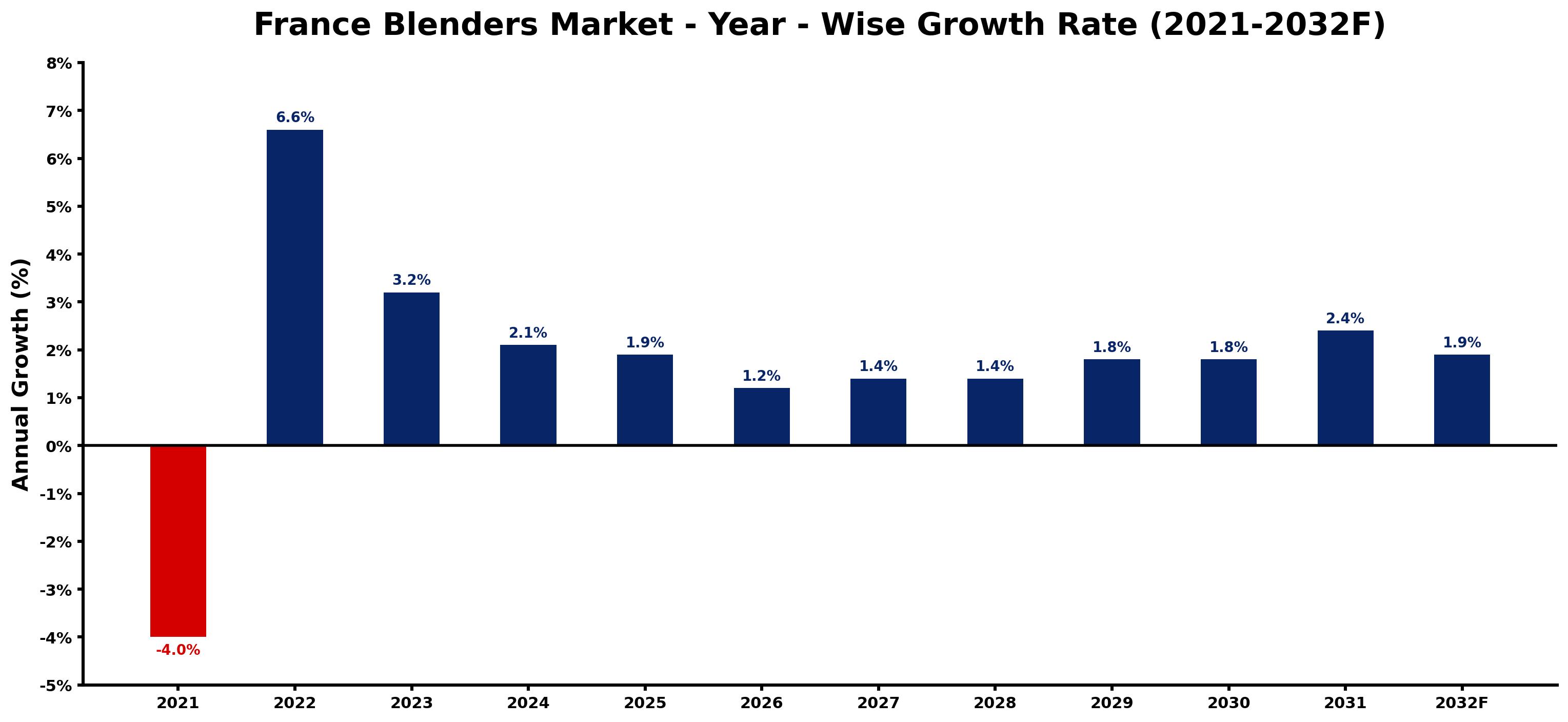
The table below presents the year wise growth rates along with the key drivers influencing the market
| Year | Growth Rate | Major Drivers |
| 2021 | -4.0% | Heightened consumer focus on sustainability led to a shift away from traditional appliance purchases. |
| 2022 | 6.6% | Retailers embraced e-commerce, enhancing availability of premium blender brands online. |
| 2023 | 3.2% | Consumer interest shifted towards health and wellness, boosting demand for high-performance blenders. |
| 2024 | 2.1% | Brands started emphasizing eco-friendly materials in product designs, attracting environmentally conscious buyers. |
| 2025 | 1.9% | Innovations in smart technology integration made blenders more appealing to tech-savvy consumers. |
| 2026 | 1.2% | Urbanization trends resulted in smaller kitchens, increasing demand for compact blending solutions. |
| 2027 | 1.4% | The café culture surge created opportunities for commercial-grade blenders in home settings. |
| 2028 | 1.4% | Consumer preference for plant-based diets boosted sales of blenders suitable for smoothies and soups. |
| 2029 | 1.8% | Lifestyle influencers began promoting DIY recipes, further driving blender usage in households. |
| 2030 | 1.8% | Partnerships between appliance brands and fitness organizations expanded market reach to health enthusiasts. |
| 2031 | 2.4% | The introduction of multi-functional kitchen appliances positioned blenders as versatile cooking tools. |
| 2032 | 1.9% | Sustainability initiatives led to increased demand for energy-efficient blenders among eco-conscious consumers. |
Note - Market size estimations and growth projections presented in this report are based on 6Wresearch's advanced forecasting approach, validated with industry datasets as of June 2026.
France Blenders Market Synopsis
The France Blenders Market is projected to reach 1.2% and witness significant growth during the forecast period (2026-2032). This flourishing sector is characterized by a diverse range of blender products designed for both household and commercial use. Notably, the market's expansion is largely driven by technological advancements that enhance blending performance and efficiency. Domestic consumers favor these appliances for the convenience they bring to food and beverage preparation, while commercial establishments, including cafes, bars, and restaurants, are increasingly investing in robust, professional-grade blenders. The continued innovation in product design and functionality is anticipated to bolster the market's growth trajectory as consumer demand for smoothies, juices, and fresh blended beverages rises.
France Blenders Market Growth Drivers
Several factors contribute to the robust growth of the France Blenders Market. First and foremost, the rising consumer inclination towards healthy eating habits has fueled demand for blended beverages. The popularity of smoothies and fresh juices can be attributed to increasing health awareness among the population. Secondly, ongoing innovations in blender technology, such as the introduction of high-performance motors and advanced blade designs, have led to more efficient blending processes, enticing both home and commercial users.
- The convenience factor plays a pivotal role; busy lifestyles drive consumers to seek quick and efficient solutions for meal preparation, rendering blenders an essential kitchen appliance.
- Sustainability trends are also influencing purchase decisions, with eco-friendly designs and materials gaining traction among environmentally conscious consumers.
- The growing trend of home cooking and experimentation with recipes during the global pandemic has further solidified the role of blenders in everyday culinary tasks.
- Commercial venues are increasingly investing in high-capacity, durable blenders to meet customer demands for fresh and high-quality blended beverages.
- The rising disposable income among consumers also fuels the demand for premium blender products with advanced features.
France Blenders Market Challenges and Restraints
Despite the positive growth projections, the France Blenders Market faces several challenges that could impede its expansion. One notable concern is the saturation of the market, particularly in urban areas where a high number of households already own blenders. This saturation may lead to intense competition among manufacturers, resulting in price wars that could affect profit margins.
- High initial costs of advanced blenders can deter budget-conscious consumers, limiting their market reach.
- Consumer preferences can be fickle, with trends shifting towards alternative kitchen appliances, potentially impacting blender sales.
- The need for regular maintenance and replacement of blender parts can lead to additional costs for users, which they may find burdensome.
- Regulatory challenges, particularly concerning energy consumption and product safety, can pose obstacles to market entry for new manufacturers.
- The presence of counterfeit products in the market can undermine consumer trust and affect established brands' reputations.
France Blenders Market Trends and Opportunities
The France Blenders Market is witnessing several notable trends that present opportunities for growth. A growing interest in plant-based diets among consumers has led to increased demand for blenders that can handle fibrous vegetables and fruits, thereby creating an opportunity for manufacturers to innovate in their product offerings.
- The integration of smart technology, such as app connectivity and programmable settings, is becoming increasingly popular among tech-savvy consumers.
- Sustainable manufacturing practices, such as the use of recyclable materials, appeal to consumers who prioritize environmental concerns when making purchases.
- There is a noticeable rise in DIY food and beverage culture, encouraging consumers to invest in high-quality blenders for home use.
- The growth of e-commerce platforms provides a convenient avenue for consumers to purchase blenders, expanding market reach beyond traditional retail.
- Personalization features, such as customizable blending programs, are gaining traction, allowing users to create tailored beverage experiences.
France Blenders Market Government Investment and Initiatives
The French government has recognized the importance of the blending appliance industry within the broader context of consumer electronics and sustainable development. Various initiatives focused on promoting energy efficiency in kitchen appliances have been implemented, aiming to encourage manufacturers to enhance the eco-friendliness of their products. Additionally, public spending in technology research and development is expected to benefit the France Blenders Market as companies seek to innovate and meet evolving consumer expectations. Incentives for sustainable manufacturing practices are also advancing initiatives that support the production of high-efficiency blenders, aligning with the European Union's environmental objectives. Such government backing may help stimulate growth in the sector while promoting environmentally responsible consumption.
France Blenders Market Latest Developments (May 2025 - June 2026)
Recent developments in the France Blenders Market highlight a shift towards sustainability and smart technology integration. Manufacturers are increasingly focusing on producing energy-efficient blenders that align with consumer demands for eco-friendly products. Trends indicate a heightened interest in blenders boasting advanced features such as self-cleaning mechanisms, smart connectivity, and enhanced processing capabilities. Furthermore, the demand for professional-grade blenders suitable for commercial establishments has seen significant growth, suggesting a diversification of product offerings in response to market requirements. The expansion of online retail channels has also gained momentum, enabling consumers to access a wider array of blender options and enhancing overall market visibility.
France Blenders Market - Key Attractiveness of the Report
- 10 Years of Market Numbers
- Historical Data Starting from 2022 to 2025
- Base Year: 2025
- Forecast Data until 2032
- Key Performance Indicators Impacting the Market
- Major Upcoming Developments and Projects
Key Highlights of the Report:
- France Blenders Market Outlook
- Market Size of France Blenders Market, 2025
- Forecast of France Blenders Market, 2032
- Historical Data and Forecast of France Blenders Revenues & Volume for the Period 2022-2032
- France Blenders Market Trend Evolution
- France Blenders Market Drivers and Challenges
- France Blenders Price Trends
- France Blenders Porter's Five Forces
- France Blenders Industry Life Cycle
- Historical Data and Forecast of France Blenders Market Revenues & Volume By Types for the Period 2022-2032
- Historical Data and Forecast of France Blenders Market Revenues & Volume By Hand Blenders for the Period 2022-2032
- Historical Data and Forecast of France Blenders Market Revenues & Volume By Single-Serve Blenders for the Period 2022-2032
- Historical Data and Forecast of France Blenders Market Revenues & Volume By Full-Size Blenders for the Period 2022-2032
- Historical Data and Forecast of France Blenders Market Revenues & Volume By Applications for the Period 2022-2032
- Historical Data and Forecast of France Blenders Market Revenues & Volume By Commercial for the Period 2022-2032
- Historical Data and Forecast of France Blenders Market Revenues & Volume By Household for the Period 2022-2032
- France Blenders Import Export Trade Statistics
- Market Opportunity Assessment By Types
- Market Opportunity Assessment By Applications
- France Blenders Top Companies Market Share
- France Blenders Competitive Benchmarking By Technical and Operational Parameters
- France Blenders Company Profiles
- France Blenders Key Strategic Recommendations






































