France Cargo Shipping Market Size, Share & Growth Rate
The France Cargo Shipping Market was estimated at USD 139 Million in 2025 and is projected to reach USD 154 Million by 2032, growing at a CAGR of 1.5% from 2026 to 2032. This growth trajectory is propelled by France's strategic positioning as a maritime trade hub, enhancing import and export activities, particularly due to the surge in e-commerce. Additionally, the continuous advancements in logistics and transportation infrastructure play a crucial role in sustaining market momentum.
France Cargo Shipping Market Year-wise Growth Rate and Key Drivers
This graph highlights how the France Cargo Shipping Market has steadily grown over the years, supported by major growth factors.
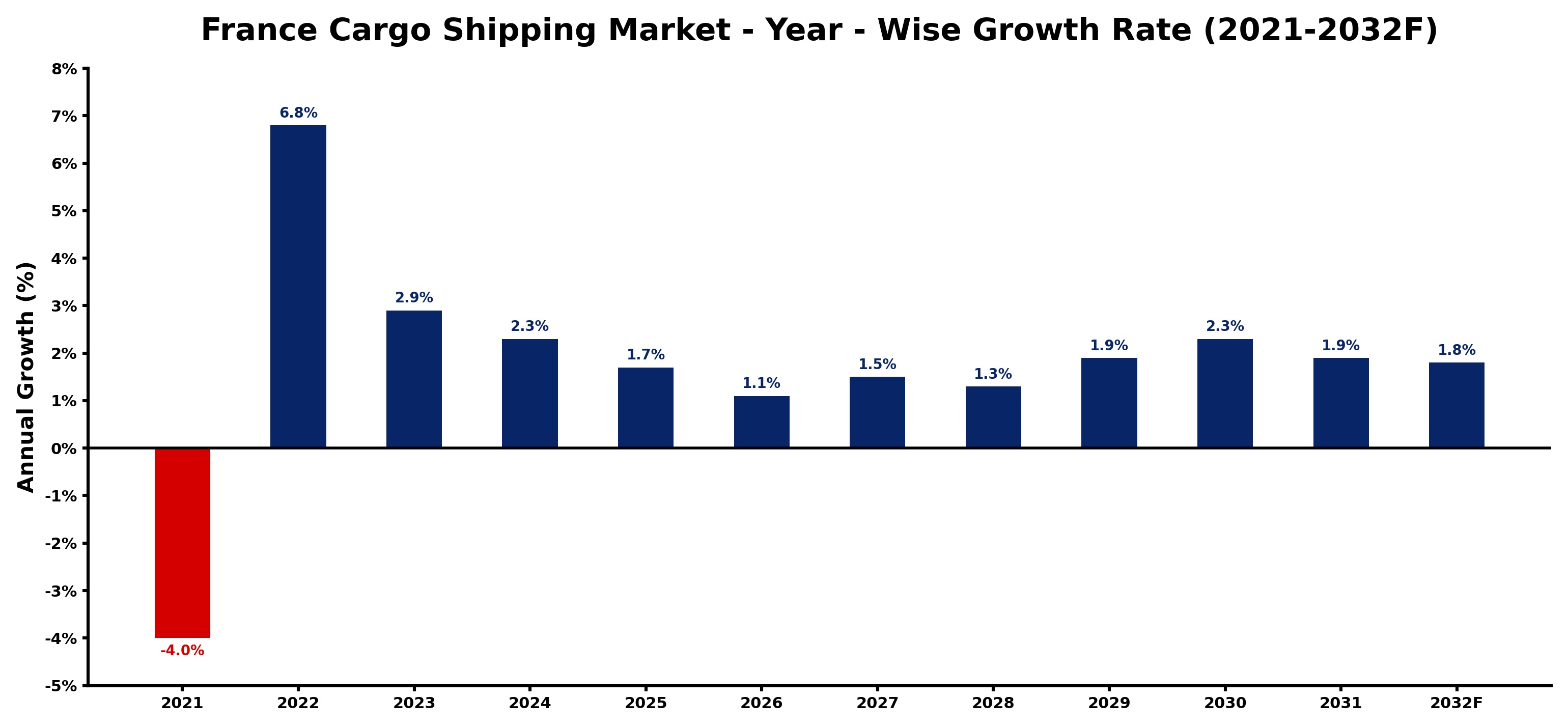
The table below presents the year‑wise growth rates along with the key drivers influencing the market
| Year | Growth Rate | Major Drivers |
| 2021 | -4.0% | Government infrastructure modernization initiatives |
| 2022 | 6.8% | Increasing industrial infrastructure investments |
| 2023 | 2.9% | Growing renewable energy integration projects |
| 2024 | 2.3% | Government infrastructure modernization initiatives |
| 2025 | 1.7% | Increasing industrial infrastructure investments |
| 2026 | 1.1% | Growing urbanization and commercial development |
| 2027 | 1.5% | Rising electricity demand across industries |
| 2028 | 1.3% | Growing renewable energy integration projects |
| 2029 | 1.9% | Increasing industrial automation investments |
| 2030 | 2.3% | Government infrastructure modernization initiatives |
| 2031 | 1.9% | Expansion of manufacturing activities |
| 2032 | 1.8% | Government infrastructure modernization initiatives |
Note - Market size estimations and growth projections presented in this report are based on 6Wresearch’s advanced forecasting approach, validated with industry datasets as of June 2026.
France Cargo Shipping Market Synopsis
The French cargo shipping landscape is marked by its robust network of ports, including key gateways that facilitate seamless trade between Europe and global markets. Port authorities are increasingly focused on enhancing operational efficiency, which is vital for managing the burgeoning volume of cargo movement spurred by international trade agreements.
Moreover, the rise of e-commerce has transformed shipping requirements, prompting companies to adopt faster and more reliable logistics solutions. This demand for efficiency is reshaping service offerings across the industry, as companies look to innovate and meet the evolving needs of shippers and consumers alike.
France Cargo Shipping Market Key Takeaways
- The market is heavily influenced by globalization and expanding trade networks, driving demand for efficient cargo shipping solutions.
- Government investments in port infrastructure are aimed at enhancing competitive advantage and supporting sustainable practices.
- Regulatory frameworks are evolving to incorporate stricter environmental standards, influencing operational strategies within the sector.
- Innovations in logistics technology are enabling companies to streamline operations and reduce costs, boosting market growth.
- Geopolitical factors and market volatility present ongoing risks that impact shipping dynamics and operational planning.
Evaluation of Restraints in France Cargo Shipping Market
While the France cargo shipping market shows promising growth prospects, it is not without its challenges. Fluctuating fuel prices remain a significant restraint, as they can erode profit margins for shipping companies. Additionally, overcapacity on certain routes creates competitive pressure that can lower shipping rates, making it difficult for some operators to remain profitable. The complexity of regulatory changes surrounding trade agreements and tariffs further complicates the landscape, as businesses must adapt to an ever-shifting compliance environment.
Moreover, environmental regulations necessitate substantial investments in cleaner technologies, which can pose financial challenges, particularly for smaller operators. The interplay between these factors can create an unpredictable business climate, influencing strategic planning within the market.
France Cargo Shipping Market Trends
Key trends currently shaping the France cargo shipping market include the increasing adoption of digital technologies, such as blockchain and IoT, to enhance supply chain transparency and efficiency. Companies are also exploring automation within ports to streamline operations and reduce turnaround times. Furthermore, the rising emphasis on sustainability is prompting shipping firms to invest in greener vessels and logistics practices that align with global environmental targets.
Another notable trend is the growing integration of artificial intelligence in logistics management, allowing for better demand forecasting and resource allocation. These trends collectively contribute to a more agile, responsive cargo shipping environment in France.
France Cargo Shipping Market Opportunities
There are significant growth opportunities within the France cargo shipping market, particularly through the expansion of e-commerce logistics. As online shopping continues to proliferate, shipping companies can capitalize on the need for faster and more reliable delivery systems. Additionally, investments in sustainable practices and technologies provide avenues for differentiation and alignment with consumer expectations regarding environmental responsibility.
Moreover, the ongoing development of France's port infrastructure presents opportunities for improved operational efficiencies. Collaborative initiatives between government and industry can enhance capacity, streamline processes, and ultimately support greater market competitiveness.
Government Initiatives in the France Cargo Shipping Market
Government policies in France are increasingly focused on bolstering the cargo shipping sector through investments in maritime infrastructure and logistics networks. These initiatives aim to enhance port efficiency, reduce congestion, and improve supply chain resilience. Regulatory agencies are actively working to ensure compliance with safety and environmental standards, which is critical for maintaining competitive advantages in global trade.
Furthermore, public spending is directed towards developing green technologies and promoting sustainable shipping practices, in response to both domestic and international environmental commitments. Such initiatives are expected to play a vital role in shaping the future of the cargo shipping market in France.
Future Insights of the France Cargo Shipping Market
Looking ahead to 2026-2032, the France cargo shipping market is poised for steady growth, driven by the ongoing integration of advanced technologies and the increasing globalization of trade. As companies adapt to the demands of e-commerce and seek to optimize their logistics networks, the market will likely see enhanced competition and innovation. Continued government support for sustainable practices will also influence market dynamics, encouraging investments in cleaner technologies and practices.
Overall, the interplay of regulatory changes, market demands, and technological advancements will shape the strategic direction of the market, ultimately creating new opportunities for growth and transformation.
France Cargo Shipping Market Latest Developments (May 2025 - June 2026)
Recent developments in the France cargo shipping market indicate a continued focus on infrastructure improvements and sustainable practices. Innovations in logistics technology are being rapidly adopted to enhance operational efficiency and meet evolving customer expectations. Additionally, various industry collaborations are underway to address environmental challenges and promote greener shipping solutions.
Market stakeholders are also actively monitoring geopolitical developments, which could influence trade flows and shipping dynamics. Overall, the industry is poised to adapt to these changes while leveraging new technologies and practices to drive growth.
France Cargo Shipping Market - Key Attractiveness of the Report
- 10 Years of Market Numbers
- Historical Data Starting from 2022 to 2025
- Base Year: 2025
- Forecast Data until 2032
- Key Performance Indicators Impacting the Market
- Major Upcoming Developments and Projects
Key Highlights of the Report:
- France Cargo Shipping Market Outlook
- Market Size of France Cargo Shipping Market, 2025
- Forecast of France Cargo Shipping Market, 2032
- Historical Data and Forecast of France Cargo Shipping Revenues & Volume for the Period 2022-2032F
- France Cargo Shipping Market Trend Evolution
- France Cargo Shipping Market Drivers and Challenges
- France Cargo Shipping Price Trends
- France Cargo Shipping Porter's Five Forces
- France Cargo Shipping Industry Life Cycle
- Historical Data and Forecast of France Cargo Shipping Market Revenues & Volume By Cargo Infrastructure for the Period 2022-2032F
- Historical Data and Forecast of France Cargo Shipping Market Revenues & Volume By Port Developments in Asia for the Period 2022-2032F
- Historical Data and Forecast of France Cargo Shipping Market Revenues & Volume By Port Developments in Europe for the Period 2022-2032F
- Historical Data and Forecast of France Cargo Shipping Market Revenues & Volume By Port Developments in North America for the Period 2022-2032F
- Historical Data and Forecast of France Cargo Shipping Market Revenues & Volume By Port Developments in South America for the Period 2022-2032F
- Historical Data and Forecast of France Cargo Shipping Market Revenues & Volume By Port Developments in Africa for the Period 2022-2032F
- Historical Data and Forecast of France Cargo Shipping Market Revenues & Volume By Cargo Type for the Period 2022-2032F
- Historical Data and Forecast of France Cargo Shipping Market Revenues & Volume By Container Cargo for the Period 2022-2032F
- Historical Data and Forecast of France Cargo Shipping Market Revenues & Volume By Bulk Cargo for the Period 2022-2032F
- Historical Data and Forecast of France Cargo Shipping Market Revenues & Volume By General Cargo for the Period 2022-2032F
- Historical Data and Forecast of France Cargo Shipping Market Revenues & Volume By Oil & Gas for the Period 2022-2032F
- Historical Data and Forecast of France Cargo Shipping Market Revenues & Volume By Industry Type for the Period 2022-2032F
- Historical Data and Forecast of France Cargo Shipping Market Revenues & Volume By Food, Manufacturing for the Period 2022-2032F
- Historical Data and Forecast of France Cargo Shipping Market Revenues & Volume By Oil & Ores for the Period 2022-2032F
- Historical Data and Forecast of France Cargo Shipping Market Revenues & Volume By Electrical & Electronics for the Period 2022-2032F
- France Cargo Shipping Import Export Trade Statistics
- Market Opportunity Assessment By Cargo Infrastructure
- Market Opportunity Assessment By Cargo Type
- Market Opportunity Assessment By Industry Type
- France Cargo Shipping Top Companies Market Share
- France Cargo Shipping Competitive Benchmarking By Technical and Operational Parameters
- France Cargo Shipping Company Profiles
- France Cargo Shipping Key Strategic Recommendations






































