France Carnauba Wax Market Size (2020-2030)
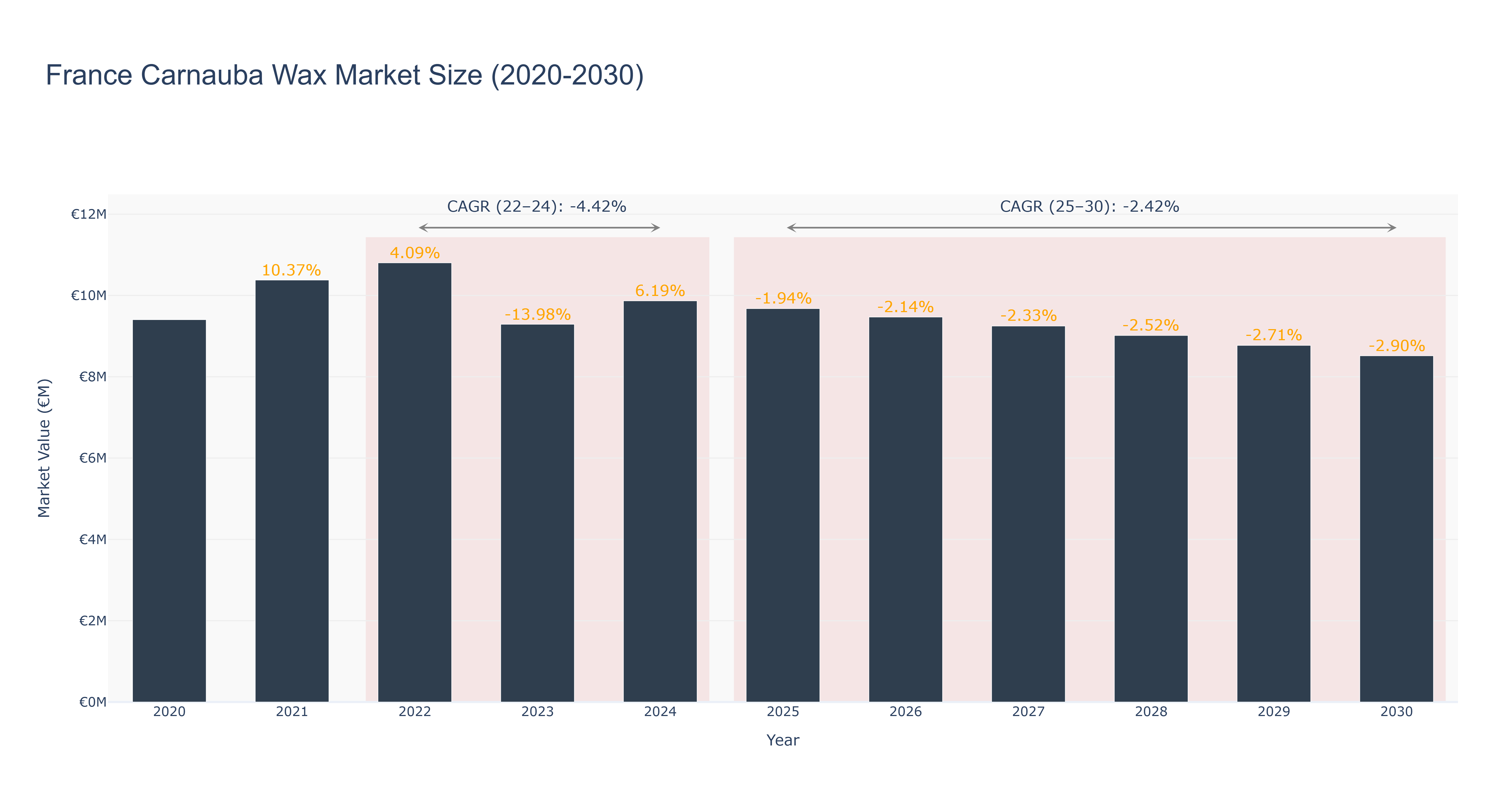
France Carnauba Wax Market has seen fluctuations in market size over the years. The peak market size was €10.80 million in 2022, followed by a decline to €9.29 million in 2023. The market showed some recovery in 2024 with a size of €9.87 million. However, from 2025 to 2030, the market is forecasted to continue on a downward trend with an expected size of €8.52 million in 2030. The CAGR from 2022 to 2024 was -4.42%, while from 2025 to 2030, it is projected to be -2.42%. The market decline can be attributed to changing consumer preferences towards alternative products and the increasing focus on sustainable and eco-friendly alternatives. In the near future, France is planning to invest in research and development for bio-based waxes to meet the evolving market demands.
France Carnauba Wax Market: Production & Trade Performance (2019-2025)
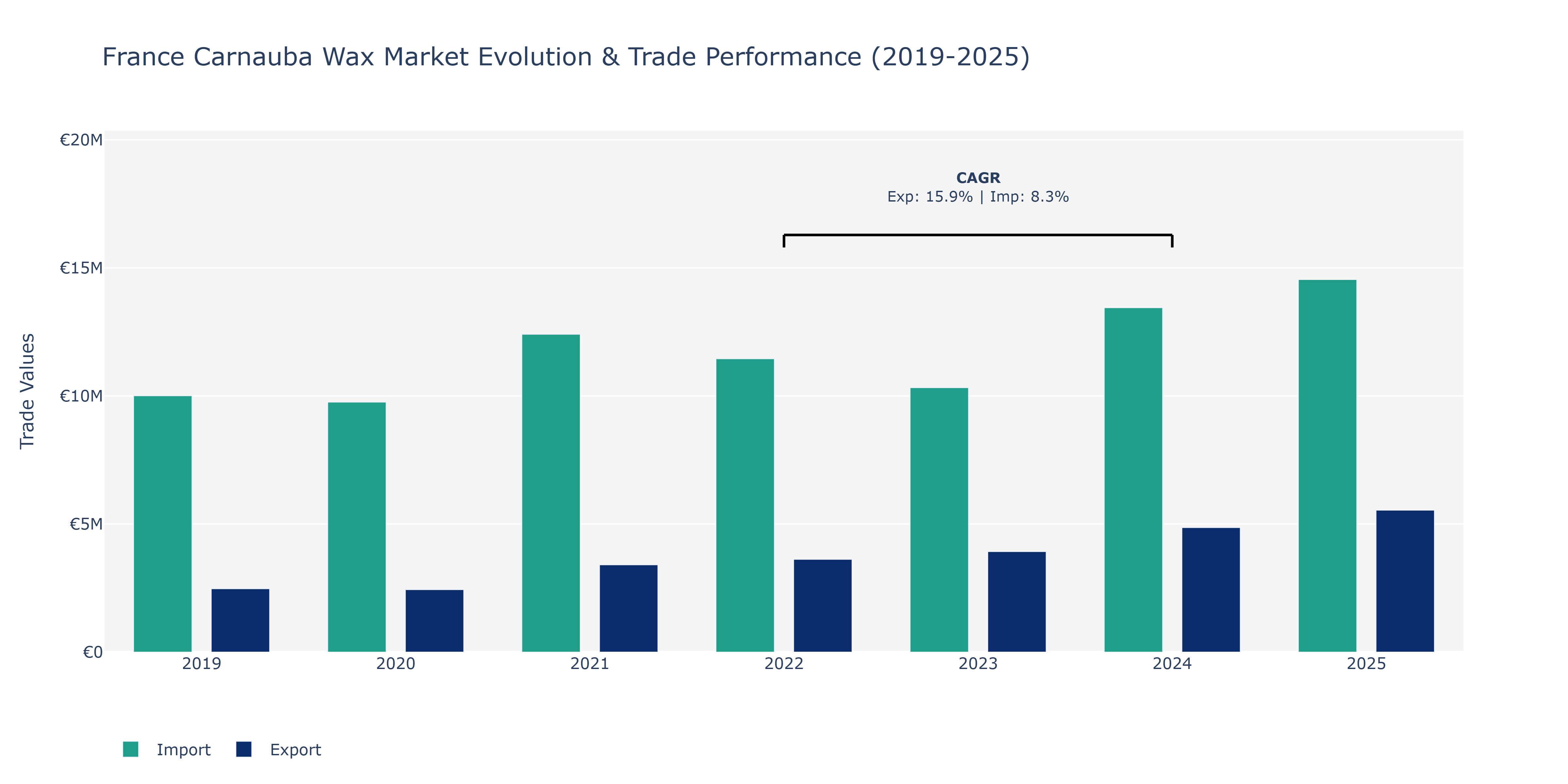
The France Carnauba Wax Market's Export value experienced a steady growth trajectory from 2019 to 2025, starting at approximately €2.47 million and reaching around €5.54 million by the end of the period. This upward trend can be attributed to the increasing global demand for eco-friendly and sustainable products, where carnauba wax is widely used, especially in industries such as automotive, cosmetics, and pharmaceuticals. On the other hand, imports followed a fluctuating pattern, peaking at about €13.44 million in 2024 after showing a slight decline in the previous years. This fluctuation could be influenced by changes in international trade agreements, shifts in suppliers' costs, and variations in consumer preferences. The market's dynamics reflect the industry's responsiveness to environmental concerns and shifting consumer preferences towards natural ingredients, driving both export growth and import fluctuations.
France Carnauba Wax Market Overview
Carnauba wax, derived from the leaves of the carnauba palm, is widely used in the cosmetics, food, and automotive industries for its natural luster and protective properties. In France, the carnauba wax market caters to diverse applications, including confectionery glazing, pharmaceutical coatings, and car wax formulations. As consumer preferences shift towards eco-friendly and sustainable products, the demand for carnauba wax as a natural alternative to synthetic waxes is expected to grow.
Drivers of the market
In France, the carnauba wax market is driven by its widespread applications across industries such as cosmetics, pharmaceuticals, food, and automotive. The market experiences growth due to factors such as the increasing demand for natural and sustainable ingredients, the versatility of carnauba wax in formulations, and its desirable properties such as gloss, hardness, and water resistance. Technological advancements in extraction and processing methods also contribute to market expansion.
Challenges of the market
In the French carnauba wax market, challenges include fluctuations in raw material supply and prices, as carnauba palm cultivation is limited to specific regions with unique environmental conditions. Additionally, the cosmetic and automotive industries, major consumers of carnauba wax, demand high-quality and sustainably sourced products, necessitating certification and traceability throughout the supply chain. Regulatory compliance regarding product safety and labeling further adds to market challenges.
Government Policy of the market
Government policies in France regarding environmental conservation, consumer safety, and product quality influence the carnuba wax market. Regulatory agencies set standards and specifications for the production, labeling, and marketing of carnuba wax, ensuring its purity, authenticity, and compliance with food and cosmetic regulations. Environmental regulations may also impact harvesting practices and sustainability initiatives within the carnauba wax industry, promoting responsible sourcing and conservation efforts. Furthermore, trade agreements and import/export regulations govern the international trade of carnuba wax, shaping market dynamics and business strategies for industry stakeholders. Consumer awareness of eco-friendly products and natural ingredients drives demand for carnauba wax in various applications, influencing market trends and innovation efforts.
Key Highlights of the Report:
- France Carnauba Wax Market Outlook
- Market Size of France Carnauba Wax Market, 2021
- Forecast of France Carnauba Wax Market, 2028
- Historical Data and Forecast of France Carnauba Wax Revenues & Volume for the Period 2018 - 2028
- France Carnauba Wax Market Trend Evolution
- France Carnauba Wax Market Drivers and Challenges
- France Carnauba Wax Price Trends
- France Carnauba Wax Porter's Five Forces
- France Carnauba Wax Industry Life Cycle
- Historical Data and Forecast of France Carnauba Wax Market Revenues & Volume By Product for the Period 2018 - 2028
- Historical Data and Forecast of France Carnauba Wax Market Revenues & Volume By Type1 for the Period 2018 - 2028
- Historical Data and Forecast of France Carnauba Wax Market Revenues & Volume By Type3 for the Period 2018 - 2028
- Historical Data and Forecast of France Carnauba Wax Market Revenues & Volume By Type4 for the Period 2018 - 2028
- Historical Data and Forecast of France Carnauba Wax Market Revenues & Volume By Application for the Period 2018 - 2028
- Historical Data and Forecast of France Carnauba Wax Market Revenues & Volume By Cosmetics for the Period 2018 - 2028
- Historical Data and Forecast of France Carnauba Wax Market Revenues & Volume By Food for the Period 2018 - 2028
- Historical Data and Forecast of France Carnauba Wax Market Revenues & Volume By Automotive for the Period 2018 - 2028
- Historical Data and Forecast of France Carnauba Wax Market Revenues & Volume By Pharmaceutical for the Period 2018 - 2028
- Historical Data and Forecast of France Carnauba Wax Market Revenues & Volume By Others for the Period 2018 - 2028
- France Carnauba Wax Import Export Trade Statistics
- Market Opportunity Assessment By Product
- Market Opportunity Assessment By Application
- France Carnauba Wax Top Companies Market Share
- France Carnauba Wax Competitive Benchmarking By Technical and Operational Parameters
- France Carnauba Wax Company Profiles
- France Carnauba Wax Key Strategic Recommendations






































