France Chamotte Market Size, Share & Growth Rate
The France Chamotte Market was estimated at USD 163 Million in 2025 and is projected to reach USD 181 Million by 2032, growing at a CAGR of 1.5% from 2026 to 2032. This steady growth is primarily driven by increased demand in diverse sectors such as ceramics and construction, where chamotte's thermal resistance is highly valued. Moreover, the push towards sustainable manufacturing practices is further propelling innovation and investment within this segment.
France Chamotte Market Year-wise Growth Rate and Key Drivers
This graph highlights how the France Chamotte Market has steadily grown over the years, supported by major growth factors.
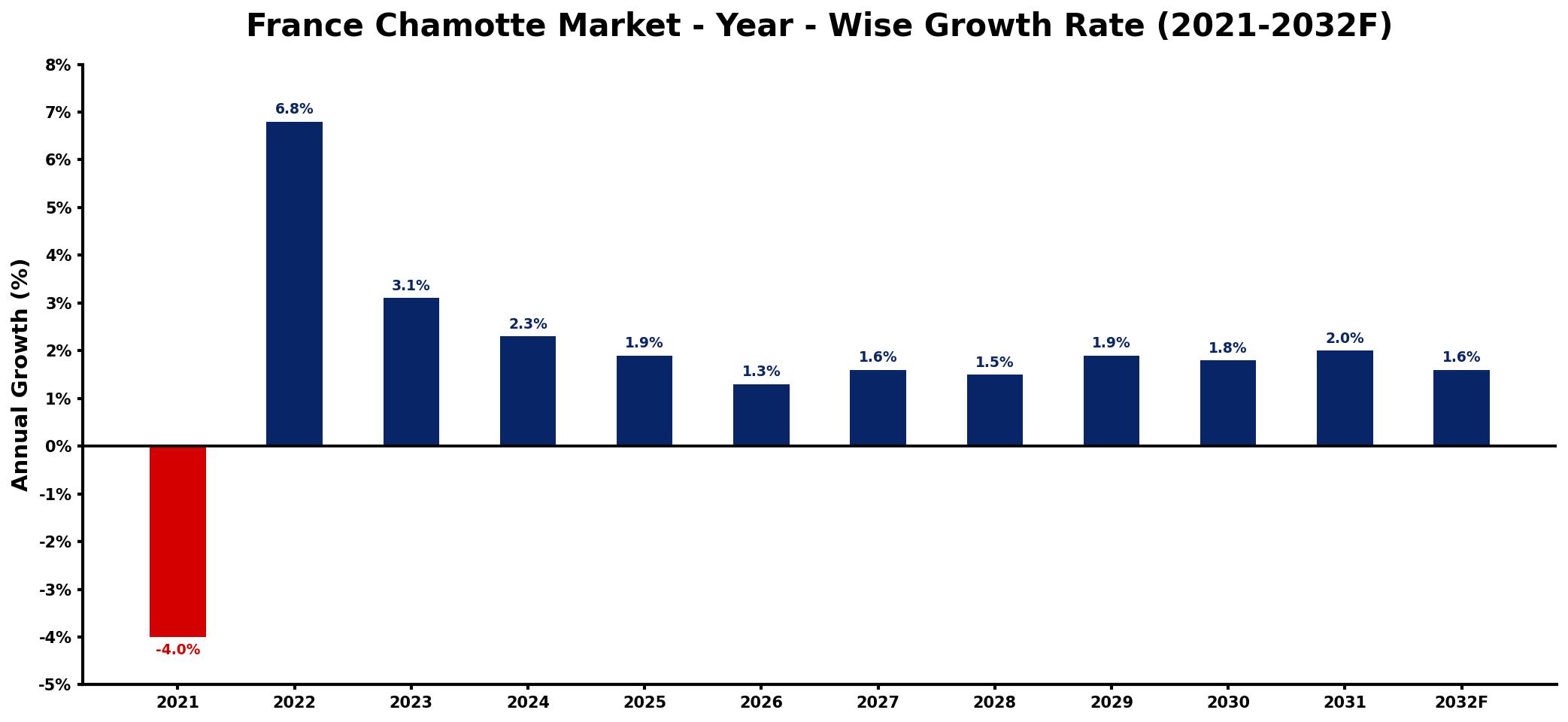
The table below presents the year‑wise growth rates along with the key drivers influencing the market
| Year | Growth Rate | Major Drivers |
| 2021 | -4.0% | decreased construction project investments |
| 2022 | 6.8% | rising demand in construction sector |
| 2023 | 3.1% | expansion of industrial applications |
| 2024 | 2.3% | increased investments in infrastructure |
| 2025 | 1.9% | growing popularity of sustainable materials |
| 2026 | 1.3% | enhanced production capabilities emerging |
| 2027 | 1.6% | strengthened export markets development |
| 2028 | 1.5% | increased focus on energy efficiency |
| 2029 | 1.9% | growing adoption of advanced technologies |
| 2030 | 1.8% | rising consumer preference for durability |
| 2031 | 2.0% | expanding international trade agreements |
| 2032 | 1.6% | increased collaboration among manufacturers |
Note: Market size estimations and growth projections presented in this report are based on 6Wresearch's proprietary forecasting methodology, utilizing the latest available industry data, government publications, and primary research inputs.
France Chamotte Market Synopsis
The strongest force shaping the France Chamotte Market today is the growing emphasis on sustainability. Eco-friendly chamotte production is gaining traction, as both manufacturers and consumers increasingly prioritize environmentally responsible materials in their choices. This shift not only aligns with regulatory frameworks but also responds to changing consumer preferences.
Additionally, advancements in production processes are enhancing the performance characteristics of chamotte. The market is witnessing a demand for high-quality products that provide superior thermal insulation, chemical resistance, and overall durability, broadening the scope of applications and attracting new customers across multiple industries.
France Chamotte Market Key Takeaways
- The market is driven by diverse applications across ceramics, construction, and metallurgy.
- Sustainable manufacturing practices are becoming a critical focus for industry players.
- Innovation in product development is vital for maintaining competitive advantage.
- Increasing construction activities are anticipated to spur further demand for chamotte.
- Technological advancements are paving the way for new applications and market growth.
Evaluation of Restraints in France Chamotte Market
Despite its promising growth trajectory, the France Chamotte Market faces several notable constraints. Chief among these are the rising competition from alternative materials such as refractory bricks and ceramic fibers, which can offer similar or superior properties. Fluctuations in raw material prices—especially those pertaining to high-grade chamotte—can significantly influence production costs and overall profitability. Furthermore, stringent environmental regulations require manufacturers to invest in cleaner technologies and processes, adding to operational challenges. Lastly, the market's dependency on the performance of end-use sectors such as steel and construction makes it susceptible to economic fluctuations, which can impact demand.
France Chamotte Market Trends
Current trends in the France Chamotte Market reflect a heightened focus on quality and sustainability. Manufacturers are increasingly investing in research and development to enhance product performance, particularly in thermal insulation and chemical resistance. Additionally, the rise of eco-conscious consumerism is steering companies toward exploring biodegradable and recyclable materials. There is also a notable trend towards collaborative efforts between businesses and research institutions aimed at innovating chamotte applications, including lightweight aggregates for construction.
France Chamotte Market Opportunities
Investment opportunities in the France Chamotte Market are robust, particularly with the rising demand across multiple sectors. The increasing need for energy-efficient construction materials is a significant area for growth, as is the demand for advanced refractory materials in industrial applications. Companies that focus on sustainable practices and innovative manufacturing technologies are well-positioned to capture market share. Furthermore, the potential for diversification into lightweight aggregates and other advanced materials presents lucrative avenues for both new and existing players in the market.
Government Initiatives in the France Chamotte Market
The French government has enacted several policies to bolster the chamotte industry, emphasizing environmental sustainability and product quality. These regulations aim to minimize the ecological impact of production processes through strict controls on emissions and waste management. Quality standards ensure that chamotte products meet specific safety and performance criteria. Additionally, the government provides financial support for research and development initiatives, aiming to foster innovation and maintain competitiveness within the sector. Such initiatives create a more favorable environment for growth while balancing economic interests with environmental stewardship.
Future Insights of the France Chamotte Market
Looking ahead to 2026-2032, the France Chamotte Market is set to benefit from ongoing growth in key end-use industries, particularly ceramics and construction. As the construction sector continues to thrive, it is likely to drive increased adoption of chamotte products, further reinforcing the market's trajectory. Technological advancements will not only enhance the production processes but also lead to the development of innovative applications. However, the industry must remain vigilant about fluctuating raw material prices and environmental regulations that could influence market dynamics. Overall, the outlook is cautiously optimistic, as the market adapts to emerging trends and evolving consumer expectations.
France Chamotte Market Latest Developments (2025 - 2026)
Recent industry developments indicate a shift towards collaborative initiatives aimed at enhancing sustainable practices in chamotte production. Companies are increasingly focusing on reducing their carbon footprint and exploring alternatives that align with environmental regulations. Technological advancements in production processes have also been reported, aimed at improving efficiency and product quality. Moreover, partnerships between manufacturers and research institutions are becoming more common as the industry seeks to innovate and diversify chamotte applications.
France Chamotte Market - Key Attractiveness of the Report
- 10 Years of Market Numbers
- Historical Data Starting from 2022 to 2025
- Base Year: 2025
- Forecast Data until 2032
- Key Performance Indicators Impacting the Market
- Major Upcoming Developments and Projects
Key Highlights of the Report:
- France Chamotte Market Outlook
- Market Size of France Chamotte Market, 2025
- Forecast of France Chamotte Market, 2032
- Historical Data and Forecast of France Chamotte Revenues & Volume for the Period 2022-2032F
- France Chamotte Market Trend Evolution
- France Chamotte Market Drivers and Challenges
- France Chamotte Price Trends
- France Chamotte Porter's Five Forces
- France Chamotte Industry Life Cycle
- Historical Data and Forecast of France Chamotte Market Revenues & Volume By Type for the Period 2022-2032F
- Historical Data and Forecast of France Chamotte Market Revenues & Volume By Clinker for the Period 2022-2032F
- Historical Data and Forecast of France Chamotte Market Revenues & Volume By Cement Clinker for the Period 2022-2032F
- Historical Data and Forecast of France Chamotte Market Revenues & Volume By Application for the Period 2022-2032F
- Historical Data and Forecast of France Chamotte Market Revenues & Volume By Cement for the Period 2022-2032F
- Historical Data and Forecast of France Chamotte Market Revenues & Volume By Silicate Material for the Period 2022-2032F
- Historical Data and Forecast of France Chamotte Market Revenues & Volume By Others for the Period 2022-2032F
- France Chamotte Import Export Trade Statistics
- Market Opportunity Assessment By Type
- Market Opportunity Assessment By Application
- France Chamotte Top Companies Market Share
- France Chamotte Competitive Benchmarking By Technical and Operational Parameters
- France Chamotte Company Profiles
- France Chamotte Key Strategic Recommendations






































