France Coffee Beans Market Top 5 Importing Countries and Market Competition (HHI) Analysis
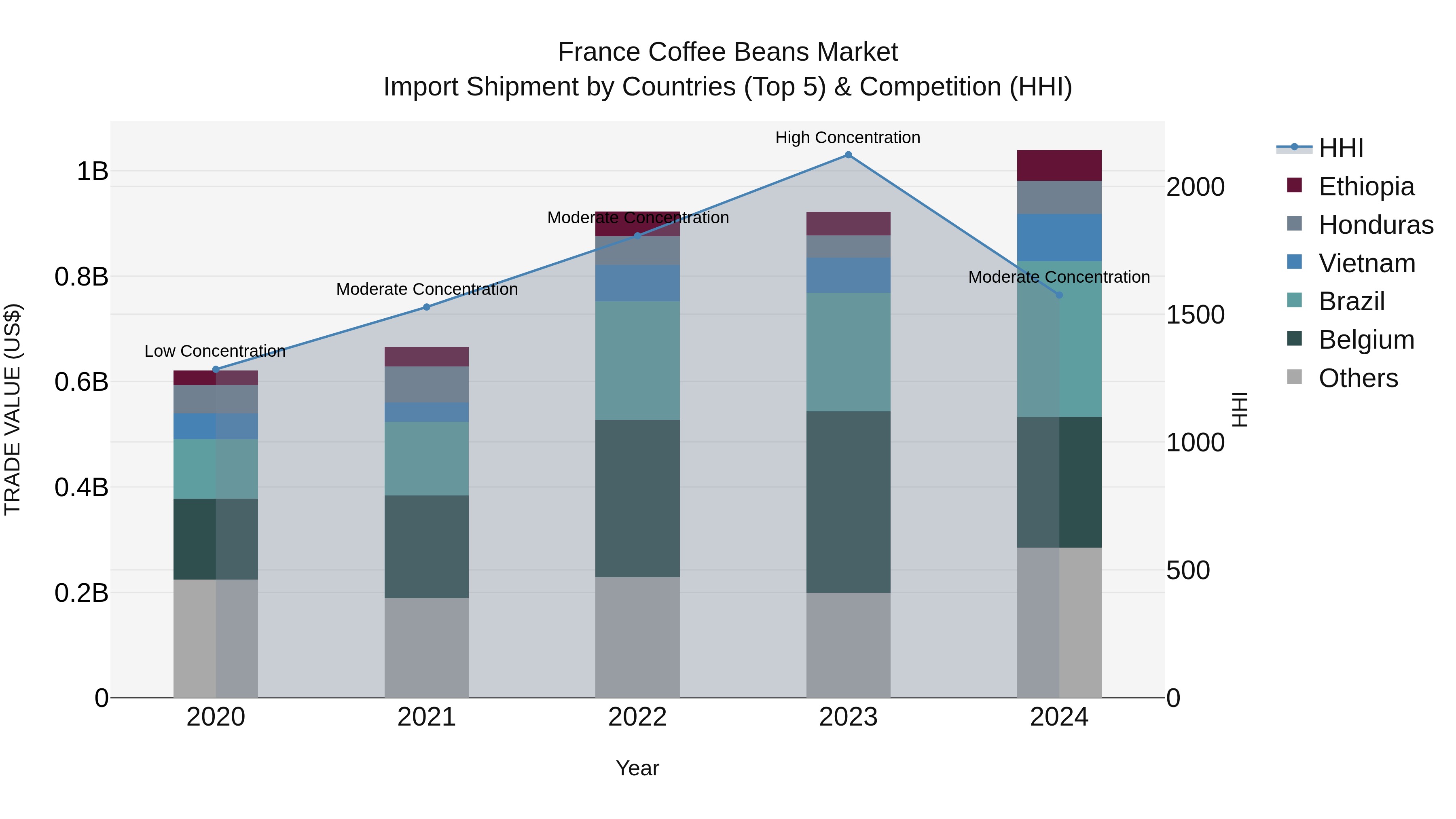
France`s coffee bean import market saw significant diversification in 2024, with top exporters including Brazil, Belgium, Vietnam, Honduras, and Ethiopia. The market shifted from high concentration in 2023 to a more moderate level in 2024, indicating increased competition and options for buyers. The impressive Compound Annual Growth Rate (CAGR) of 13.74% from 2020 to 2024 highlights the growing demand for coffee beans in France. Additionally, the notable growth rate of 12.71% from 2023 to 2024 suggests a continued upward trajectory for the market, offering opportunities for both domestic and international suppliers.
France Coffee Beans Market Overview
France boasts a vibrant coffee culture, reflected in the robust demand for high-quality coffee beans. Specialty coffee varieties, sourced from diverse regions worldwide, command a loyal consumer base seeking unique flavor profiles and ethical sourcing practices. The market is characterized by a proliferation of artisanal coffee shops, roasteries, and online retailers catering to discerning coffee enthusiasts.
Drivers of the market
In France, the coffee beans market is experiencing sustained growth driven by evolving consumer preferences towards premium and specialty coffee varieties. With a burgeoning café culture and an increasing number of artisanal coffee shops across major cities, there is a growing demand for high-quality, ethically sourced coffee beans. Moreover, the rising popularity of home brewing and gourmet coffee experiences among consumers further fuels the demand for specialty coffee beans. Additionally, the emphasis on sustainability and fair trade practices in the coffee industry is influencing purchasing decisions, driving the adoption of certified organic and fair trade coffee beans.
Challenges of the market
The coffee beans market in France encounters challenges related to competition from multinational coffee chains and shifting consumer preferences toward specialty and ethically sourced coffee. Additionally, concerns about the environmental and social impact of coffee production, such as deforestation and fair labor practices, may influence purchasing decisions.
Government Policy of the market
France has a vibrant Coffee Beans market, driven by consumer demand for high-quality and ethically sourced coffee products. The government supports sustainable coffee farming practices through certification programs and provides financial incentives to coffee growers who adopt environmentally friendly cultivation methods. Moreover, there are initiatives to promote fair trade practices and support small-scale coffee producers in developing countries.
Key Highlights of the Report:
- France Coffee Beans Market Outlook
- Market Size of France Coffee Beans Market, 2024
- Forecast of France Coffee Beans Market, 2031
- Historical Data and Forecast of France Coffee Beans Revenues & Volume for the Period 2021-2031
- France Coffee Beans Market Trend Evolution
- France Coffee Beans Market Drivers and Challenges
- France Coffee Beans Price Trends
- France Coffee Beans Porter's Five Forces
- France Coffee Beans Industry Life Cycle
- Historical Data and Forecast of France Coffee Beans Market Revenues & Volume By Product Type for the Period 2021-2031
- Historical Data and Forecast of France Coffee Beans Market Revenues & Volume By Arabica for the Period 2021-2031
- Historical Data and Forecast of France Coffee Beans Market Revenues & Volume By Robusta for the Period 2021-2031
- Historical Data and Forecast of France Coffee Beans Market Revenues & Volume By Others for the Period 2021-2031
- Historical Data and Forecast of France Coffee Beans Market Revenues & Volume By Applications for the Period 2021-2031
- Historical Data and Forecast of France Coffee Beans Market Revenues & Volume By Personal Care for the Period 2021-2031
- Historical Data and Forecast of France Coffee Beans Market Revenues & Volume By Food for the Period 2021-2031
- Historical Data and Forecast of France Coffee Beans Market Revenues & Volume By Pharmaceutical for the Period 2021-2031
- France Coffee Beans Import Export Trade Statistics
- Market Opportunity Assessment By Product Type
- Market Opportunity Assessment By Applications
- France Coffee Beans Top Companies Market Share
- France Coffee Beans Competitive Benchmarking By Technical and Operational Parameters
- France Coffee Beans Company Profiles
- France Coffee Beans Key Strategic Recommendations






































