France Decentralized Identity Market Size & Growth Rate (2026-2032)
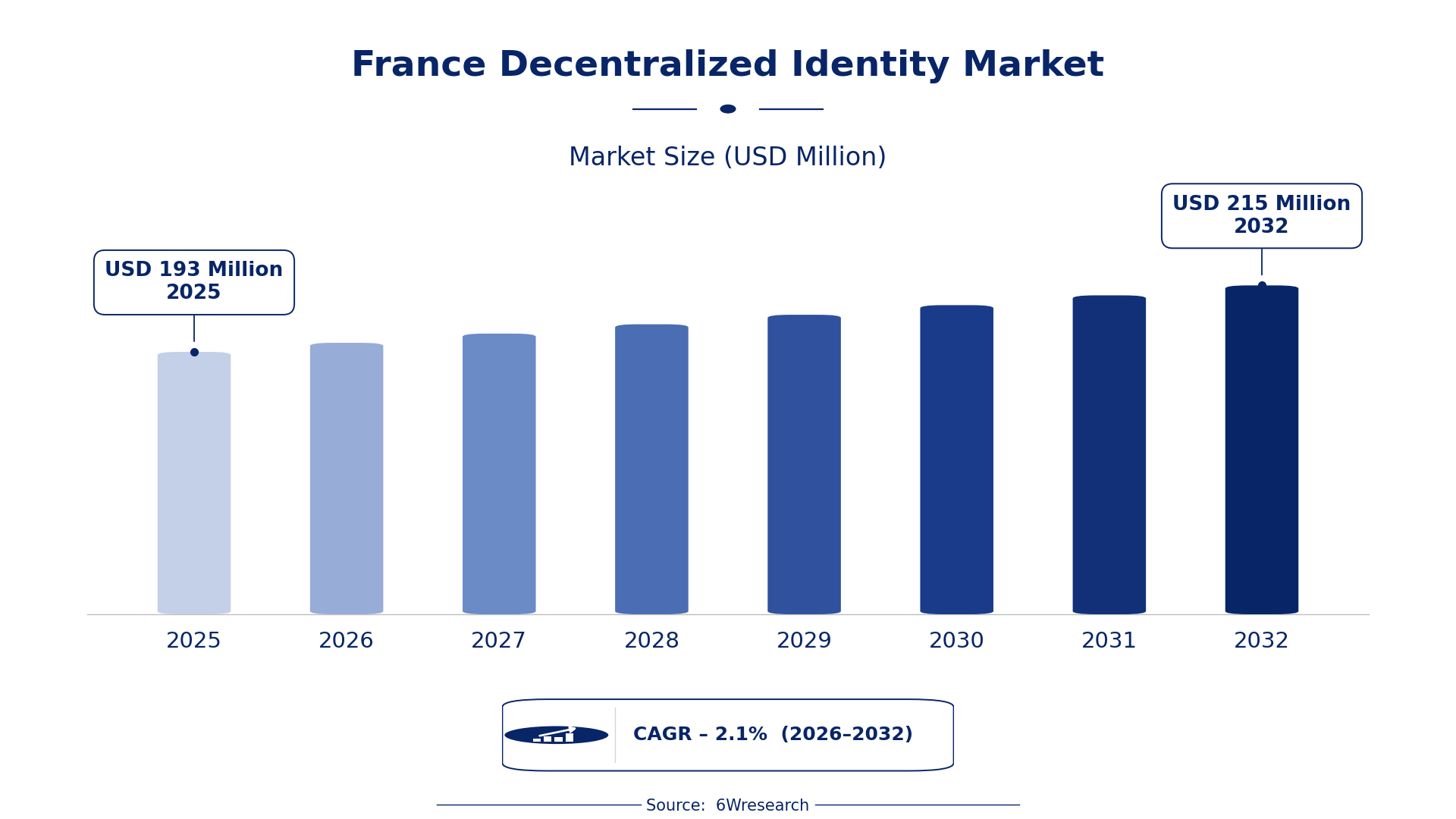
The France Decentralized Identity Market was estimated at USD 193 Million in 2025 and is projected to reach USD 215 Million by 2032, growing at a CAGR of 2.1% from 2026 to 2032.
France Decentralized Identity Market Synopsis
In France, the shift toward decentralized identity solutions is being fueled by a growing demand for secure methods of managing digital identities. With rising concerns about privacy and data ownership, individuals and organizations are increasingly turning to decentralized platforms that leverage blockchain technology, enabling users to take control of their identity information.
The French market is characterized by both innovation and regulatory challenges. While the need for identity solutions that maintain user privacy drives adoption, companies struggle with implementing self-sovereign identity frameworks that comply with local regulations. This balancing act of empowerment and adherence to the law defines the market dynamics in France.
France Decentralized Identity Market Year-wise Growth Rate and Key Drivers
This graph illustrates the annual growth rates of the France Decentralized Identity Market from 2021 to 2032, highlighting a steady upward trajectory and projected expansion over the forecast period.
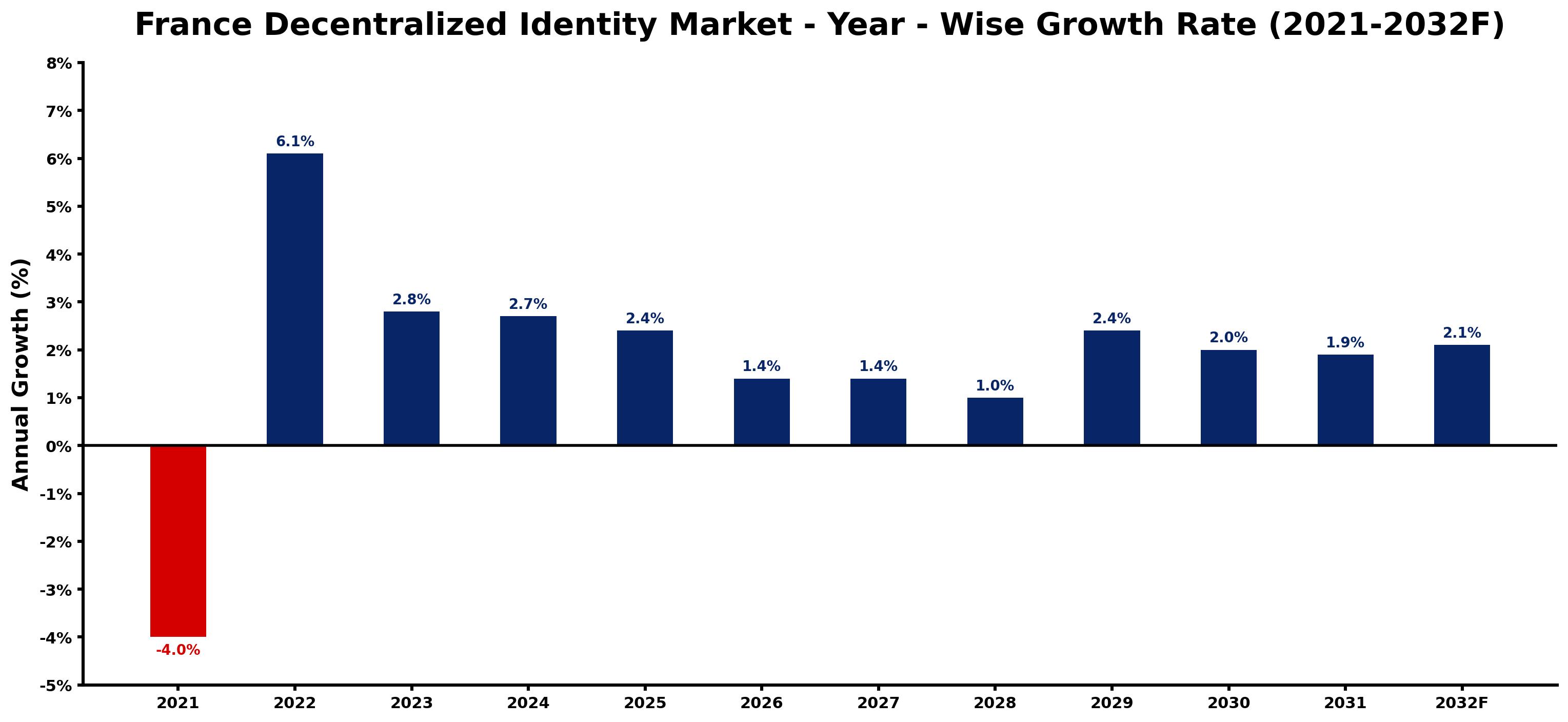
The table below presents the year‑wise growth rates along with the key drivers influencing the market
| Year | Growth Rate | Major Drivers |
| 2021 | -4.0% | National legislation uncertainty delayed adoption of decentralized IDs. |
| 2022 | 6.1% | Implementation of French digital ID security regulations. |
| 2023 | 2.8% | Increased demand for biometric verification solutions. |
| 2024 | 2.7% | Support for self-sovereign identity initiatives by government. |
| 2025 | 2.4% | Partnerships between fintechs and identity providers growing. |
| 2026 | 1.4% | EU guidelines promoting cross-border identity verification. |
| 2027 | 1.4% | Rise in digital transactions necessitating robust identity solutions. |
| 2028 | 1.0% | Growing public awareness of data privacy issues. |
| 2029 | 2.4% | Increased investment in blockchain-based identity projects. |
| 2030 | 2.0% | Development of national digital identity framework progressing. |
| 2031 | 1.9% | Regulatory push for enhanced cybersecurity in identities. |
| 2032 | 2.1% | Adoption of digital health passes fueling identity services. |
Note: Market size estimations and growth projections presented in this report are based on 6Wresearch's proprietary forecasting methodology, utilizing the latest available industry data, government publications, and primary research inputs.
France Decentralized Identity Market Key Takeaways
Below are some of the specific key takeaways from the market, including:
- The market is increasingly focused on user empowerment through decentralized solutions.
- Challenges persist regarding compliance with regulatory frameworks around identity management.
- Innovation in blockchain technology is a driving force behind market growth.
- Privacy and security remain top priorities for users and organizations alike.
- The role of government policies is crucial in shaping the adoption of decentralized identity technologies.
Evaluation of Restraints in France Decentralized Identity Market
Establishing trust in decentralized identity systems poses a significant challenge for market players. Many organizations find it difficult to implement frameworks that allow users to manage their personal data without undermining regulatory compliance. Concerns about identity theft and data breaches amplify hesitancy among potential adopters. Interoperability issues also complicate efforts to create a cohesive ecosystem, hindering widespread acceptance of these innovative solutions.
France Decentralized Identity Market Trends
A notable trend in the France Decentralized Identity Market is the increasing integration of artificial intelligence and machine learning technologies. These advancements enhance identity verification processes, providing more reliable and efficient solutions. Additionally, there is a shift toward collaborative approaches among various stakeholders, including tech firms, governments, and privacy advocates, aiming to create a more unified and secure identity management framework.
User-centric design is gaining traction as well, with solutions prioritizing intuitive interfaces and seamless user experiences. As organizations recognize the importance of building trust with end-users, there is a push towards transparency in data handling practices.
France Decentralized Identity Market Opportunities
Several areas within the France Decentralized Identity Market are ripe for growth and investment. The increasing demand for secure digital identity solutions among various sectors, including finance, healthcare, and government, provides fertile ground for innovation. Companies that can effectively address regulatory compliance while delivering user-friendly experiences stand to gain substantial market share.
Moreover, the expansion of cross-border identity solutions presents a unique opportunity for businesses to tap into international markets. As globalization continues, the need for interoperable identity systems will drive new partnerships and collaborations.
Government Initiatives in the France Decentralized Identity Market
The French government is actively promoting decentralized identity solutions through various initiatives aimed at enhancing digital identity standards and ensuring privacy for citizens. This regulatory support plays a critical role in fostering an environment conducive to innovation and security in identity management.
- A national digital identity strategy launched in early 2023 aims to improve the framework for identity verification in public services.
- Currently ongoing is a pilot program to implement blockchain-based identity verification systems in local government agencies.
- A planned public-private partnership, set for rollout by mid-2026, is expected to enhance the infrastructure for decentralized identity management.
- In 2024, a regulatory framework focusing on user consent and data protection standards for digital identities was introduced.
- The government's initiative to collaborate with tech companies for developing interoperable identity solutions is also underway.
Future Insights of the France Decentralized Identity Market
Looking ahead to 2026-2032, the France Decentralized Identity Market is expected to evolve significantly. Advances in technology will likely lead to more sophisticated identity management solutions that prioritize user empowerment while adhering to regulatory requirements. The growth of digital services will further necessitate the development of decentralized identity systems, driving innovation and investment in this sector.
France Decentralized Identity Market Latest Developments
Recent months have seen a surge in activity within the France Decentralized Identity Market, reflecting a strong commitment to enhancing identity management solutions. Various initiatives and collaborations are currently shaping the direction of the market.
- A collaboration between local tech firms and government agencies began in early 2023 to develop a standardized framework for decentralized identities.
- An initiative aimed at testing blockchain-based identity solutions in healthcare settings is currently underway, expected to yield results by late 2025.
- A major technology vendor announced plans for a service upgrade focused on enhancing data security measures for decentralized identity applications, set to launch in early 2026.
- A public awareness campaign is in progress, initiated in Q3 2025, aimed at educating citizens on the benefits of decentralized identity solutions.
- By the end of 2025, a new regulatory guideline on identity data usage is anticipated to be introduced, impacting how organizations approach decentralized identity.
France Decentralized Identity Market - Key Attractiveness of the Report
- 10 Years of Market Numbers
- Historical Data Starting from 2022 to 2025
- Base Year: 2025
- Forecast Data until 2032
- Key Performance Indicators Impacting the Market
- Major Upcoming Developments and Projects
Key Highlights of the Report:
- France Decentralized Identity Market Outlook
- Market Size of France Decentralized Identity Market, 2025
- Forecast of France Decentralized Identity Market, 2032
- Historical Data and Forecast of France Decentralized Identity Revenues & Volume for the Period 2022-2032F
- France Decentralized Identity Market Trend Evolution
- France Decentralized Identity Market Drivers and Challenges
- France Decentralized Identity Price Trends
- France Decentralized Identity Porter's Five Forces
- France Decentralized Identity Industry Life Cycle
- Historical Data and Forecast of France Decentralized Identity Market Revenues & Volume By Vertical for the Period 2022-2032F
- Historical Data and Forecast of France Decentralized Identity Market Revenues & Volume By BFSI for the Period 2022-2032F
- Historical Data and Forecast of France Decentralized Identity Market Revenues & Volume By Government for the Period 2022-2032F
- Historical Data and Forecast of France Decentralized Identity Market Revenues & Volume By Healthcare and Life Sciences for the Period 2022-2032F
- Historical Data and Forecast of France Decentralized Identity Market Revenues & Volume By Retail and eCommerce for the Period 2022-2032F
- Historical Data and Forecast of France Decentralized Identity Market Revenues & Volume By Telecom and IT for the Period 2022-2032F
- Historical Data and Forecast of France Decentralized Identity Market Revenues & Volume By Transport and Logistics for the Period 2022-2032F
- Historical Data and Forecast of France Decentralized Identity Market Revenues & Volume By Real Estate for the Period 2022-2032F
- Historical Data and Forecast of France BFSI Decentralized Identity Market Revenues & Volume By Others for the Period 2022-2032F
- Historical Data and Forecast of France Decentralized Identity Market Revenues & Volume By Identity Type for the Period 2022-2032F
- Historical Data and Forecast of France Decentralized Identity Market Revenues & Volume By Non- biometrics for the Period 2022-2032F
- Historical Data and Forecast of France Decentralized Identity Market Revenues & Volume By Biometrics for the Period 2022-2032F
- Historical Data and Forecast of France Decentralized Identity Market Revenues & Volume By End User for the Period 2022-2032F
- Historical Data and Forecast of France Decentralized Identity Market Revenues & Volume By Enterprises for the Period 2022-2032F
- Historical Data and Forecast of France Decentralized Identity Market Revenues & Volume By Individual for the Period 2022-2032F
- Historical Data and Forecast of France Decentralized Identity Market Revenues & Volume By Organization Size for the Period 2022-2032F
- Historical Data and Forecast of France Decentralized Identity Market Revenues & Volume By Large Enterprises for the Period 2022-2032F
- Historical Data and Forecast of France Decentralized Identity Market Revenues & Volume By SMEs for the Period 2022-2032F
- France Decentralized Identity Import Export Trade Statistics
- Market Opportunity Assessment By Vertical
- Market Opportunity Assessment By Identity Type
- Market Opportunity Assessment By End User
- Market Opportunity Assessment By Organization Size
- France Decentralized Identity Top Companies Market Share
- France Decentralized Identity Competitive Benchmarking By Technical and Operational Parameters
- France Decentralized Identity Company Profiles
- France Decentralized Identity Key Strategic Recommendations






































