France DevSecOps Market Size & Growth Rate (2026-2032)
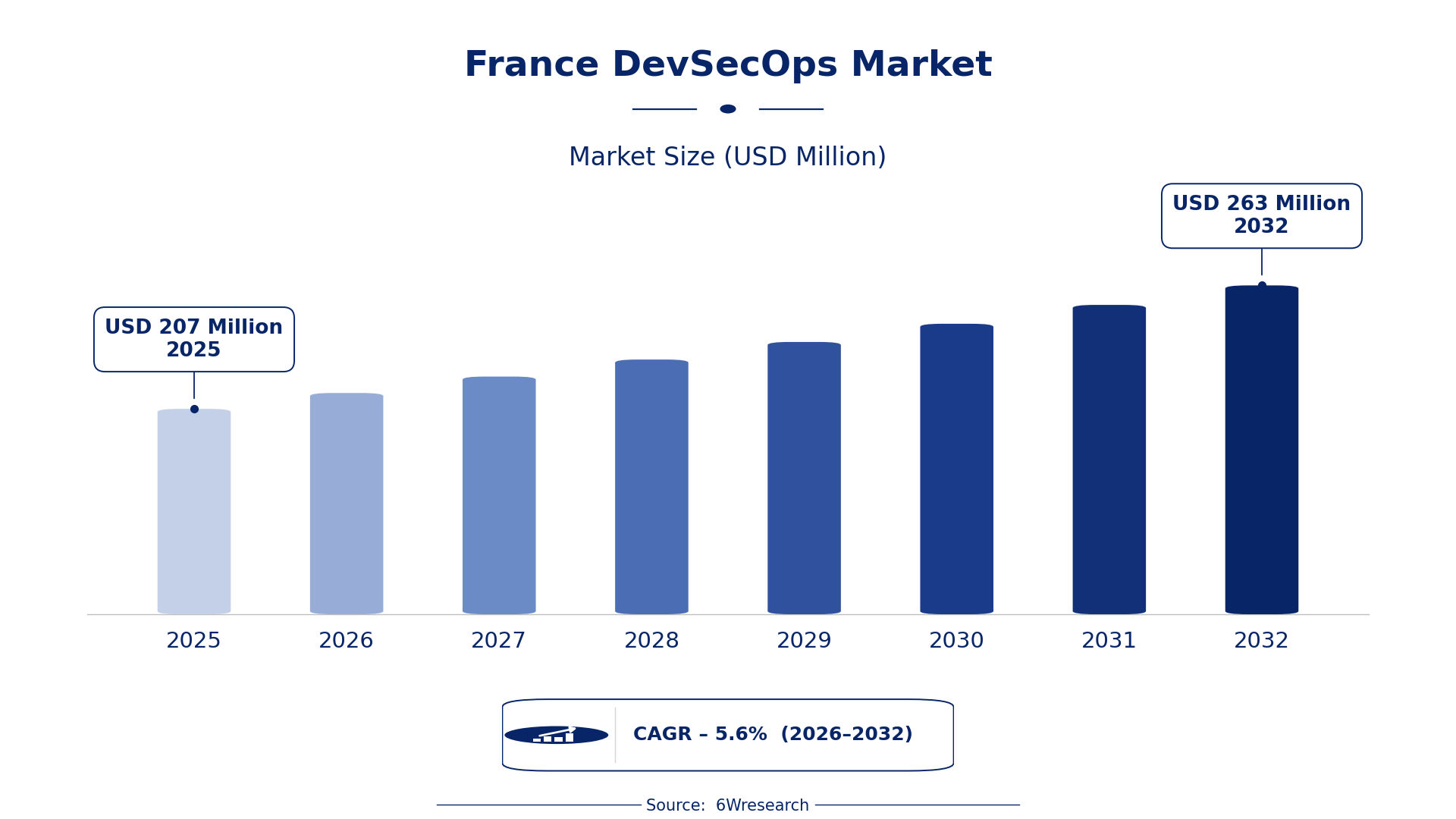
The France DevSecOps Market was estimated at USD 207 Million in 2025 and is projected to reach USD 263 Million by 2032, growing at a CAGR of 5.6% from 2026 to 2032.
France DevSecOps Market Synopsis
In France, the demand for DevSecOps is increasingly driven by the urgent need for organizations to integrate security into their software development processes. As cyber threats escalate, businesses recognize that embedding security throughout the development lifecycle is not just a compliance issue but a necessity for operational resilience.
The French DevSecOps market is experiencing a shift towards collaborative practices that unite development and security teams. This cultural transformation is critical, as it fosters a proactive approach to risk management and compliance, ensuring that security measures are not an afterthought but an integral part of the software development process.
France DevSecOps Market Year-wise Growth Rate and Key Drivers
This graph illustrates the annual growth rates of the France DevSecOps Market from 2021 to 2032, highlighting a steady upward trajectory and projected expansion over the forecast period.
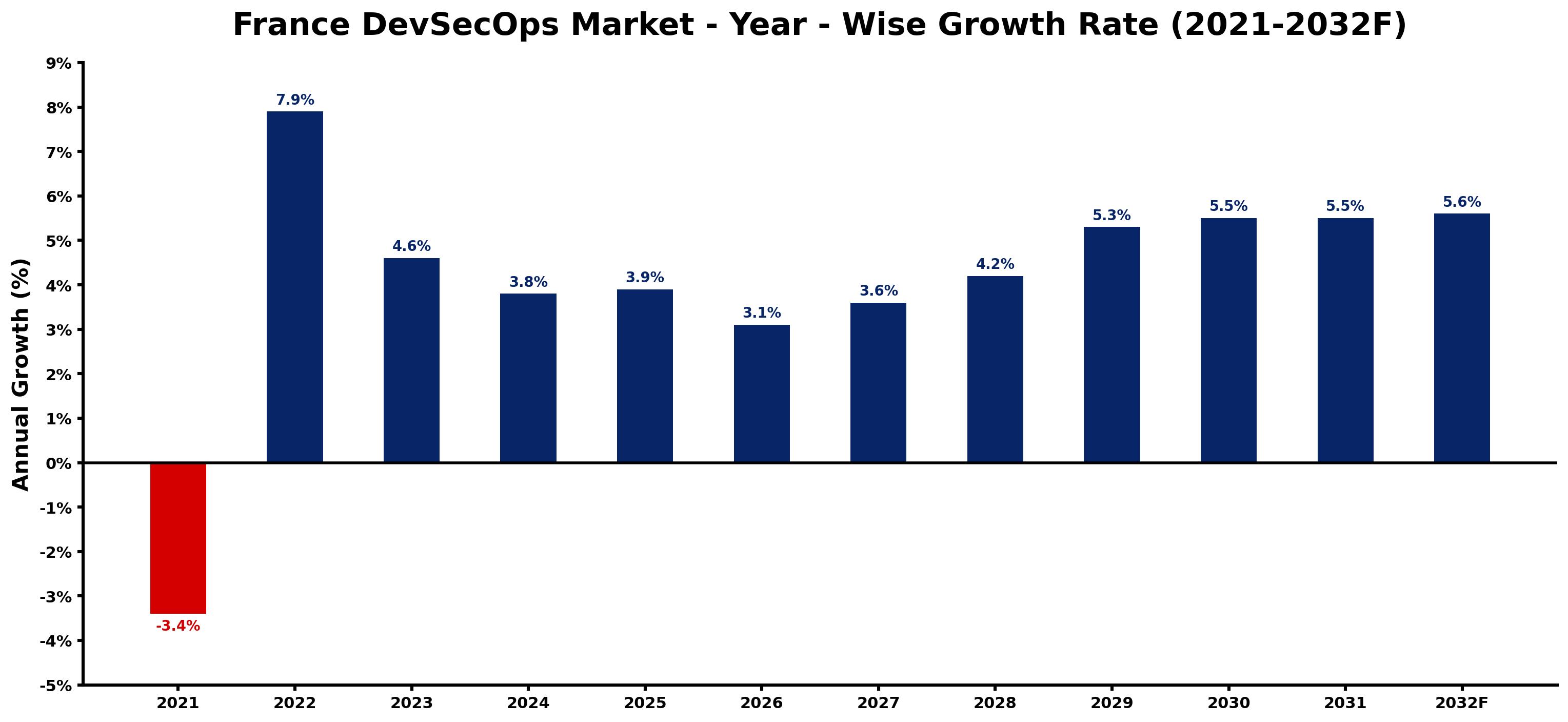
The table below presents the year‑wise growth rates along with the key drivers influencing the market
| Year | Growth Rate | Major Drivers |
| 2021 | -3.4% | French cybersecurity regulations delayed DevSecOps implementation timelines |
| 2022 | 7.9% | Increased adoption of GDPR compliance solutions in France |
| 2023 | 4.6% | Growing local need for cybersecurity in public sectors |
| 2024 | 3.8% | Investment in Cloud-Native applications by French enterprises |
| 2025 | 3.9% | Support from ANSSI for secure software development practices |
| 2026 | 3.1% | Rise in remote work increasing DevSecOps tool demand |
| 2027 | 3.6% | Emergence of French startups focusing on cybersecurity innovations |
| 2028 | 4.2% | Government initiatives promoting secure digital transformation strategies |
| 2029 | 5.3% | Demand for agile methodologies in France's tech ecosystem |
| 2030 | 5.5% | Increased focus on automated security testing in fintech |
| 2031 | 5.5% | Growth of collaborative platforms integrating cybersecurity solutions |
| 2032 | 5.6% | French regulations boosting adoption of DevSecOps practices |
Note: Market size estimations and growth projections presented in this report are based on 6Wresearch's proprietary forecasting methodology, utilizing the latest available industry data, government publications, and primary research inputs.
France DevSecOps Market Key Takeaways
Below are some of the specific key takeaways from the market, including:
- The integration of security in DevOps practices is driving growth across various sectors.
- Compliance with evolving regulations is a key factor influencing market dynamics.
- Enterprises are increasingly adopting automation tools to streamline security processes.
- Cultural resistance within organizations remains a challenge to DevSecOps adoption.
- Government initiatives are providing a supportive framework for DevSecOps implementation.
Evaluation of Restraints in France DevSecOps Market
The France DevSecOps market faces notable challenges that can hinder its growth. One significant restraint is the cultural resistance encountered within organizations. Traditional mindsets often clash with the collaborative ethos that DevSecOps promotes, making it difficult to integrate security practices effectively. Additionally, organizational silos can impede communication between development and security teams, further complicating the implementation of cohesive strategies. Skills shortages in the workforce also limit the capacity to adopt advanced security measures, leaving many companies struggling to fill critical roles necessary for successful DevSecOps practices.
France DevSecOps Market Trends
A key trend shaping the France DevSecOps market is the increasing reliance on automation and artificial intelligence to enhance security protocols. Companies are exploring automated testing and monitoring tools to identify vulnerabilities earlier in the development cycle. Another trend is the rising emphasis on compliance with data protection regulations, which is prompting firms to adopt more stringent security measures. on top of that, the push for continuous integration and continuous deployment (CI/CD) is driving the need for integrated security solutions that can keep pace with rapid development cycles.
France DevSecOps Market Opportunities
As organizations prioritize cybersecurity, the France DevSecOps market presents numerous growth opportunities. Companies that invest in training and upskilling their workforce will be better equipped to implement effective DevSecOps practices. Additionally, there is a growing market for solutions that facilitate seamless integration of security tools within existing development frameworks. Startups and established vendors that innovate in this space stand to benefit from the increasing demand for enhanced security in software development. Public-private partnerships can also play a critical role in advancing DevSecOps initiatives across industries.
Government Initiatives in the France DevSecOps Market
Government policies in France are actively promoting the adoption of DevSecOps practices as a means of bolstering national cybersecurity. Initiatives focus on enhancing collaboration between the public and private sectors to embed security within software development. This regulatory support is essential, as it encourages organizations to prioritize security in their operations and fosters a culture of compliance and risk management.
- A national cybersecurity enhancement program launched in 2023 aims to integrate security measures into the software development lifecycle across various industries.
- Ongoing initiatives are focused on creating standardized guidelines for DevSecOps practices among public sector organizations to ensure consistent security measures.
- Planned investments in digital infrastructure expected to begin in 2026 will include provisions for DevSecOps tools and training to improve security across sectors.
- The French government is currently developing a framework to promote continuous security testing in all phases of software development, set to roll out by mid-2025.
Future Insights of the France DevSecOps Market
Looking ahead to 2026-2032, the France DevSecOps market is likely to experience sustained growth driven by the necessity of robust cybersecurity measures. As organizations increasingly embrace cloud-native architectures, the need for DevSecOps practices that adapt to dynamic environments will intensify. Businesses will prioritize investments in automation, training, and collaboration tools to create a more secure development ecosystem. This will not only enhance resilience against cyber threats but also streamline operations, making DevSecOps a core component of modern software development strategies.
France DevSecOps Market Latest Developments
In the past year, activity within the France DevSecOps market has been marked by a surge in companies seeking to enhance their security frameworks. Organizations are increasingly recognizing the importance of integrating security into their development processes, leading to various strategic partnerships and technology rollouts.
- A major technology vendor launched an innovative security automation tool in late 2023, aimed at streamlining vulnerability assessments within DevSecOps pipelines.
- An initiative that began in early 2023 focused on developing a collaborative platform for developers and security teams, which is currently underway and gaining traction.
- A planned rollout of a new set of compliance guidelines for software security is expected to be introduced by the French government in 2025.
- Several organizations have initiated pilot programs integrating AI-driven security solutions into their DevSecOps practices, with evaluations ongoing since Q3 2023.
France DevSecOps Market - Key Attractiveness of the Report
- 10 Years of Market Numbers
- Historical Data Starting from 2022 to 2025
- Base Year: 2025
- Forecast Data until 2032
- Key Performance Indicators Impacting the Market
- Major Upcoming Developments and Projects
Key Highlights of the Report:
- France DevSecOps Market Outlook
- Market Size of France DevSecOps Market, 2025
- Forecast of France DevSecOps Market, 2032
- Historical Data and Forecast of France DevSecOps Revenues & Volume for the Period 2022-2032F
- France DevSecOps Market Trend Evolution
- France DevSecOps Market Drivers and Challenges
- France DevSecOps Price Trends
- France DevSecOps Porter's Five Forces
- France DevSecOps Industry Life Cycle
- Historical Data and Forecast of France DevSecOps Market Revenues & Volume By Component for the Period 2022-2032F
- Historical Data and Forecast of France DevSecOps Market Revenues & Volume By Solution for the Period 2022-2032F
- Historical Data and Forecast of France DevSecOps Market Revenues & Volume By Services for the Period 2022-2032F
- Historical Data and Forecast of France DevSecOps Market Revenues & Volume By Vertical for the Period 2022-2032F
- Historical Data and Forecast of France DevSecOps Market Revenues & Volume By BFSI for the Period 2022-2032F
- Historical Data and Forecast of France DevSecOps Market Revenues & Volume By IT for the Period 2022-2032F
- Historical Data and Forecast of France DevSecOps Market Revenues & Volume By Telecommunications for the Period 2022-2032F
- Historical Data and Forecast of France DevSecOps Market Revenues & Volume By Manufacturing for the Period 2022-2032F
- Historical Data and Forecast of France DevSecOps Market Revenues & Volume By Government for the Period 2022-2032F
- Historical Data and Forecast of France DevSecOps Market Revenues & Volume By Public Sector for the Period 2022-2032F
- Historical Data and Forecast of France DevSecOps Market Revenues & Volume By Deployment Type for the Period 2022-2032F
- Historical Data and Forecast of France DevSecOps Market Revenues & Volume By On-premises for the Period 2022-2032F
- Historical Data and Forecast of France DevSecOps Market Revenues & Volume By Cloud for the Period 2022-2032F
- Historical Data and Forecast of France DevSecOps Market Revenues & Volume By Organization Size for the Period 2022-2032F
- Historical Data and Forecast of France DevSecOps Market Revenues & Volume By SMEs for the Period 2022-2032F
- Historical Data and Forecast of France DevSecOps Market Revenues & Volume By Large Enterprises for the Period 2022-2032F
- France DevSecOps Import Export Trade Statistics
- Market Opportunity Assessment By Component
- Market Opportunity Assessment By Vertical
- Market Opportunity Assessment By Deployment Type
- Market Opportunity Assessment By Organization Size
- France DevSecOps Top Companies Market Share
- France DevSecOps Competitive Benchmarking By Technical and Operational Parameters
- France DevSecOps Company Profiles
- France DevSecOps Key Strategic Recommendations






































