France Digital Badges Market Size, Share & Growth Rate
The France Digital Badges Market was estimated at USD 96 Million in 2025 and is projected to reach USD 106 Million by 2032, growing at a CAGR of 1.4% from 2026 to 2032. This growth is fueled by an increasing emphasis on lifelong learning and the recognition of skills through digital platforms. As both educational institutions and employers seek efficient ways to validate competencies, the adoption of digital badges is becoming integral to the professional landscape in France.
France Digital Badges Market Year-wise Growth Rate and Key Drivers
This graph highlights how the France Digital Badges Market has steadily grown over the years, supported by major growth factors.
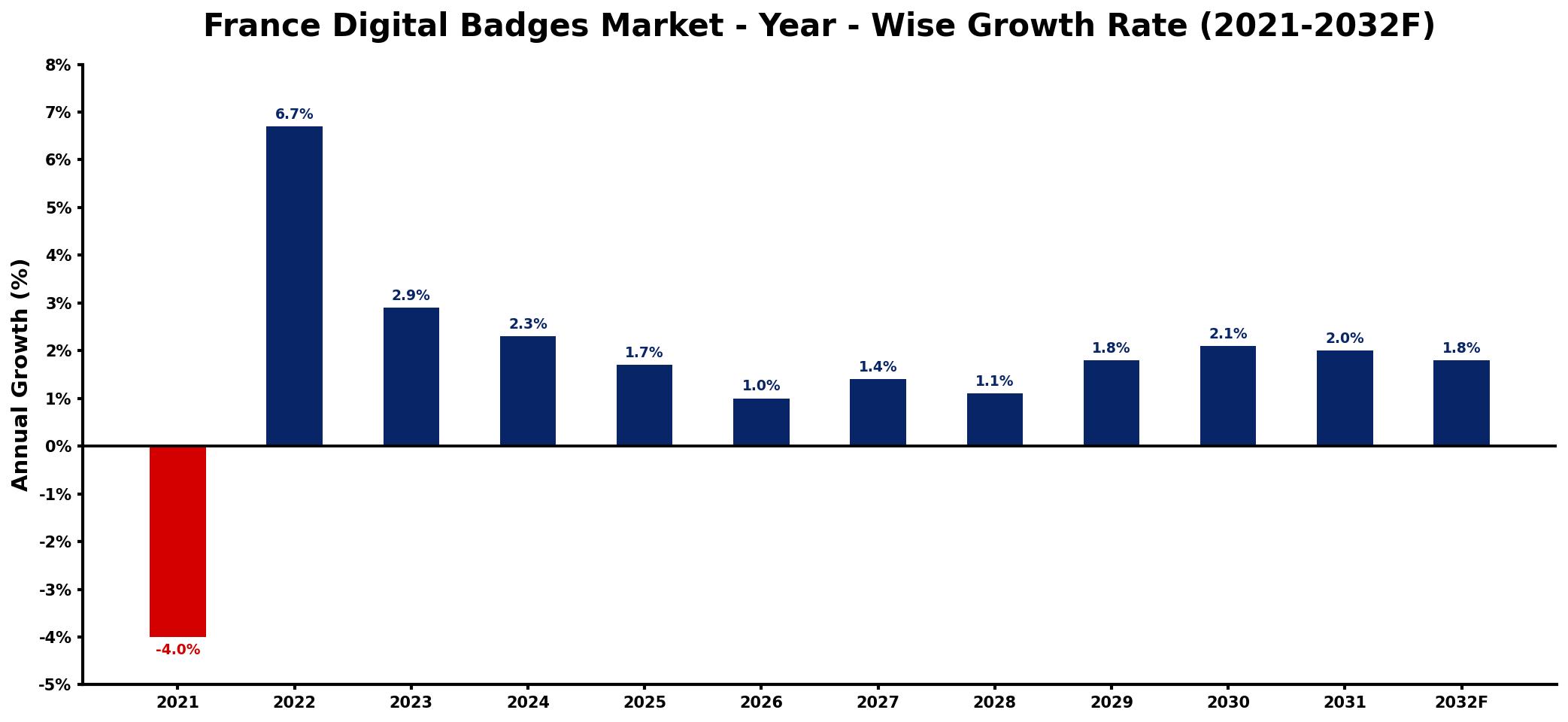
The table below presents the year‑wise growth rates along with the key drivers influencing the market
| Year | Growth Rate | Major Drivers |
| 2021 | -4.0% | decrease in educational funding |
| 2022 | 6.7% | rise in online learning platforms |
| 2023 | 2.9% | growing recognition of skills |
| 2024 | 2.3% | increased corporate training investments |
| 2025 | 1.7% | expansion of remote work initiatives |
| 2026 | 1.0% | enhanced gamification in education |
| 2027 | 1.4% | surge in youth engagement programs |
| 2028 | 1.1% | development of new certification standards |
| 2029 | 1.8% | growth in employer partnerships |
| 2030 | 2.1% | advancements in technology integration |
| 2031 | 2.0% | rising end-use demand growth |
| 2032 | 1.8% | increased focus on lifelong learning |
Note: Market size estimations and growth projections presented in this report are based on 6Wresearch's proprietary forecasting methodology, utilizing the latest available industry data, government publications, and primary research inputs.
France Digital Badges Market Synopsis
In recent years, the France Digital Badges Market has experienced significant momentum, driven by the rising demand for transparent and verifiable credentials. This shift underscores a transformation from traditional qualifications to more flexible, skill-based representations of achievements. Looking ahead, the market is poised to continue evolving, aligning with workforce mobility and the growing importance of continuous professional development.
The future trajectory of the market indicates a consolidation of digital credentialing systems as standardization efforts gain traction. Stakeholders, including educational entities and employers, are increasingly recognizing the value of digital badges in enhancing employability and career advancement. As the demand for skilled professionals grows, digital badges will likely become central to talent development initiatives across various sectors.
France Digital Badges Market Key Takeaways
- The market is experiencing steady growth driven by the recognition of skills through digital means.
- Digital badges are increasingly used for showcasing competencies acquired through diverse training and education programs.
- Standardization and interoperability remain critical challenges facing market expansion.
- Government policies are fostering a conducive environment for the adoption of digital credentials.
- Continuous professional development initiatives are creating new opportunities for digital badge implementation.
Evaluation of Restraints in France Digital Badges Market
Despite the potential for growth in the France Digital Badges Market, several restraints are limiting its progress. A significant hurdle is the lack of standardized frameworks that ensure the credibility and recognition of digital credentials across varying educational institutions and industries. Many stakeholders grapple with issues regarding the portability of digital badges, as employers and educational bodies strive to implement systems that accurately reflect individuals' achievements and competencies. Additionally, the challenge of securing buy-in from all relevant stakeholders continues to impact the broader acceptance of digital badge initiatives.
France Digital Badges Market Trends
A few key trends are shaping the France Digital Badges Market. The integration of advanced technologies, such as blockchain, is enhancing the security and traceability of digital credentials, fostering greater trust among employers and educational institutions. Furthermore, a growing awareness among learners about the benefits of digital badges is propelling their demand as a means to enhance personal branding and professional visibility. Additionally, partnerships between educational institutions and industry leaders are becoming more commonplace, facilitating tailored badge programs that meet specific labor market needs.
France Digital Badges Market Opportunities
Opportunities for growth within the France Digital Badges Market lie primarily in expanding partnerships between educational institutions and employers. By developing customized badge systems that reflect industry-specific competencies, these collaborations can enhance the relevance and value of digital badges. Additionally, initiatives aimed at promoting digital literacy and recognizing informal learning experiences are poised to open new avenues for market expansion, enabling a wider array of individuals to benefit from digital credentialing.
Government Initiatives in the France Digital Badges Market
The French government is actively promoting the recognition of digital badges as part of its broader commitment to lifelong learning and workforce development. Initiatives focus on aligning credentialing programs with labor market demands, thereby enhancing the employability of graduates and retraining workers. By providing support for skills recognition and digital credentialing, government policies are paving the way for a more integrated approach to talent development in the country.
Future Insights of the France Digital Badges Market
Looking toward the period from 2026 to 2032, the France Digital Badges Market is likely to witness a profound transformation driven by evolving workforce needs and technological advancements. As organizations increasingly seek to validate and showcase skills, digital badges will become more embedded within education and training programs. The emphasis on personalization and recognition of diverse learning pathways will continue to shape the market, fostering a culture of continuous professional development that is accessible to all.
France Digital Badges Market Latest Developments (2025 - 2026)
Recent developments within the France Digital Badges Market have focused on enhancing the interoperability and recognition of digital credentials across sectors. Industry discussions are increasingly centered around creating standardized frameworks to bolster trust in digital badges. Moreover, stakeholders are exploring innovative approaches to integrate digital badges into existing educational and professional development systems, thereby promoting wider adoption and acceptance.
France Digital Badges Market - Key Attractiveness of the Report
- 10 Years of Market Numbers
- Historical Data Starting from 2022 to 2025
- Base Year: 2025
- Forecast Data until 2032
- Key Performance Indicators Impacting the Market
- Major Upcoming Developments and Projects
Key Highlights of the Report:
- France Digital Badges Market Outlook
- Market Size of France Digital Badges Market, 2025
- Forecast of France Digital Badges Market, 2032
- Historical Data and Forecast of France Digital Badges Revenues & Volume for the Period 2022-2032F
- France Digital Badges Market Trend Evolution
- France Digital Badges Market Drivers and Challenges
- France Digital Badges Price Trends
- France Digital Badges Porter's Five Forces
- France Digital Badges Industry Life Cycle
- Historical Data and Forecast of France Digital Badges Market Revenues & Volume By Offering for the Period 2022-2032F
- Historical Data and Forecast of France Digital Badges Market Revenues & Volume By Platform for the Period 2022-2032F
- Historical Data and Forecast of France Digital Badges Market Revenues & Volume By Services for the Period 2022-2032F
- Historical Data and Forecast of France Digital Badges Market Revenues & Volume By End-User for the Period 2022-2032F
- Historical Data and Forecast of France Digital Badges Market Revenues & Volume By Academic for the Period 2022-2032F
- Historical Data and Forecast of France Digital Badges Market Revenues & Volume By Corporate for the Period 2022-2032F
- France Digital Badges Import Export Trade Statistics
- Market Opportunity Assessment By Offering
- Market Opportunity Assessment By End-User
- France Digital Badges Top Companies Market Share
- France Digital Badges Competitive Benchmarking By Technical and Operational Parameters
- France Digital Badges Company Profiles
- France Digital Badges Key Strategic Recommendations






































