France Dill Seed Oil Market Size, Share & Growth Rate
The France Dill Seed Oil Market was estimated at USD 115 Million in 2025 and is projected to reach USD 128 Million by 2032, growing at a CAGR of 1.5% from 2026 to 2032. This growth trajectory is primarily fueled by increasing consumer demand for natural and organic ingredients, particularly in the food and cosmetic sectors. The rising awareness of health benefits associated with dill seed oil, along with its versatile applications in culinary and personal care products, further bolsters market expansion.
France Dill Seed Oil Market Year-wise Growth Rate and Key Drivers
This graph highlights how the France Dill Seed Oil Market has steadily grown over the years, supported by major growth factors.
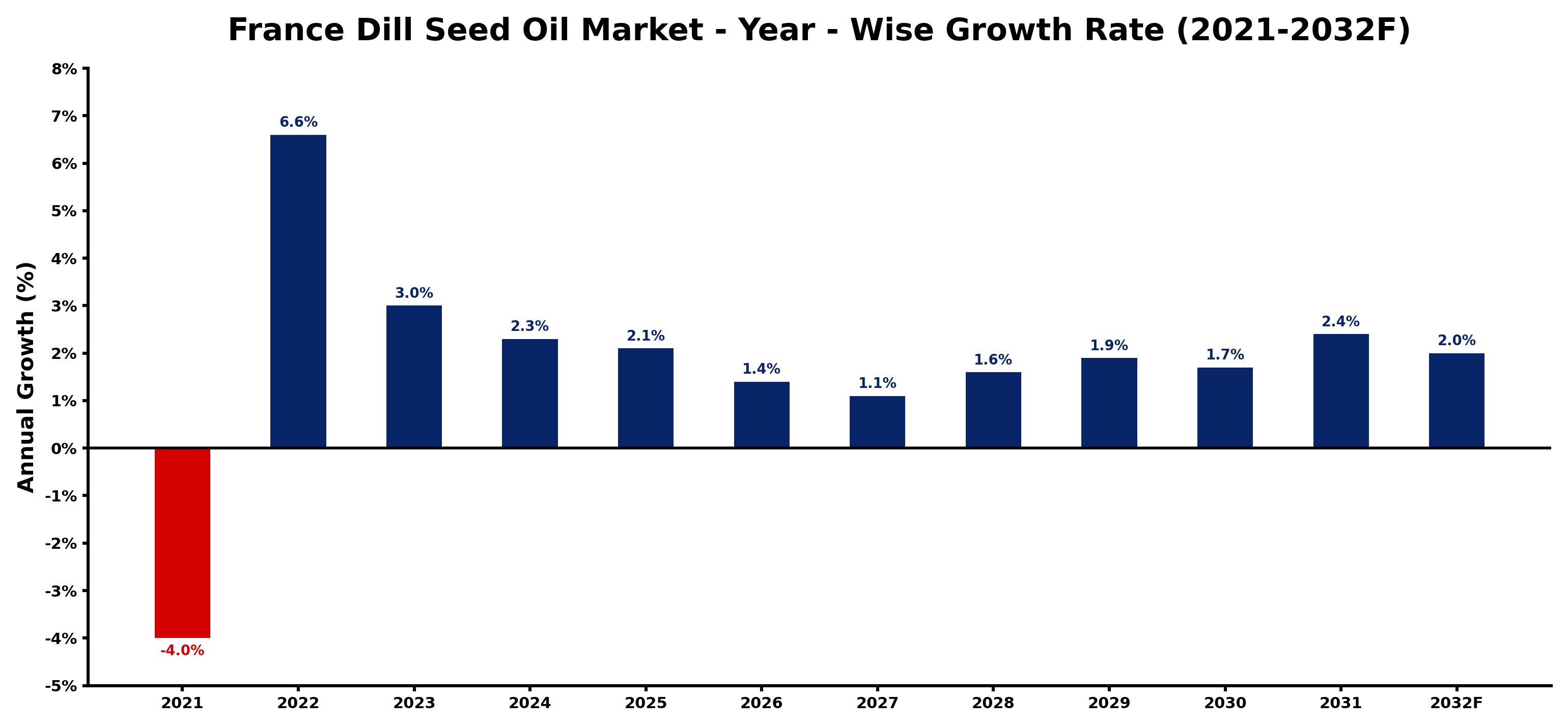
The table below presents the year‑wise growth rates along with the key drivers influencing the market
| Year | Growth Rate | Major Drivers |
| 2021 | -4.0% | Expansion of manufacturing activities |
| 2022 | 6.6% | Expansion of transportation and logistics networks |
| 2023 | 3.0% | Growing renewable energy integration projects |
| 2024 | 2.3% | Expansion of manufacturing activities |
| 2025 | 2.1% | Growing urbanization and commercial development |
| 2026 | 1.4% | Increasing industrial automation investments |
| 2027 | 1.1% | Rising electricity demand across industries |
| 2028 | 1.6% | Expansion of transportation and logistics networks |
| 2029 | 1.9% | Increasing adoption of advanced technologies |
| 2030 | 1.7% | Expansion of transportation and logistics networks |
| 2031 | 2.4% | Growing urbanization and commercial development |
| 2032 | 2.0% | Rising electricity demand across industries |
Note - Market size estimations and growth projections presented in this report are based on 6Wresearch's advanced forecasting approach, validated with industry datasets as of June 2026.
France Dill Seed Oil Market Synopsis
The French dill seed oil market is characterized by a notable increase in its application within aromatherapy and traditional medicine sectors, reflecting a broader consumer shift towards holistic health approaches. Dill seed oil is recognized for its anti-inflammatory and digestive properties, making it an attractive ingredient for both food and wellness products.
In the food industry, dill seed oil is being integrated into a range of products, from seasonings to dressings, enhancing flavor while appealing to health-conscious consumers. The cosmetics sector, too, has begun to embrace this oil for its skin-nourishing qualities, thus contributing to the market's robust growth.
France Dill Seed Oil Market Key Takeaways
- The increasing preference for natural and organic products is driving market growth.
- Dill seed oil's diverse applications span food, cosmetics, and wellness sectors.
- Sustainable production practices are becoming crucial for consumer acceptance.
- Regulatory frameworks surrounding aromatic plants provide a structured market environment.
- Health benefits and innovative product formulations present ongoing opportunities for expansion.
Evaluation of Restraints in France Dill Seed Oil Market
While the France Dill Seed Oil Market is positioned for growth, it faces several notable restraints. Fluctuating environmental conditions can adversely impact dill seed production, leading to potential supply shortages and increased price volatility. Additionally, competition from other essential oils and herbal remedies could challenge the market presence of dill seed oil. As consumer preferences shift towards alternative oils with distinct health benefits, the market must navigate these dynamics carefully. Regulatory complexities within the essential oil industry may also hinder smooth production and distribution processes, necessitating strategic compliance efforts.
France Dill Seed Oil Market Trends
Current trends indicate a significant pivot toward organic and ethically sourced products within the France Dill Seed Oil Market. As consumers become more knowledgeable about health and wellness, there is a growing preference for ingredients that align with sustainability and eco-friendliness. Additionally, the integration of dill seed oil in personal care and cosmetic formulations is on the rise, as manufacturers increasingly highlight its skin-enhancing properties. Aromatherapy practices are also gaining traction, leveraging the oil's therapeutic potential.
France Dill Seed Oil Market Opportunities
The France Dill Seed Oil Market presents several lucrative investment opportunities, particularly in the realms of production and distribution. With the steady ascent of natural and organic product demand, investors can benefit by establishing production facilities or forging partnerships with existing manufacturers. Furthermore, the potential for exporting dill seed oil to markets where interest is burgeoning can enhance revenue streams. Capitalizing on the trend towards sustainability by investing in eco-friendly production methods also stands to attract a growing segment of consumers.
Government Initiatives in the France Dill Seed Oil Market
While specific government policies targeting the dill seed oil market are limited, the broader regulatory framework governing aromatic plant cultivation and processing plays a significant role. These regulations ensure product safety and quality, which is crucial for maintaining consumer trust. Additionally, the French government promotes sustainable agricultural practices through various programs, providing subsidies and incentives that benefit dill seed oil producers and encourage environmentally conscious farming methods.
Future Insights of the France Dill Seed Oil Market
Looking ahead to 2026-2032, the France Dill Seed Oil Market is set to flourish as health and wellness trends continue to shape consumer behavior. The sustained interest in natural ingredients across various industries, coupled with the expanding utilization of dill seed oil in alternative medicine and aromatherapy, reinforces its market potential. As product innovation and sustainable sourcing remain key priorities for manufacturers, the market is likely to witness dynamic growth fueled by evolving consumer preferences and increasing awareness of the benefits associated with dill seed oil.
France Dill Seed Oil Market Latest Developments (May 2025 - June 2026)
In recent months, there has been a noticeable uptick in initiatives focused on the sustainable sourcing of dill seed oil in France. Manufacturers are increasingly adopting eco-friendly practices, responding to consumer demand for transparency in ingredient sourcing. Additionally, collaborations between industry stakeholders aim to enhance quality control processes, ensuring that products meet stringent safety standards. The cosmetic sector is also seeing a rise in dill seed oil-based formulations as brands highlight its skin benefits, indicative of a growing market trend towards natural ingredients.
France Dill Seed Oil Market - Key Attractiveness of the Report
- 10 Years of Market Numbers
- Historical Data Starting from 2022 to 2025
- Base Year: 2025
- Forecast Data until 2032
- Key Performance Indicators Impacting the Market
- Major Upcoming Developments and Projects
Key Highlights of the Report:
- France Dill Seed Oil Market Outlook
- Market Size of France Dill Seed Oil Market, 2025
- Forecast of France Dill Seed Oil Market, 2032
- Historical Data and Forecast of France Dill Seed Oil Revenues & Volume for the Period 2022-2032F
- France Dill Seed Oil Market Trend Evolution
- France Dill Seed Oil Market Drivers and Challenges
- France Dill Seed Oil Price Trends
- France Dill Seed Oil Porter's Five Forces
- France Dill Seed Oil Industry Life Cycle
- Historical Data and Forecast of France Dill Seed Oil Market Revenues & Volume By Type for the Period 2022-2032F
- Historical Data and Forecast of France Dill Seed Oil Market Revenues & Volume By Anethum Graveolens Seed Oil for the Period 2022-2032F
- Historical Data and Forecast of France Dill Seed Oil Market Revenues & Volume By Anethum Sowa Seed Oil for the Period 2022-2032F
- Historical Data and Forecast of France Dill Seed Oil Market Revenues & Volume By Application for the Period 2022-2032F
- Historical Data and Forecast of France Dill Seed Oil Market Revenues & Volume By Flavor for the Period 2022-2032F
- Historical Data and Forecast of France Dill Seed Oil Market Revenues & Volume By Fragrance for the Period 2022-2032F
- Historical Data and Forecast of France Dill Seed Oil Market Revenues & Volume By Pharmaceutical for the Period 2022-2032F
- Historical Data and Forecast of France Dill Seed Oil Market Revenues & Volume By Skincare for the Period 2022-2032F
- Historical Data and Forecast of France Dill Seed Oil Market Revenues & Volume By Aromatherapy for the Period 2022-2032F
- France Dill Seed Oil Import Export Trade Statistics
- Market Opportunity Assessment By Type
- Market Opportunity Assessment By Application
- France Dill Seed Oil Top Companies Market Share
- France Dill Seed Oil Competitive Benchmarking By Technical and Operational Parameters
- France Dill Seed Oil Company Profiles
- France Dill Seed Oil Key Strategic Recommendations






































