France Facility Management Market Size & Growth Rate (2026-2032)
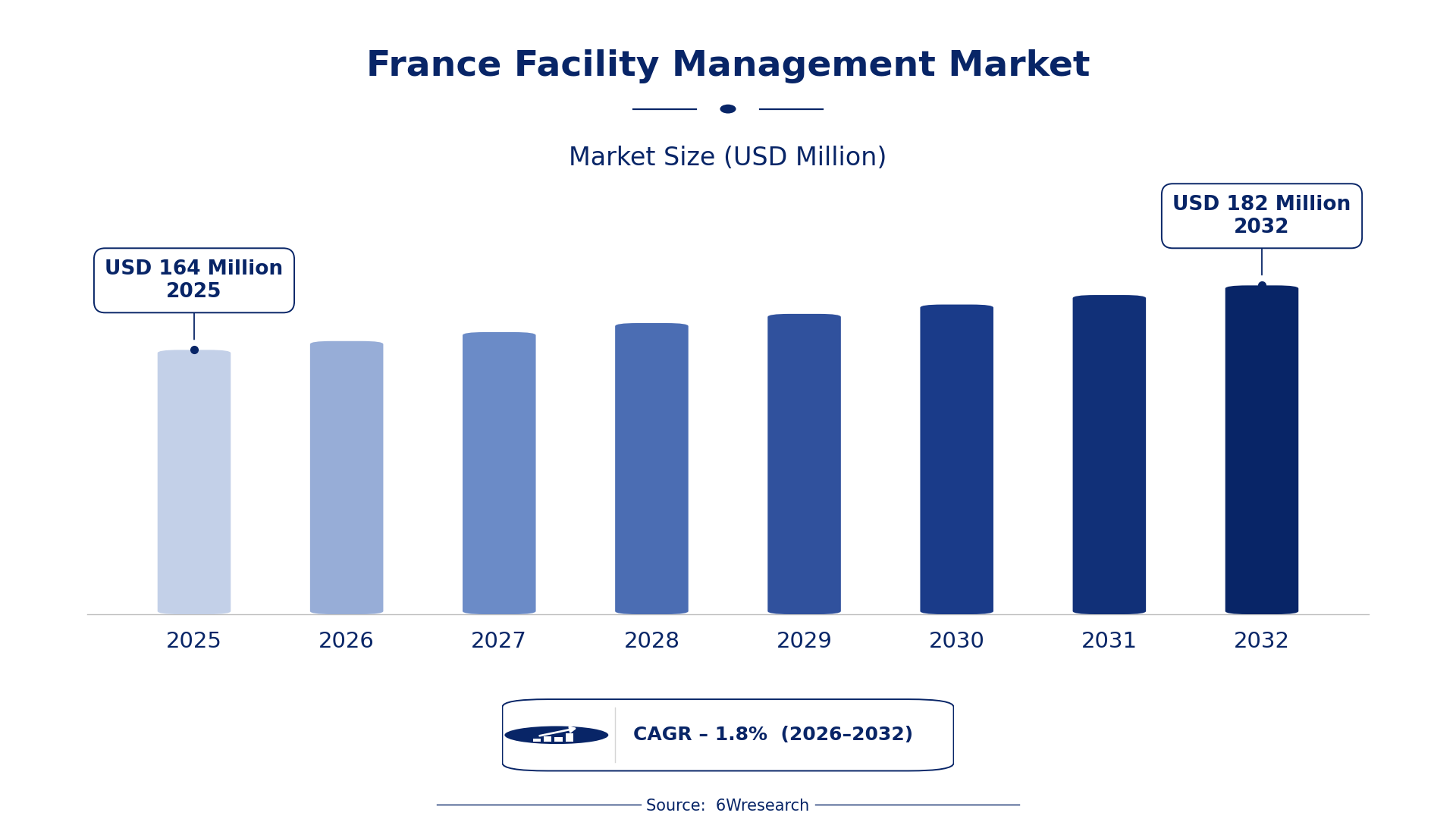
The France Facility Management Market was estimated at USD 164 Million in 2025 and is projected to reach USD 182 Million by 2032, growing at a CAGR of 1.8% from 2026 to 2032.
France Facility Management Market Synopsis
The driving force behind the France Facility Management Market is the increasing trend of outsourcing non-core functions to specialized service providers. This shift is reshaping how businesses manage their operational needs, pushing them to focus on their core competencies while relying on expert partners for facility management services.
As companies prioritize cost efficiency and sustainability, demand for comprehensive facility management services is on the rise. This trend reflects a growing recognition of the value these services provide in optimizing resources and enhancing workplace environments, positioning facility management as a critical component of modern business strategy.
France Facility Management Market Year-wise Growth Rate and Key Drivers
This graph illustrates the annual growth rates of the France Facility Management Market from 2021 to 2032, highlighting a steady upward trajectory and projected expansion over the forecast period.
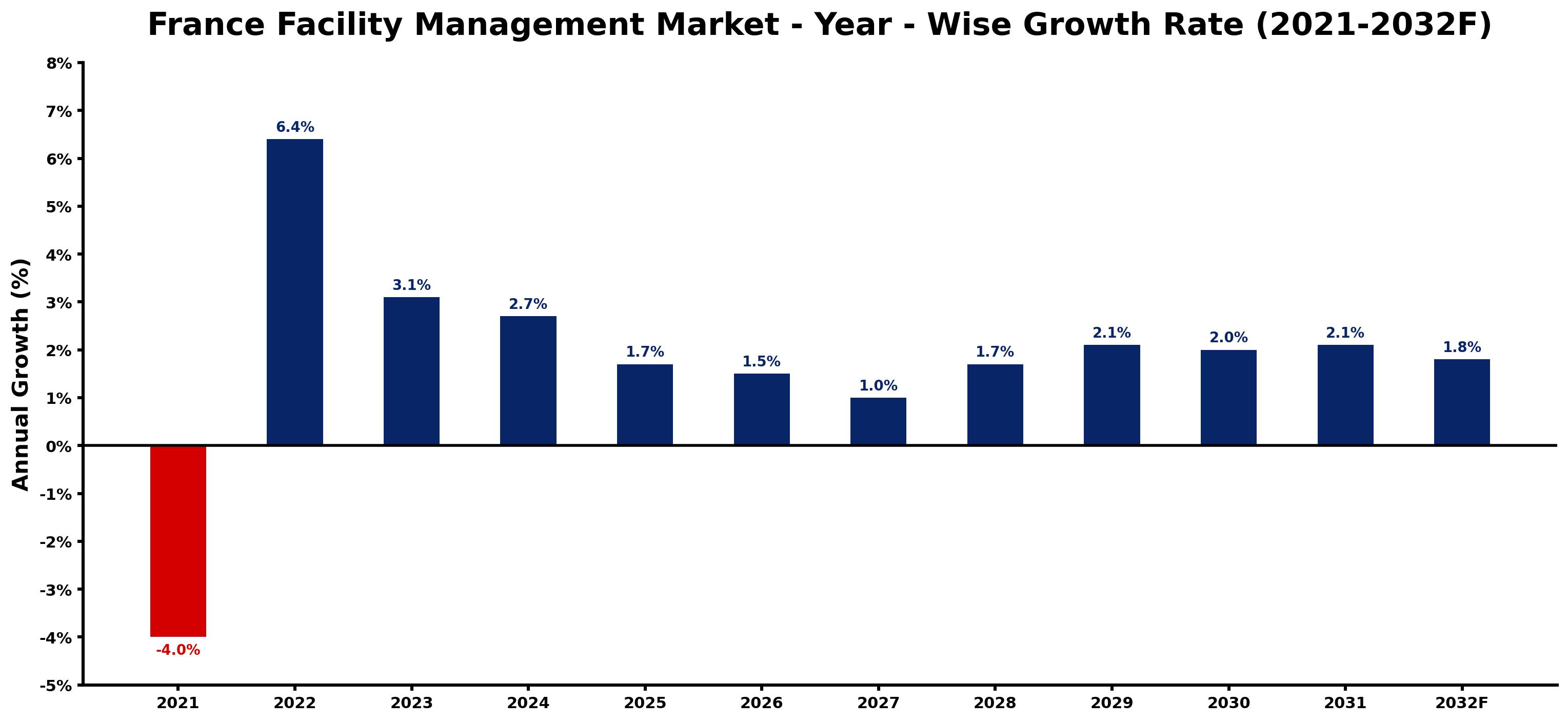
The table below presents the year‑wise growth rates along with the key drivers influencing the market
| Year | Growth Rate | Major Drivers |
| 2021 | -4.0% | COVID-19 health restrictions limited facility access. |
| 2022 | 6.4% | Increased demand for workplace safety compliance regulations. |
| 2023 | 3.1% | Government incentives for energy-efficient building retrofits. |
| 2024 | 2.7% | Growing trend of outsourced facility services in SMEs. |
| 2025 | 1.7% | Rising focus on sustainability certifications in construction. |
| 2026 | 1.5% | Continued growth in remote work facility management solutions. |
| 2027 | 1.0% | Urban population shifts driving new facility service needs. |
| 2028 | 1.7% | Implementation of digital facility management technologies expands. |
| 2029 | 2.1% | Post-pandemic workplace redesigns necessitating specialized services. |
| 2030 | 2.0% | Strengthened regulatory focus on health and safety standards. |
| 2031 | 2.1% | Increased adoption of smart building technologies in facilities. |
| 2032 | 1.8% | Enhanced facility management training programs boost service quality. |
Note: Market size estimations and growth projections presented in this report are based on 6Wresearch's proprietary forecasting methodology, utilizing the latest available industry data, government publications, and primary research inputs.
France Facility Management Market Key Takeaways
Below are some of the specific key takeaways from the market, including:
- Strong growth driven by the outsourcing of non-core business functions.
- Increased emphasis on sustainability and energy efficiency in facility operations.
- Technological advancements, particularly in smart building integration and IoT.
- A competitive landscape with both domestic and international service providers.
- Expansion of facility management services into sectors like healthcare and education.
Evaluation of Restraints in France Facility Management Market
Despite its growth, the France Facility Management Market faces several challenges. Intense competition among service providers is pushing down margins, forcing companies to continuously innovate while managing costs. Additionally, evolving regulatory requirements related to sustainability and energy efficiency necessitate constant adaptation, placing pressure on firms to stay compliant. The need for a skilled workforce further complicates this scenario, as attracting and retaining talent becomes crucial for maintaining service quality and operational excellence.
France Facility Management Market Trends
Several trends are shaping the France Facility Management Market. The adoption of smart technologies is at the forefront, with businesses integrating IoT and data analytics to enhance operational efficiency. Sustainability is no longer just a buzzword; it has become a primary focus as organizations strive to reduce their environmental impact. The outsourcing of facility management is gaining traction across various sectors, enabling specialized providers to offer tailored solutions that meet the unique demands of different industries.
France Facility Management Market Opportunities
Opportunities abound in the France Facility Management Market, particularly for companies that can offer integrated solutions. As businesses seek to improve cost efficiency and workplace satisfaction, there is a growing appetite for services that combine multiple functions—from maintenance to energy management. on top of that, the push for compliance with stringent regulations presents a chance for providers to showcase their expertise and align their services with clients' sustainability goals.
Government Initiatives in the France Facility Management Market
Government policy plays a critical role in shaping the France Facility Management Market. With a focus on quality service and compliance, the French government enforces various regulations that impact facility management practices. These policies not only address labor rights and environmental standards but also incentivize sustainable practices, setting the stage for a more responsible industry.
- A recently completed initiative aimed at enhancing compliance with the Public Procurement Code, streamlining the process for contracting facility management services in the public sector.
- A current program promoting energy efficiency standards, requiring facility management companies to adopt eco-friendly practices and technologies.
- A planned public-private partnership expected to bolster infrastructure development for sustainable facilities by 2028.
- Ongoing efforts to update labor regulations within the facility management sector, ensuring worker rights and safety are prioritized.
Future Insights of the France Facility Management Market
Looking ahead to 2026-2032, the France Facility Management Market is set to expand as businesses increasingly recognize the value of integrated solutions. The convergence of smart technologies with traditional facility management practices will likely drive innovation, improving service delivery and operational efficiency. As firms prioritize employee experience and sustainability, the market will continue to evolve, presenting ample opportunities for growth and differentiation.
France Facility Management Market Latest Developments
In the past year, the France Facility Management Market has witnessed notable developments reflecting the industry's shift toward innovation and sustainability. Companies are actively seeking to enhance their service offerings to meet the changing demands of clients, particularly in the realms of technology and environmental responsibility.
- A major technology vendor launched a new data analytics platform in early 2025, enabling facility managers to optimize energy usage and maintenance schedules.
- An initiative aimed at integrating smart building technologies began in mid-2025 and remains underway, with several commercial properties currently undergoing upgrades.
- A leading regional operator announced plans for a service expansion targeting the healthcare sector, expected to begin by mid-2026.
- In Q3 2025, a partnership was formed between facility management firms to develop a training program focused on attracting skilled labor to the industry.
France Facility Management Market - Key Attractiveness of the Report
- 10 Years of Market Numbers
- Historical Data Starting from 2022 to 2025
- Base Year: 2025
- Forecast Data until 2032
- Key Performance Indicators Impacting the Market
- Major Upcoming Developments and Projects
Key Highlights of the Report:
- France Facility Management Market Outlook
- Market Size of France Facility Management Market, 2025
- Forecast of France Facility Management Market, 2032
- Historical Data and Forecast of France Facility Management Revenues & Volume for the Period 2022-2032F
- France Facility Management Market Trend Evolution
- France Facility Management Market Drivers and Challenges
- France Facility Management Price Trends
- France Facility Management Porter's Five Forces
- France Facility Management Industry Life Cycle
- Historical Data and Forecast of France Facility Management Market Revenues & Volume By Component for the Period 2022-2032F
- Historical Data and Forecast of France Facility Management Market Revenues & Volume By Solutions for the Period 2022-2032F
- Historical Data and Forecast of France Facility Management Market Revenues & Volume By Services for the Period 2022-2032F
- Historical Data and Forecast of France Facility Management Market Revenues & Volume By Deployment Mode for the Period 2022-2032F
- Historical Data and Forecast of France Facility Management Market Revenues & Volume By Cloud for the Period 2022-2032F
- Historical Data and Forecast of France Facility Management Market Revenues & Volume By On-premises for the Period 2022-2032F
- Historical Data and Forecast of France Facility Management Market Revenues & Volume By Organization Size for the Period 2022-2032F
- Historical Data and Forecast of France Facility Management Market Revenues & Volume By Large enterprises for the Period 2022-2032F
- Historical Data and Forecast of France Facility Management Market Revenues & Volume By Small and medium-sized enterprises (SMEs) for the Period 2022-2032F
- Historical Data and Forecast of France Facility Management Market Revenues & Volume By Vertical for the Period 2022-2032F
- Historical Data and Forecast of France Facility Management Market Revenues & Volume By BFSI for the Period 2022-2032F
- Historical Data and Forecast of France Facility Management Market Revenues & Volume By IT and Telecom for the Period 2022-2032F
- Historical Data and Forecast of France Facility Management Market Revenues & Volume By Government and Public Administration for the Period 2022-2032F
- Historical Data and Forecast of France Facility Management Market Revenues & Volume By Healthcare for the Period 2022-2032F
- Historical Data and Forecast of France Facility Management Market Revenues & Volume By Education for the Period 2022-2032F
- Historical Data and Forecast of France Facility Management Market Revenues & Volume By Retail for the Period 2022-2032F
- Historical Data and Forecast of France Facility Management Market Revenues & Volume By Energy and Utilities for the Period 2022-2032F
- Historical Data and Forecast of France Facility Management Market Revenues & Volume By Manufacturing for the Period 2022-2032F
- France Facility Management Import Export Trade Statistics
- Market Opportunity Assessment By Component
- Market Opportunity Assessment By Deployment Mode
- Market Opportunity Assessment By Organization Size
- Market Opportunity Assessment By Vertical
- France Facility Management Top Companies Market Share
- France Facility Management Competitive Benchmarking By Technical and Operational Parameters
- France Facility Management Company Profiles
- France Facility Management Key Strategic Recommendations






































