France Fencing Market Size, Share & Growth Rate
The France Fencing Market was estimated at USD 133 Million in 2025 and is projected to reach USD 148 Million by 2032, growing at a CAGR of 1.5% from 2026 to 2032. This growth trajectory is predominantly driven by increasing urbanization and a heightened focus on home security and privacy. Additionally, the surge in home improvement projects is further propelling demand for a diverse array of fencing solutions.
France Fencing Market Year-wise Growth Rate and Key Drivers
This graph highlights how the France Fencing Market has steadily grown over the years, supported by major growth factors.
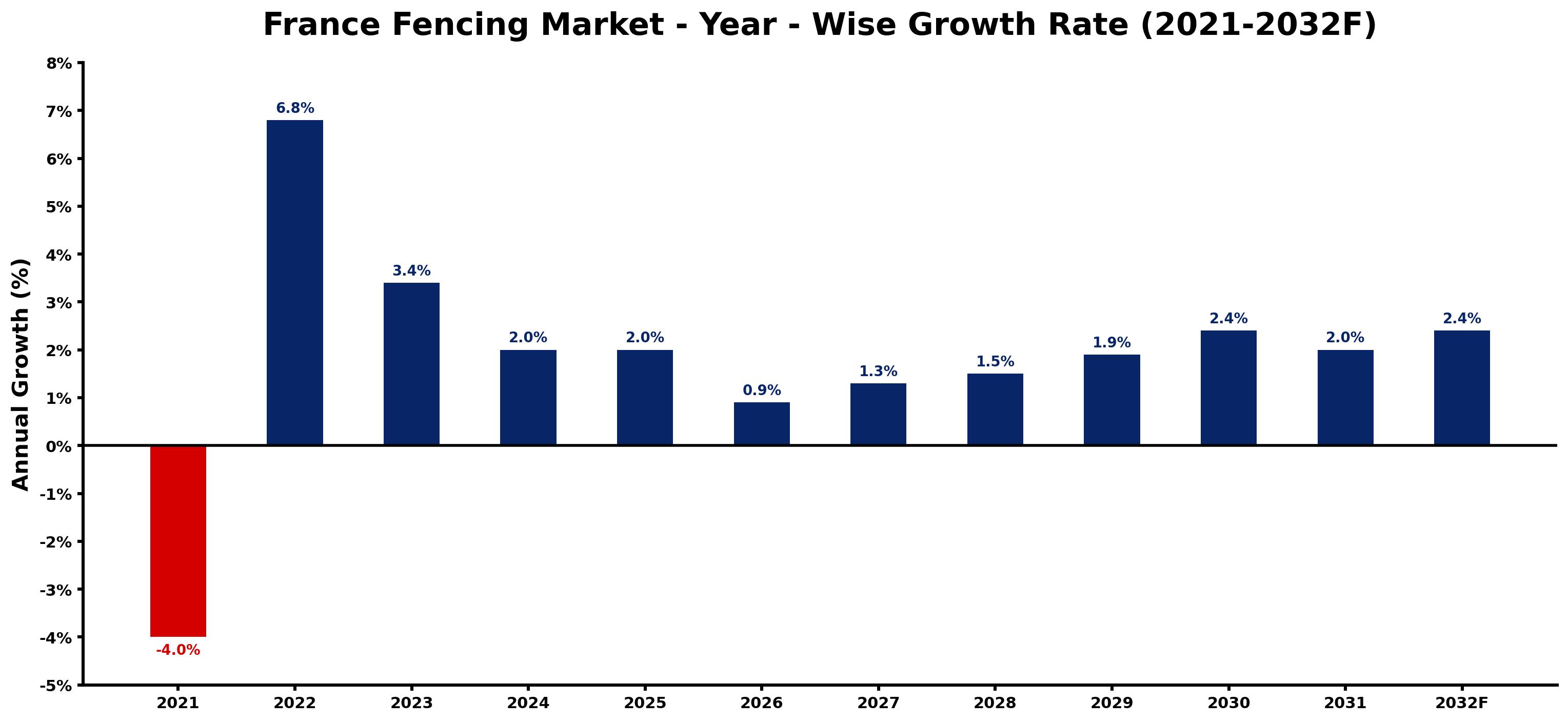
The table below presents the year‑wise growth rates along with the key drivers influencing the market
| Year | Growth Rate | Major Drivers |
| 2021 | -4.0% | Increasing smart city development projects |
| 2022 | 6.8% | Rising electricity demand across industries |
| 2023 | 3.4% | Increasing adoption of advanced technologies |
| 2024 | 2.0% | Increasing adoption of advanced technologies |
| 2025 | 2.0% | Increasing adoption of advanced technologies |
| 2026 | 0.9% | Rising electricity demand across industries |
| 2027 | 1.3% | Increasing smart city development projects |
| 2028 | 1.5% | Growing urbanization and commercial development |
| 2029 | 1.9% | Increasing smart city development projects |
| 2030 | 2.4% | Growing urbanization and commercial development |
| 2031 | 2.0% | Increasing industrial infrastructure investments |
| 2032 | 2.4% | Expansion of transportation and logistics networks |
Note - Market size estimations and growth projections presented in this report are based on 6Wresearch’s advanced forecasting approach, validated with industry datasets as of June 2026.
France Fencing Market Synopsis
In France, the demand for fencing products is surging as homeowners increasingly prioritize aesthetics alongside security. There is also a marked trend towards utilizing eco-friendly materials, as consumers gravitate towards sustainable options like bamboo and composite fencing, reflecting a broader commitment to environmental responsibility.
Supply-side dynamics reveal that manufacturers are innovating in design and material technology, thereby enhancing the durability and visual appeal of fencing solutions. The introduction of smart fencing options, integrating remote access and monitoring capabilities, is also emerging as a significant factor in the market.
France Fencing Market Key Takeaways
- The market is anticipated to grow steadily due to rising urbanization and home security concerns.
- Eco-friendly materials are becoming increasingly popular, catering to a more environmentally conscious consumer base.
- Smart fencing solutions are on the rise, combining technology with traditional fencing needs.
- DIY fencing kits are appealing to cost-conscious homeowners looking for customizable options.
- Government regulations ensure quality and safety in fencing materials and installation practices.
Evaluation of Restraints in France Fencing Market
Despite the positive growth outlook, the France fencing market faces certain restraints. Competition from low-cost imports can undermine local manufacturers, compelling them to balance quality with competitive pricing. Additionally, fluctuating raw material costs create unpredictability in pricing strategies. Economic uncertainties may shift consumer preferences toward alternative security solutions, posing a challenge to traditional fencing offerings.
France Fencing Market Trends
Several trends are shaping the France fencing market, notably the increasing preference for high-quality materials like wrought iron and aluminum. These materials are favored for their durability and aesthetic appeal, aligning with consumer desires for long-lasting investments in home improvement. Furthermore, the rise of smart technologies in fencing, such as integration with home security systems, reflects a growing demand for innovations that enhance safety and convenience.
France Fencing Market Opportunities
The France fencing market presents ample investment opportunities, particularly in urban development and infrastructure projects. Companies focusing on innovative and sustainable fencing technologies, such as smart systems and eco-friendly materials, stand to gain significantly. Additionally, as security concerns escalate, there is a burgeoning need for high-security fencing solutions in public and commercial spaces, creating niches for specialized offerings.
Government Initiatives in the France Fencing Market
Government regulations play a crucial role in shaping the France fencing market, ensuring compliance with safety and quality standards. Building permits may be required for certain fencing installations, with local authorities enforcing regulations that govern material usage and installation practices. These guidelines are designed to protect both consumers and the public, promoting uniformity and safety in fencing solutions across residential and commercial properties.
Future Insights of the France Fencing Market
Looking ahead to 2026-2032, the France fencing market is poised for continued expansion. Growth will likely be fueled by ongoing urbanization and a sustained demand for secure and aesthetically pleasing outdoor spaces. The rising trend of home improvement projects and innovative materials will further enhance market dynamics, providing a fertile ground for companies to introduce novel products and differentiate themselves in a competitive landscape.
France Fencing Market Latest Developments (May 2025 - June 2026)
Recent developments in the France fencing market include a notable uptick in the introduction of smart fencing solutions, integrating advanced security features. Additionally, companies are increasingly adopting sustainable practices, reflecting a shift towards environmentally responsible manufacturing processes. Furthermore, collaboration with construction firms for large-scale urban projects is becoming more prevalent, aligning with ongoing infrastructure development efforts across the country.
France Fencing Market - Key Attractiveness of the Report
- 10 Years of Market Numbers
- Historical Data Starting from 2022 to 2025
- Base Year: 2025
- Forecast Data until 2032
- Key Performance Indicators Impacting the Market
- Major Upcoming Developments and Projects
Key Highlights of the Report:
- France Fencing Market Outlook
- Market Size of France Fencing Market, 2025
- Forecast of France Fencing Market, 2032
- Historical Data and Forecast of France Fencing Revenues & Volume for the Period 2022-2032F
- France Fencing Market Trend Evolution
- France Fencing Market Drivers and Challenges
- France Fencing Price Trends
- France Fencing Porter's Five Forces
- France Fencing Industry Life Cycle
- Historical Data and Forecast of France Fencing Market Revenues & Volume By Material for the Period 2022-2032F
- Historical Data and Forecast of France Fencing Market Revenues & Volume By Metal for the Period 2022-2032F
- Historical Data and Forecast of France Fencing Market Revenues & Volume By Wood for the Period 2022-2032F
- Historical Data and Forecast of France Fencing Market Revenues & Volume By Plastic & Composite for the Period 2022-2032F
- Historical Data and Forecast of France Fencing Market Revenues & Volume By Concrete for the Period 2022-2032F
- Historical Data and Forecast of France Fencing Market Revenues & Volume By Distribution Channel for the Period 2022-2032F
- Historical Data and Forecast of France Fencing Market Revenues & Volume By Online for the Period 2022-2032F
- Historical Data and Forecast of France Fencing Market Revenues & Volume By Retail for the Period 2022-2032F
- Historical Data and Forecast of France Fencing Market Revenues & Volume By Installation for the Period 2022-2032F
- Historical Data and Forecast of France Fencing Market Revenues & Volume By Do-It-Yourself for the Period 2022-2032F
- Historical Data and Forecast of France Fencing Market Revenues & Volume By Contractor for the Period 2022-2032F
- Historical Data and Forecast of France Fencing Market Revenues & Volume By Application for the Period 2022-2032F
- Historical Data and Forecast of France Fencing Market Revenues & Volume By Residential for the Period 2022-2032F
- Historical Data and Forecast of France Fencing Market Revenues & Volume By Agricultural for the Period 2022-2032F
- Historical Data and Forecast of France Fencing Market Revenues & Volume By Industrial for the Period 2022-2032F
- Historical Data and Forecast of France Fencing Market Revenues & Volume By End-users for the Period 2022-2032F
- Historical Data and Forecast of France Fencing Market Revenues & Volume By Government for the Period 2022-2032F
- Historical Data and Forecast of France Fencing Market Revenues & Volume By Petroleum & Chemicals for the Period 2022-2032F
- Historical Data and Forecast of France Fencing Market Revenues & Volume By Military & Defense for the Period 2022-2032F
- Historical Data and Forecast of France Fencing Market Revenues & Volume By Mining for the Period 2022-2032F
- Historical Data and Forecast of France Fencing Market Revenues & Volume By Energy & Power for the Period 2022-2032F
- Historical Data and Forecast of France Fencing Market Revenues & Volume By Transport for the Period 2022-2032F
- Historical Data and Forecast of France Fencing Market Revenues & Volume By Others for the Period 2022-2032F
- France Fencing Import Export Trade Statistics
- Market Opportunity Assessment By Material
- Market Opportunity Assessment By Distribution Channel
- Market Opportunity Assessment By Installation
- Market Opportunity Assessment By Application
- Market Opportunity Assessment By End-users
- France Fencing Top Companies Market Share
- France Fencing Competitive Benchmarking By Technical and Operational Parameters
- France Fencing Company Profiles
- France Fencing Key Strategic Recommendations






































