France Ferrochrome Market Size (2020-2030)
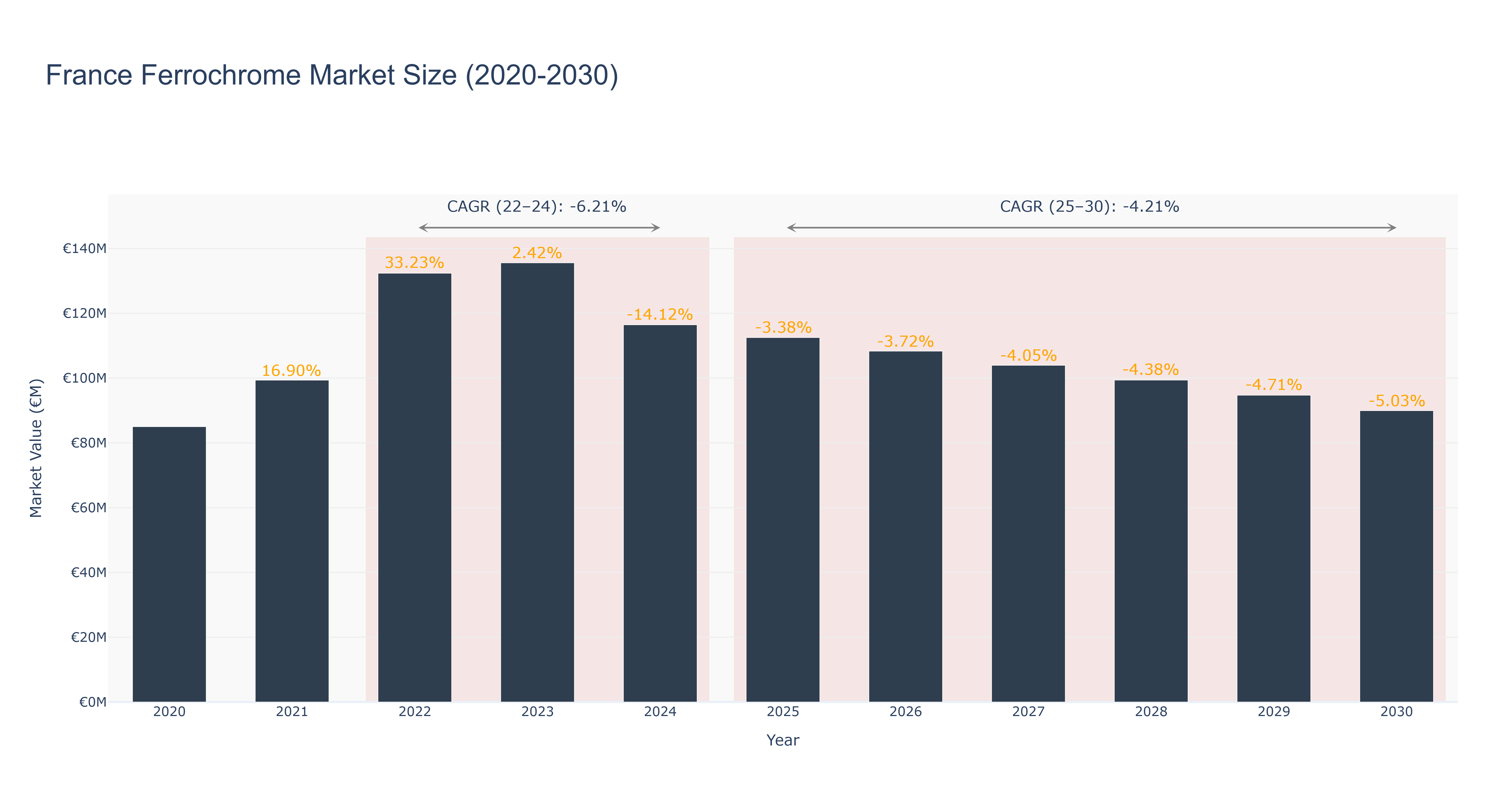
The France Ferrochrome Market experienced significant growth in the early 2020s, peaking in 2022 with a market size of €132.38 million, reflecting a remarkable growth rate of 33.23% compared to the previous year. However, this momentum has slowed considerably, with the market size declining to €116.44 million in 2024, resulting in a negative CAGR of -6.21% for the period from 2022 to 2024. Looking ahead to the forecasted period from 2025 to 2030, the market is expected to continue its downward trajectory, with projected sizes decreasing from €112.50 million in 2025 to €89.94 million by 2030, indicative of a CAGR of -4.21%. This decline can be attributed to several factors, including fluctuating demand from the stainless steel industry, environmental regulations, and potential supply chain disruptions. As the market navigates these challenges, macroeconomic drivers and potential technological advancements will be crucial in shaping its future trajectory.
France Ferrochrome Market: Production & Trade Performance (2019-2025)
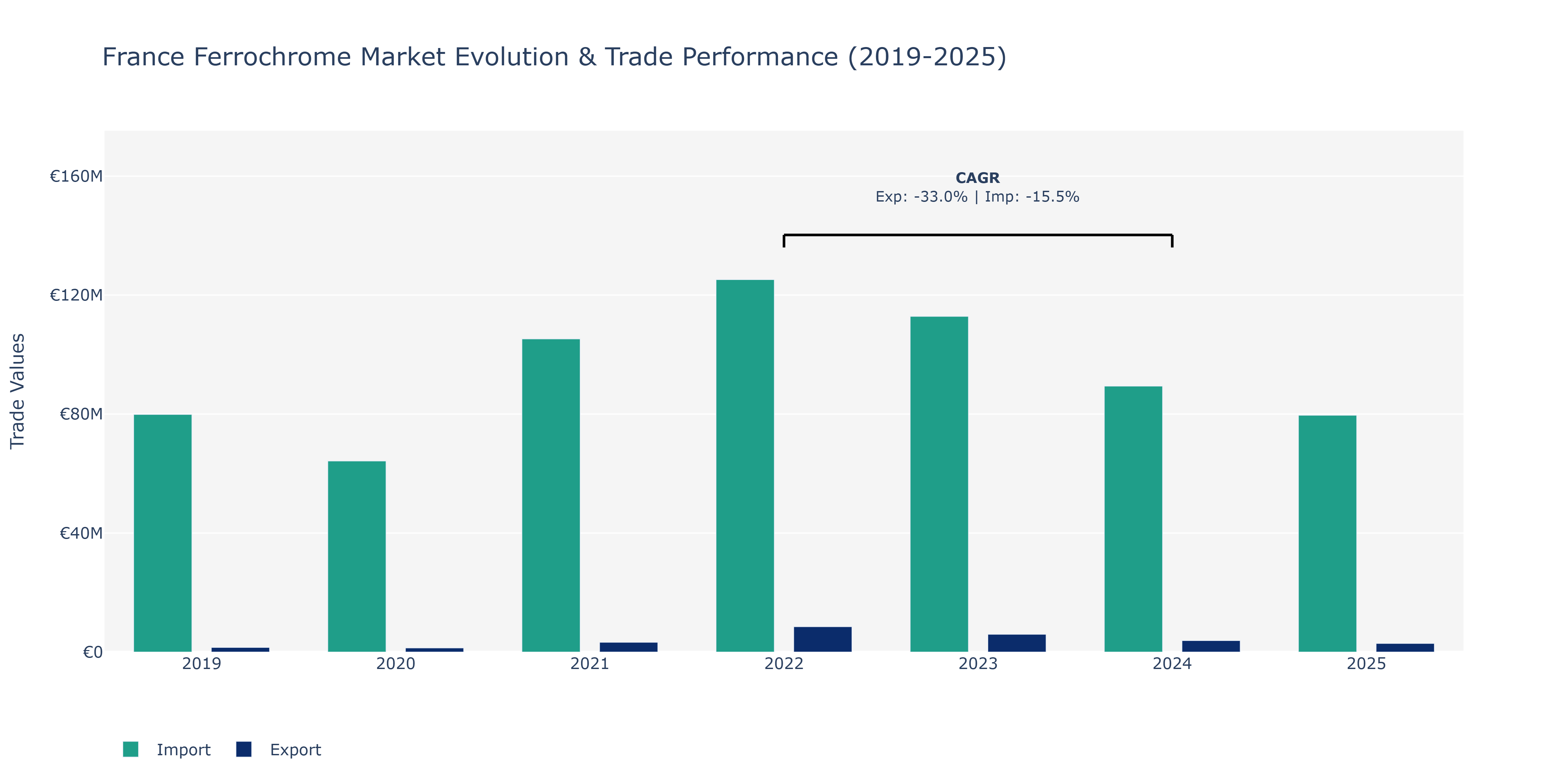
The France Ferrochrome Market witnessed varying trends in Exports and Imports from 2019 to 2025. In 2019, Exports stood at €1.52 million, while Imports were significantly higher at €79.87 million. The year 2021 marked a notable increase in both Exports, reaching €3.27 million, and Imports, reaching €105.26 million. However, in 2024, Exports declined to €3.83 million, and Imports decreased to €89.39 million. Notably, the peak point for Exports was in 2022 at €8.52 million, while Imports peaked in 2022 at €125.2 million. The subsequent decrease in Exports and Imports could be attributed to global economic fluctuations impacting demand and supply dynamics in the ferrochrome market. Factors like changes in trade policies, currency fluctuations, and shifts in industrial production could have influenced these trends. To maintain market competitiveness, stakeholders may consider diversifying export destinations and optimizing import strategies to navigate future uncertainties in the market.
France Ferrochrome Market Overview
The France Ferrochrome market is characterized by steady growth due to the country`s strong focus on industrial development and the presence of key players in the ferrochrome industry. The market is driven by increasing demand from the stainless steel sector, as ferrochrome is a crucial element in stainless steel production. France`s emphasis on sustainability and environmental regulations has also led to a growing interest in ferrochrome production processes that are more eco-friendly. Additionally, technological advancements and innovations in ferrochrome production are contributing to the market`s expansion. With the ongoing shift towards cleaner energy sources and the increasing adoption of electric vehicles, the demand for ferrochrome is expected to further rise, making France a key player in the global ferrochrome market.
France Ferrochrome Market Trends
The France Ferrochrome Market is experiencing a growing demand due to the expanding stainless steel industry and increased infrastructure projects. Environmental concerns and regulations are pushing companies to adopt cleaner production methods, leading to a shift towards more sustainable practices in ferrochrome production. Additionally, technological advancements and innovations in the industry are driving efficiency improvements and cost reductions. The market is also witnessing a focus on sourcing raw materials ethically and responsibly, with a growing emphasis on transparency in the supply chain. Overall, the France Ferrochrome Market is poised for steady growth as companies adapt to changing market dynamics and consumer preferences.
France Ferrochrome Market Challenges
In the France Ferrochrome market, one of the key challenges faced is the volatility of raw material prices, particularly for chrome ore and electricity. Fluctuations in these costs can significantly impact the production costs and profitability of ferrochrome manufacturers. Additionally, environmental regulations and sustainability concerns pose challenges for the industry as stricter emissions standards require investments in cleaner production technologies, which can increase operational expenses. Furthermore, competition from other global ferrochrome producers, especially from countries with lower production costs, can put pressure on French companies to remain competitive. Adapting to market trends and consumer preferences, such as the increasing demand for high carbon ferrochrome for stainless steel production, also presents a challenge for companies in the France Ferrochrome market.
France Ferrochrome Market Investment Opportunities
The France Ferrochrome Market presents promising investment opportunities due to the growing demand for ferrochrome in various industries such as stainless steel production, automotive manufacturing, and aerospace. With France being a major player in the European steel industry, investments in ferrochrome production facilities or companies involved in its supply chain can be lucrative. Additionally, the push towards sustainability and the increasing focus on clean energy technologies are driving the demand for ferrochrome in the production of renewable energy components like wind turbines. Investing in innovative technologies for eco-friendly ferrochrome production processes could also be a strategic move in this market. Overall, the France Ferrochrome Market offers potential for investors looking to capitalize on the country`s industrial growth and the evolving global trends in steel and clean energy industries.
France Ferrochrome Market Government Policy
In France, government policies related to the Ferrochrome Market focus on promoting sustainability and environmental protection. The French government has implemented regulations to reduce carbon emissions and encourage the use of cleaner energy sources in the production of ferrochrome. Additionally, there are stringent guidelines in place to ensure that companies operating in the ferrochrome industry comply with environmental standards and minimize their impact on the environment. The government also supports research and development initiatives aimed at improving the efficiency and sustainability of ferrochrome production processes. Overall, the regulatory framework in France aims to balance economic growth in the ferrochrome market with environmental considerations, promoting a more sustainable and responsible industry.
France Ferrochrome Market Future Outlook
The future outlook for the France Ferrochrome Market appears positive, driven by factors such as increasing demand from the stainless steel industry, growth in infrastructure projects, and technological advancements in the ferrochrome production process. The market is expected to witness steady growth as France aims to reduce its reliance on imported ferrochrome by boosting domestic production. Additionally, government initiatives promoting sustainable practices and reducing carbon emissions are likely to influence market dynamics, leading to a shift towards eco-friendly ferrochrome production methods. Overall, the France Ferrochrome Market is poised for expansion, offering opportunities for companies to invest in research and development to innovate and meet the evolving needs of the industry.
Key Highlights of the Report:
- France Ferrochrome Market Outlook
- Market Size of France Ferrochrome Market, 2021
- Forecast of France Ferrochrome Market, 2027
- Historical Data and Forecast of France Ferrochrome Revenues & Volume for the Period 2018 - 2027
- France Ferrochrome Market Trend Evolution
- France Ferrochrome Market Drivers and Challenges
- France Ferrochrome Price Trends
- France Ferrochrome Porter's Five Forces
- France Ferrochrome Industry Life Cycle
- Historical Data and Forecast of France Ferrochrome Market Revenues & Volume By Type for the Period 2018 - 2027
- Historical Data and Forecast of France Ferrochrome Market Revenues & Volume By High carbon for the Period 2018 - 2027
- Historical Data and Forecast of France Ferrochrome Market Revenues & Volume By Medium carbon for the Period 2018 - 2027
- Historical Data and Forecast of France Ferrochrome Market Revenues & Volume By Low carbon for the Period 2018 - 2027
- Historical Data and Forecast of France Ferrochrome Market Revenues & Volume By Applications for the Period 2018 - 2027
- Historical Data and Forecast of France Ferrochrome Market Revenues & Volume By Stainless steel for the Period 2018 - 2027
- Historical Data and Forecast of France Ferrochrome Market Revenues & Volume By Other steels for the Period 2018 - 2027
- France Ferrochrome Import Export Trade Statistics
- Market Opportunity Assessment By Type
- Market Opportunity Assessment By Applications
- France Ferrochrome Top Companies Market Share
- France Ferrochrome Competitive Benchmarking By Technical and Operational Parameters
- France Ferrochrome Company Profiles
- France Ferrochrome Key Strategic Recommendations






































