Venezuela Ferrochrome Market Size, Share & Growth Rate
The Venezuela Ferrochrome Market was estimated at USD 402 Million in 2025 and is projected to reach USD 553 Million by 2032, growing at a CAGR of 4.7% from 2026 to 2032. This anticipated growth trajectory is primarily driven by a resurgence in global stainless steel production, which relies heavily on ferrochrome as a crucial alloying agent. As production stabilizes, increasing investments in infrastructure and technology could further enhance operational efficiency, potentially boosting output and market competitiveness.
Venezuela Ferrochrome Market Year-wise Growth Rate and Key Drivers
This graph highlights how the Venezuela Ferrochrome Market has steadily grown over the years, supported by major growth factors.
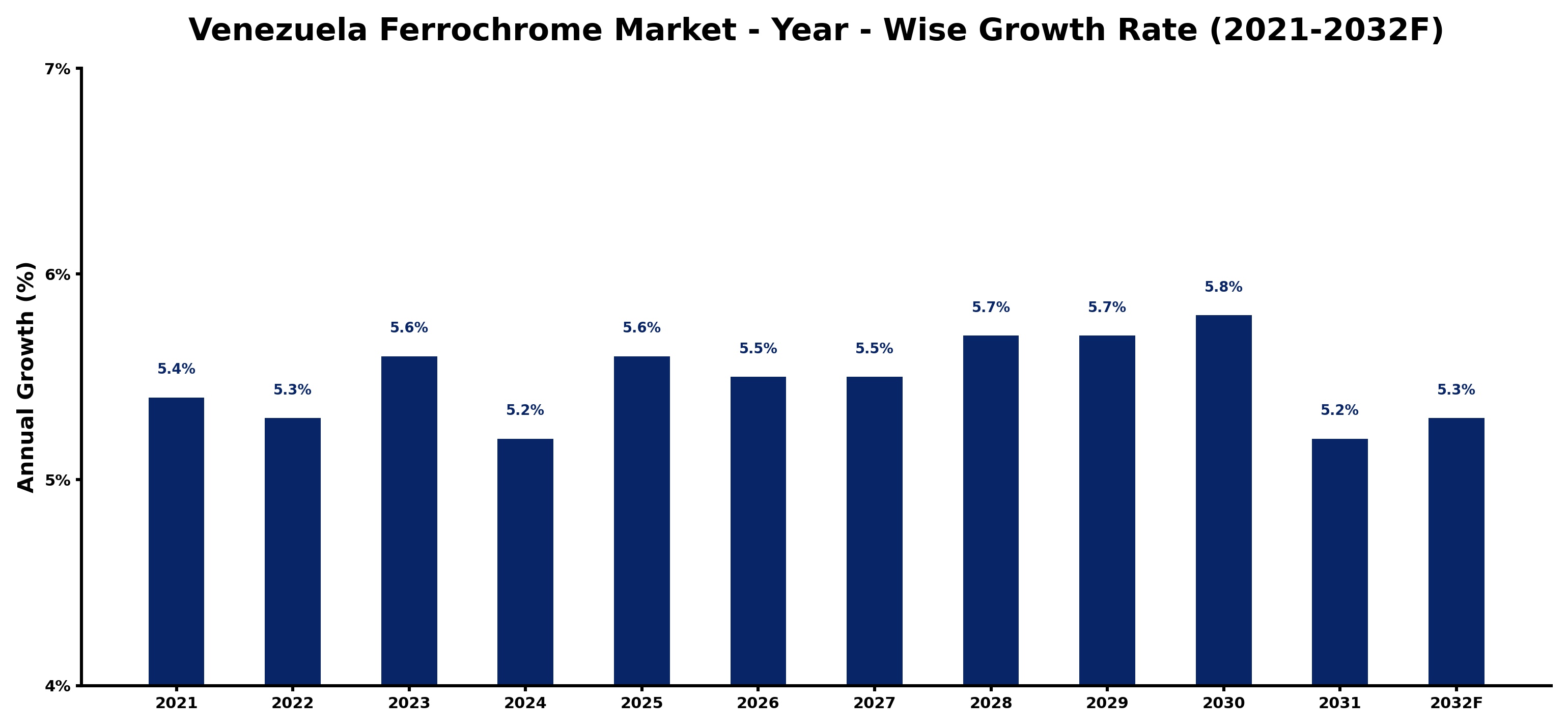
The table below presents the year‑wise growth rates along with the key drivers influencing the market
| Year | Growth Rate | Major Drivers |
| 2021 | 5.4% | Advanced smelting technologies boosted ferrochrome production efficiency in Venezuela |
| 2022 | 5.3% | Increased investments in ferrochrome smelting facilities boost production capacity |
| 2023 | 5.6% | Export driven demand for ferrochrome enhances stainless steel production capacity |
| 2024 | 5.2% | Export driven stainless steel production boosted ferrochrome procurement levels |
| 2025 | 5.6% | Updated smelting technology boosted ferrochrome output capacity and efficiency |
| 2026 | 5.5% | New smelting facilities boost ferrochrome output for export markets |
| 2027 | 5.5% | Ferrochrome smelting upgrades boost domestic stainless steel production capacity |
| 2028 | 5.7% | Improved infrastructure investments enhanced ferrochrome production efficiency and capacity |
| 2029 | 5.7% | Improved refinery capacities boosted domestic ferrochrome production output |
| 2030 | 5.8% | Improved smelting capacity boosted local ferrochrome production volumes |
| 2031 | 5.2% | Technological upgrades in furnaces improved ferrochrome production efficiency |
| 2032 | 5.3% | Ferrochrome smelting upgrades optimized energy consumption and production efficiency |
Note - Market size estimations and growth projections presented in this report are based on 6Wresearch's advanced forecasting approach, validated with industry datasets as of June 2026.
Venezuela Ferrochrome Market Synopsis
In recent years, the Venezuela Ferrochrome Market has witnessed a period marked by volatility, primarily due to the country's political and economic instability. However, emerging trends towards sustainable production methods and a global increase in stainless steel demand indicate a potential shift towards recovery and growth.
Despite ongoing challenges, Venezuela's extensive chromite reserves serve as a pivotal asset. As the market adapts to evolving global demands, players are finding innovative ways to enhance quality and sustainability, setting the stage for a dynamic future.
Venezuela Ferrochrome Market Key Takeaways
- The market is set for growth driven by increasing global demand for stainless steel.
- Venezuela's chromite reserves provide a competitive edge in the ferrochrome industry.
- Sustainability initiatives are reshaping production practices and expectations.
- Political stability and infrastructure investment will be critical to future market performance.
- Government policies aim to promote local production and safeguard domestic interests.
Evaluation of Restraints in Venezuela Ferrochrome Market
The Venezuela Ferrochrome Market faces several significant restraints, primarily stemming from persistent political turmoil and economic instability. Hyperinflation has created an unpredictable environment that complicates business operations and long-term planning. Additionally, infrastructure deficiencies, particularly in energy supply and transportation, hinder production efficiency and increase operational costs. The result is a market that struggles to attract necessary investment, which is critical for modernization and competitiveness in the global landscape.
Venezuela Ferrochrome Market Trends
Current trends in the Venezuela Ferrochrome Market are characterized by a shift towards sustainable production methodologies. As environmental concerns gain prominence globally, producers are increasingly adopting energy-efficient processes and striving to reduce carbon emissions. Furthermore, there is a notable demand for high-quality ferrochrome, reflecting the rising use of stainless steel across various industries, including automotive and construction. These trends indicate a market that is not only adapting but also evolving to meet the needs of environmentally conscious consumers.
Venezuela Ferrochrome Market Opportunities
Significant investment opportunities exist in the Venezuela Ferrochrome Market, largely due to the country's rich chromite reserves. With a global uptick in stainless steel consumption, particularly in emerging markets, there is potential for lucrative returns. Investors who can navigate the inherent political risks may find prospects in expanding production capacities or modernizing existing facilities. Moreover, the current focus on sustainability presents avenues for investment in cleaner technologies and processes.
Government Initiatives in the Venezuela Ferrochrome Market
The Venezuelan government has implemented several initiatives aimed at bolstering the ferrochrome sector. Policies focus on promoting domestic production through incentives for local producers, as well as imposing tariffs on imported ferrochrome to protect local manufacturers. Additionally, there are efforts to attract foreign investment and technology transfer, which could enhance the sector's overall competitiveness. These initiatives are part of a broader strategy to ensure sustainable development within the industry while complying with labor and environmental regulations.
Future Insights of the Venezuela Ferrochrome Market
Looking ahead to 2026-2032, the Venezuela Ferrochrome Market's trajectory is contingent on political stabilization and improvements in governance. While significant chrome ore reserves could support growth, ongoing issues like corruption and infrastructure inadequacies present barriers. If the government successfully implements reforms and attracts necessary investment, the market could experience enhanced competitiveness on a global scale. However, without addressing these challenges, sustainable growth may remain elusive.
Venezuela Ferrochrome Market Latest Developments (May 2025 - June 2026)
Recent developments in the Venezuela Ferrochrome Market indicate a cautious optimism as some producers are reporting increased output levels. Efforts to modernize facilities are being initiated, reflecting a broader commitment to enhance efficiency. Meanwhile, discussions regarding potential foreign partnerships signal a willingness to attract external investments, even amidst the prevailing political climate. As the market adapts to global trends, these movements suggest a gradual shift towards recovery.
Venezuela Ferrochrome Market - Key Attractiveness of the Report
- 10 Years of Market Numbers
- Historical Data Starting from 2022 to 2025
- Base Year: 2025
- Forecast Data until 2032
- Key Performance Indicators Impacting the Market
- Major Upcoming Developments and Projects
Key Highlights of the Report:
- Venezuela Ferrochrome Market Outlook
- Market Size of Venezuela Ferrochrome Market, 2025
- Forecast of Venezuela Ferrochrome Market, 2032
- Historical Data and Forecast of Venezuela Ferrochrome Revenues & Volume for the Period 2022-2032F
- Venezuela Ferrochrome Market Trend Evolution
- Venezuela Ferrochrome Market Drivers and Challenges
- Venezuela Ferrochrome Price Trends
- Venezuela Ferrochrome Porter's Five Forces
- Venezuela Ferrochrome Industry Life Cycle
- Historical Data and Forecast of Venezuela Ferrochrome Market Revenues & Volume By Type for the Period 2022-2032F
- Historical Data and Forecast of Venezuela Ferrochrome Market Revenues & Volume By High carbon for the Period 2022-2032F
- Historical Data and Forecast of Venezuela Ferrochrome Market Revenues & Volume By Medium carbon for the Period 2022-2032F
- Historical Data and Forecast of Venezuela Ferrochrome Market Revenues & Volume By Low carbon for the Period 2022-2032F
- Historical Data and Forecast of Venezuela Ferrochrome Market Revenues & Volume By Applications for the Period 2022-2032F
- Historical Data and Forecast of Venezuela Ferrochrome Market Revenues & Volume By Stainless steel for the Period 2022-2032F
- Historical Data and Forecast of Venezuela Ferrochrome Market Revenues & Volume By Other steels for the Period 2022-2032F
- Venezuela Ferrochrome Import Export Trade Statistics
- Market Opportunity Assessment By Type
- Market Opportunity Assessment By Applications
- Venezuela Ferrochrome Top Companies Market Share
- Venezuela Ferrochrome Competitive Benchmarking By Technical and Operational Parameters
- Venezuela Ferrochrome Company Profiles
- Venezuela Ferrochrome Key Strategic Recommendations






































