Singapore Ferrochrome Market: Import Trend Analysis
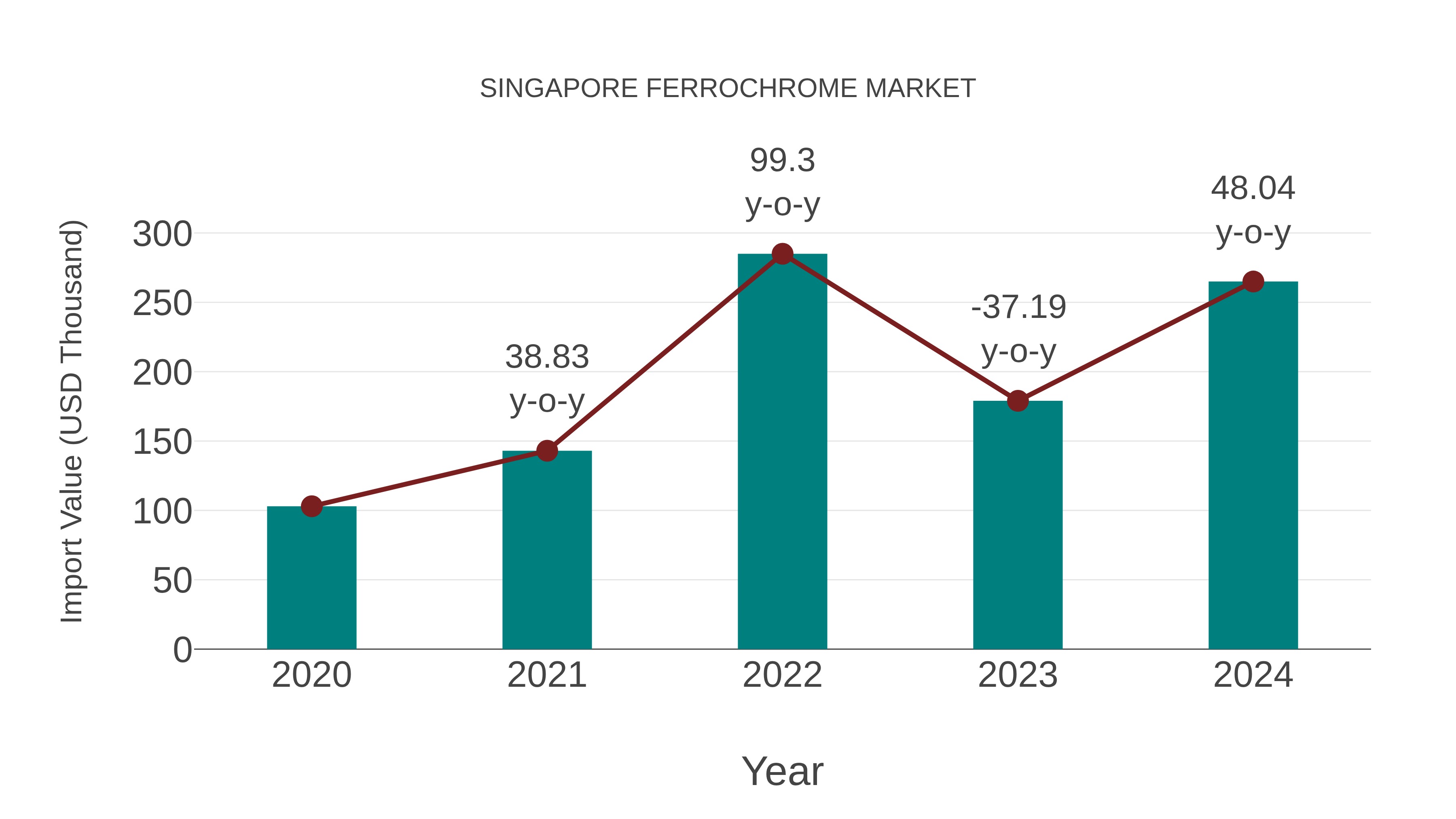
Singapore`s ferrochrome market witnessed a notable import trend from 2023 to 2024, with a growth rate of 48.04%. The compound annual growth rate (CAGR) for imports between 2020 and 2024 stood at 26.65%. This import momentum can be attributed to increasing demand from the stainless steel industry, reflecting a shift in market dynamics towards higher consumption of ferrochrome for steel production.
Ferrochrome Market: Singapore vs Top 5 Major Economies in 2027 (Asia)
In the Asia region, the Ferrochrome market in Singapore is projected to expand at a exponential growth rate of 15.56% by 2027. The largest economy is China, followed by India, Japan, Australia and South Korea.

Singapore Ferrochrome Market Synopsis
The Singapore ferrochrome market is likely to experience growth due to its applications in the stainless steel and alloy industries. Ferrochrome is a crucial alloying element used to impart corrosion resistance and durability to stainless steel. As Singapore continues to invest in infrastructure and construction projects, the demand for stainless steel in building materials is expected to rise, subsequently boosting the demand for ferrochrome. Additionally, the aerospace and automotive industries will contribute to market growth through the use of ferrochrome in alloy manufacturing. Manufacturers in this market may explore opportunities for sourcing sustainable ferrochrome and aligning with environmental regulations.
Drivers of the Market
The ferrochrome market in Singapore is closely linked to the stainless steel industry. Stainless steel, which contains ferrochrome as a key alloying element, is widely used in construction, manufacturing, and infrastructure projects. The market`s growth is influenced by Singapore construction and industrial sectors, as well as global demand for stainless steel products. As urbanization and infrastructure development continue, the demand for ferrochrome is expected to remain robust.
Challenges of the Market
The ferrochrome market in Singapore faces several hurdles. Firstly, the market is influenced by global stainless steel production trends, which can be cyclical and dependent on economic conditions. Secondly, price volatility in the chromium ore market and fluctuations in energy costs impact the cost of ferrochrome production. Additionally, environmental regulations and sustainability concerns necessitate investments in cleaner production methods. To navigate these challenges, Singapore ferrochrome industry should focus on supply chain optimization, cost control, and environmental compliance.
COVID-19 Impact on the Market
The Singapore ferrochrome market faced significant challenges during the COVID-19 pandemic. The steel and metallurgy sectors, which are major consumers of ferrochrome, experienced reduced demand due to disruptions in construction and manufacturing activities. This led to decreased production and lower prices, impacting the profitability of market players. The market is anticipated to recover gradually as industrial activities regain momentum.
Key Players in the Market
The Singapore Ferrochrome market is expected to experience moderate growth due to its extensive use in stainless steel production. Key players in this market include Glencore International AG, Eurasian Natural Resources Corporation (ENRC), and Samancor Chrome Holdings.
Key Highlights of the Report:
- Singapore Ferrochrome Market Outlook
- Market Size of Singapore Ferrochrome Market, 2025
- Forecast of Singapore Ferrochrome Market, 2032
- Historical Data and Forecast of Singapore Ferrochrome Revenues & Volume for the Period 2022-2032F
- Singapore Ferrochrome Market Trend Evolution
- Singapore Ferrochrome Market Drivers and Challenges
- Singapore Ferrochrome Price Trends
- Singapore Ferrochrome Porter's Five Forces
- Singapore Ferrochrome Industry Life Cycle
- Historical Data and Forecast of Singapore Ferrochrome Market Revenues & Volume By Type for the Period 2022-2032F
- Historical Data and Forecast of Singapore Ferrochrome Market Revenues & Volume By High carbon for the Period 2022-2032F
- Historical Data and Forecast of Singapore Ferrochrome Market Revenues & Volume By Medium carbon for the Period 2022-2032F
- Historical Data and Forecast of Singapore Ferrochrome Market Revenues & Volume By Low carbon for the Period 2022-2032F
- Historical Data and Forecast of Singapore Ferrochrome Market Revenues & Volume By Applications for the Period 2022-2032F
- Historical Data and Forecast of Singapore Ferrochrome Market Revenues & Volume By Stainless steel for the Period 2022-2032F
- Historical Data and Forecast of Singapore Ferrochrome Market Revenues & Volume By Other steels for the Period 2022-2032F
- Singapore Ferrochrome Import Export Trade Statistics
- Market Opportunity Assessment By Type
- Market Opportunity Assessment By Applications
- Singapore Ferrochrome Top Companies Market Share
- Singapore Ferrochrome Competitive Benchmarking By Technical and Operational Parameters
- Singapore Ferrochrome Company Profiles
- Singapore Ferrochrome Key Strategic Recommendations






































