Spain Ferrochrome Market Size (2020-2030)

Spain's Ferrochrome Market experienced a peak market size of €285.75 million in 2022, followed by a decline to €178.98 million in 2024. The market is forecasted to continue shrinking, with a projected size of €51.08 million in 2030. The CAGR for the period 2022-24 was -20.86%, while for 2025-30, it is expected to be -18.86%. The downturn in market size can be attributed to global economic slowdowns affecting demand for ferrochrome, coupled with increased competition and pricing pressures. However, industry drivers such as technological advancements in production processes and sustainable practices may drive future growth. Recent developments in Spain's ferrochrome sector include investments in research and development for more efficient extraction methods, aiming to enhance competitiveness in the global market.
Spain Ferrochrome Market: Production & Trade Performance (2019-2025)
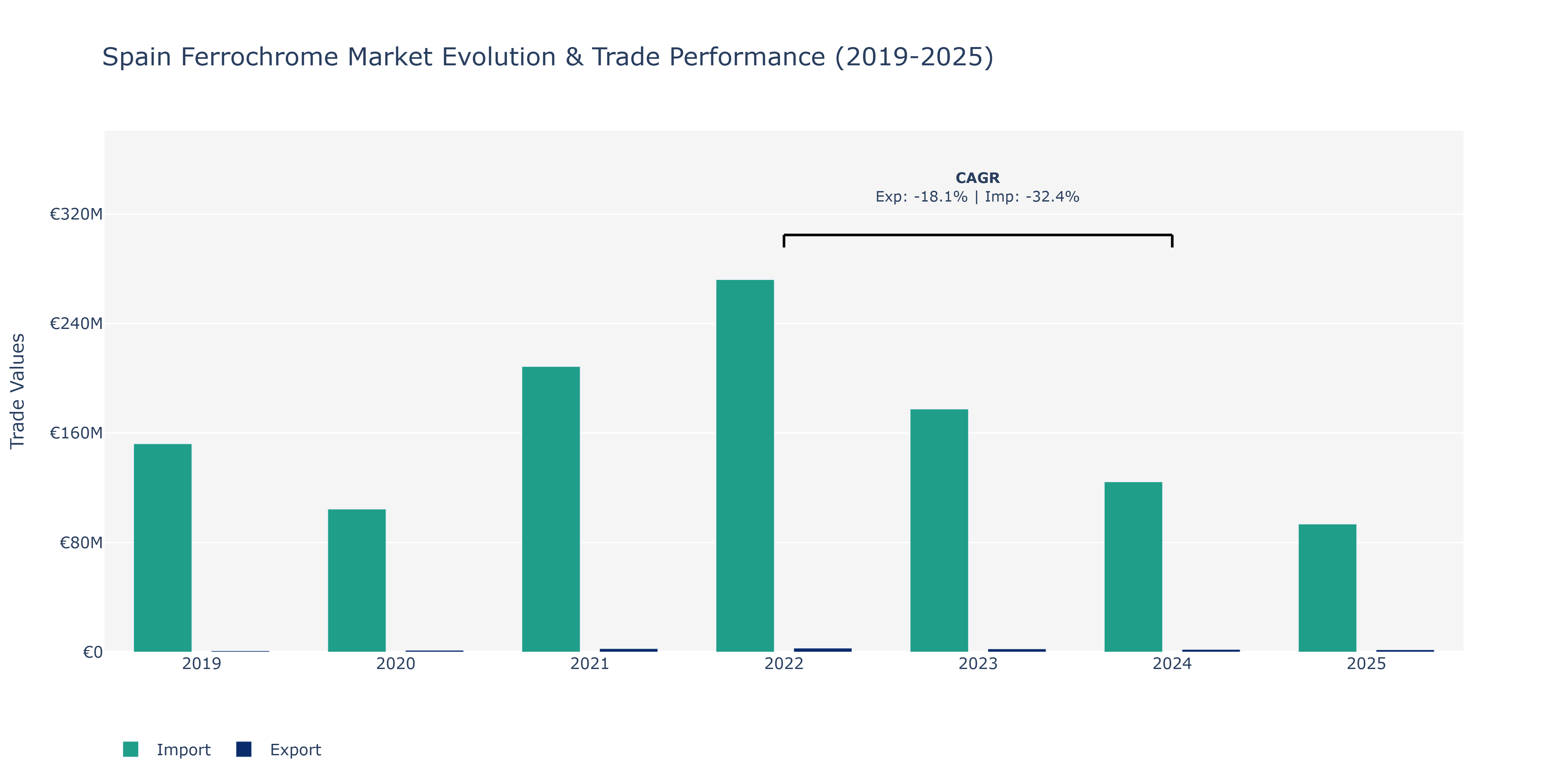
The Spain Ferrochrome Market saw fluctuations in exports and imports over the years. In 2019, exports started at €915.7 thousand and gradually increased to €2.88 million by 2022 before declining to €1.94 million in 2024 and further dropping to €1.68 million in 2025. Imports, on the other hand, began at €152.15 million in 2019, peaked at €272.09 million in 2022, and then experienced a decline to €124.35 million in 2024, followed by a decrease to €93.48 million in 2025. The significant rise in exports until 2022 can be attributed to increased global demand for ferrochrome in industries like stainless steel production. The subsequent decline in both exports and imports in the following years could be due to market saturation, fluctuating commodity prices, and evolving trade dynamics influenced by geopolitical factors impacting demand and supply chains. Such trends emphasize the market's sensitivity to external variables, necessitating adaptive strategies for market players to navigate uncertainties and sustain growth.
Spain Ferrochrome Market Overview
The Spain Ferrochrome market is a crucial sector within the country`s industrial landscape, with steady demand driven by the automotive, construction, and aerospace industries. The market is primarily dominated by established players such as Ferroatlántica, with a strong focus on quality and technological advancements to meet the evolving needs of various end-user industries. Spain`s strategic location and well-developed infrastructure provide a competitive edge for ferrochrome producers, enabling efficient transportation and trade within the European markets. However, challenges such as fluctuating raw material prices and environmental regulations pose significant hurdles for market growth. Overall, the Spain Ferrochrome market continues to show resilience and potential for expansion, supported by ongoing research and development initiatives to enhance product quality and sustainability.
Spain Ferrochrome Market Trends
In the Spain Ferrochrome market, the current trend is a gradual increase in demand driven by the growth of the stainless steel industry. The expanding infrastructure and construction projects in Spain are boosting the need for stainless steel, which in turn is driving the demand for Ferrochrome. Additionally, the automotive and aerospace sectors are also contributing to the growth of the Ferrochrome market in Spain as they require stainless steel for various applications. However, challenges such as fluctuating raw material prices and environmental regulations are impacting market dynamics. Market players are focusing on sustainable practices and technological advancements to stay competitive in the Spain Ferrochrome market amidst these trends and challenges.
Spain Ferrochrome Market Challenges
In the Spain Ferrochrome Market, some challenges include fluctuating global demand and pricing for stainless steel, which directly impacts the demand for ferrochrome as a key ingredient. Environmental regulations and energy costs also present challenges for ferrochrome producers, as the production process is energy-intensive and can have environmental implications. Additionally, competition from other ferrochrome-producing countries adds pressure on Spanish producers to remain cost-effective and competitive in the global market. Market volatility and geopolitical factors can further complicate the business environment for ferrochrome companies in Spain, requiring them to stay agile and adaptable to changing conditions to sustain growth and profitability.
Spain Ferrochrome Market Investment Opportunities
The Spain Ferrochrome market presents promising investment opportunities due to the country`s significant production of stainless steel, which is a key consumer of ferrochrome. With Spain being one of the top stainless steel producers in Europe, there is a steady demand for ferrochrome as an essential ingredient in stainless steel production. Additionally, the growing trend towards sustainable and environmentally friendly practices in the steel industry provides opportunities for investment in innovative technologies for ferrochrome production. Investing in Spain`s Ferrochrome market can offer potential returns for investors looking to capitalize on the country`s strong position in the stainless steel industry and the increasing demand for ferrochrome in both domestic and global markets.
Spain Ferrochrome Market Government Policy
The Spain Ferrochrome Market is influenced by various government policies aimed at regulating environmental impact and promoting sustainable development. Key policies include the Industrial Emissions Directive, which sets emission limits for ferrochrome production facilities to minimize air and water pollution. Additionally, the National Climate Change and Energy Transition Strategy outlines goals for reducing greenhouse gas emissions and increasing renewable energy sources, impacting the energy-intensive ferrochrome sector. The Circular Economy Strategy promotes resource efficiency and waste reduction, encouraging the recycling and reuse of ferrochrome materials. Overall, these policies are driving the Spain Ferrochrome Market towards greater environmental responsibility and long-term sustainability.
Spain Ferrochrome Market Future Outlook
The Spain Ferrochrome Market is expected to experience steady growth in the coming years, driven by increasing demand from stainless steel manufacturers and infrastructure projects. The market is likely to benefit from Spain`s strong industrial sector and the growing trend towards sustainable and energy-efficient production methods. Additionally, advancements in technology and increasing investments in research and development are anticipated to further boost the market growth. However, challenges such as fluctuating raw material prices and regulatory changes may impact the market dynamics. Overall, the Spain Ferrochrome Market is poised for expansion, with opportunities for market players to capitalize on the evolving industry landscape and meet the rising demand for high-quality ferrochrome products.
Key Highlights of the Report:
- Spain Ferrochrome Market Outlook
- Market Size of Spain Ferrochrome Market, 2021
- Forecast of Spain Ferrochrome Market, 2027
- Historical Data and Forecast of Spain Ferrochrome Revenues & Volume for the Period 2018 - 2027
- Spain Ferrochrome Market Trend Evolution
- Spain Ferrochrome Market Drivers and Challenges
- Spain Ferrochrome Price Trends
- Spain Ferrochrome Porter's Five Forces
- Spain Ferrochrome Industry Life Cycle
- Historical Data and Forecast of Spain Ferrochrome Market Revenues & Volume By Type for the Period 2018 - 2027
- Historical Data and Forecast of Spain Ferrochrome Market Revenues & Volume By High carbon for the Period 2018 - 2027
- Historical Data and Forecast of Spain Ferrochrome Market Revenues & Volume By Medium carbon for the Period 2018 - 2027
- Historical Data and Forecast of Spain Ferrochrome Market Revenues & Volume By Low carbon for the Period 2018 - 2027
- Historical Data and Forecast of Spain Ferrochrome Market Revenues & Volume By Applications for the Period 2018 - 2027
- Historical Data and Forecast of Spain Ferrochrome Market Revenues & Volume By Stainless steel for the Period 2018 - 2027
- Historical Data and Forecast of Spain Ferrochrome Market Revenues & Volume By Other steels for the Period 2018 - 2027
- Spain Ferrochrome Import Export Trade Statistics
- Market Opportunity Assessment By Type
- Market Opportunity Assessment By Applications
- Spain Ferrochrome Top Companies Market Share
- Spain Ferrochrome Competitive Benchmarking By Technical and Operational Parameters
- Spain Ferrochrome Company Profiles
- Spain Ferrochrome Key Strategic Recommendations






































