Hungary Single Cell Sequencing Market Size, Share & Growth Rate
The Hungary Single Cell Sequencing Market was estimated at USD 1444 Million in 2025 and is projected to reach USD 2055 Million by 2032, growing at a CAGR of 5.2% from 2026 to 2032. This growth trajectory is primarily driven by technological advancements in sequencing methodologies, which allow for more precise analysis of cellular diversity. Additionally, the rising focus on personalized medicine, alongside increasing research investments in genomics, are significant catalysts for the market expansion in Hungary.
Hungary Single Cell Sequencing Market Year-wise Growth Rate and Key Drivers
This graph highlights how the Hungary Single Cell Sequencing Market has steadily grown over the years, supported by major growth factors.
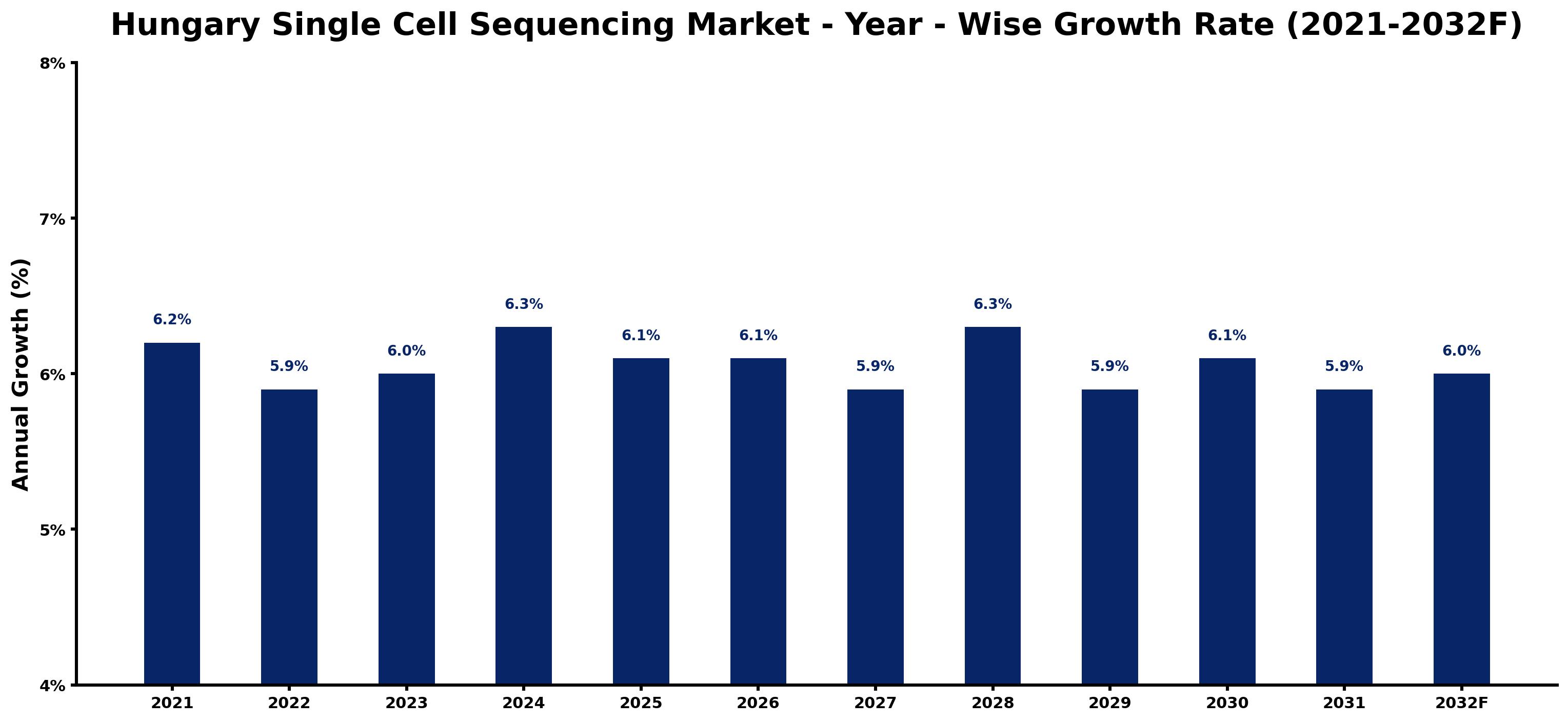
The table below presents the year‑wise growth rates along with the key drivers influencing the market
| Year | Growth Rate | Major Drivers |
| 2021 | 6.2% | Expansion of transportation and logistics networks |
| 2022 | 5.9% | Increasing industrial automation investments |
| 2023 | 6.0% | Expansion of commercial construction activities |
| 2024 | 6.3% | Expansion of transportation and logistics networks |
| 2025 | 6.1% | Increasing smart city development projects |
| 2026 | 6.1% | Increasing adoption of advanced technologies |
| 2027 | 5.9% | Expansion of transportation and logistics networks |
| 2028 | 6.3% | Rising electricity demand across industries |
| 2029 | 5.9% | Increasing industrial infrastructure investments |
| 2030 | 6.1% | Expansion of commercial construction activities |
| 2031 | 5.9% | Government infrastructure modernization initiatives |
| 2032 | 6.0% | Expansion of commercial construction activities |
Note - Market size estimations and growth projections presented in this report are based on 6Wresearch's advanced forecasting approach, validated with industry datasets as of June 2026.
Hungary Single Cell Sequencing Market Synopsis
The demand for single cell sequencing in Hungary is significantly influenced by the growing emphasis on research focused on oncology and immunology. As researchers aim to unravel the complexities of individual cellular responses, the insights gained from single cell sequencing are proving invaluable, particularly in understanding disease mechanisms.
Moreover, a surge in collaborations between academic institutions and biotechnology firms enhances the research landscape, driving innovation and application of single cell technologies. This collaborative environment is pivotal for unlocking new methodologies and improving the efficiency of sequencing processes within the Hungarian market.
Hungary Single Cell Sequencing Market Key Takeaways
- The market is characterized by a growing focus on personalized medicine and its applications across various fields.
- Collaborations between research entities and biotech companies are accelerating advancements in single cell analysis.
- Technological innovations are enhancing the accuracy and efficiency of sequencing processes.
- Increased funding for genomics research is significantly driving market growth in Hungary.
- Government initiatives are creating a supportive framework for market development and investment.
Evaluation of Restraints in Hungary Single Cell Sequencing Market
Despite the growth potential, the Hungary Single Cell Sequencing Market faces significant challenges. The high costs associated with sequencing technologies can restrict access for smaller laboratories and research institutions. Furthermore, there is a notable shortage of skilled personnel with expertise in single cell sequencing methodologies, which can hinder the effective implementation of such advanced techniques. The complexity of data interpretation also poses challenges, requiring specialized skills in bioinformatics that are not readily available across the board. Lastly, the inconsistency in protocols may impact the reliability and reproducibility of results, a critical factor in scientific research.
Hungary Single Cell Sequencing Market Trends
The Hungary Single Cell Sequencing Market is undergoing transformative changes, particularly with the advent of next-generation sequencing technologies that facilitate high-throughput analysis. Innovations in bioinformatics tools are further refining the capacity to analyze complex datasets generated by single cell sequencing. Researchers are increasingly leveraging these advancements in applications such as cancer biology and neurobiology, where understanding cellular heterogeneity is crucial. Additionally, there is a noticeable shift towards integrating single cell analysis into routine clinical workflows, emphasizing its potential in diagnostics and treatment planning.
Hungary Single Cell Sequencing Market Opportunities
Investment opportunities within the Hungary Single Cell Sequencing Market are abundant, particularly with the increasing push for personalized medicine. Biotech firms that provide innovative sequencing technologies and comprehensive bioinformatics solutions stand to benefit from the growing demand. Collaborations with local academic institutions can further enhance technology transfer and penetration into the market. The continuous evolution of genomics applications presents numerous avenues for early-stage investments, promising significant returns in an expanding field.
Government Initiatives in the Hungary Single Cell Sequencing Market
Hungary's government is actively fostering innovation in the life sciences sector, particularly concerning single cell sequencing. Strategic policies are in place to stimulate research and development, including funding for relevant projects and partnerships with industry stakeholders. There is a concerted effort to create a regulatory environment that ensures product quality and safety, thereby enhancing public confidence in single cell technologies. This supportive framework is essential for the sustainable growth of the market.
Future Insights of the Hungary Single Cell Sequencing Market
Looking ahead to 2026-2032, the Hungary Single Cell Sequencing Market is expected to experience robust growth, propelled by advancements in sequencing technology and the increasing prevalence of chronic diseases. The growing focus on personalized medicine will continue to drive demand for single cell analysis in diverse applications such as immunology and developmental biology. With governmental support and continuous research funding, the market is well-positioned to capitalize on emerging opportunities, leading to further innovations and applications in the field.
Hungary Single Cell Sequencing Market Latest Developments (May 2025 - June 2026)
Recent developments within the Hungary Single Cell Sequencing Market indicate a heightened interest in personalized therapies tailored through single cell insights. Research institutions are increasingly integrating single cell analysis into their core projects, reflecting a commitment to advancing therapeutic strategies. Additionally, new collaborations are emerging, fostering innovation in technology development and application, thereby shaping the future of genomics research in Hungary.
Hungary Single Cell Sequencing Market - Key Attractiveness of the Report
- 10 Years of Market Numbers
- Historical Data Starting from 2022 to 2025
- Base Year: 2025
- Forecast Data until 2032
- Key Performance Indicators Impacting the Market
- Major Upcoming Developments and Projects
Key Highlights of the Report:
- Taiwan Electric Truck Market Overview
- Taiwan Electric Truck Market Outlook
- Taiwan Electric Truck Market Forecast
- Historical Data and ForecastTaiwan Electric Truck MarketRevenues and Volume for the Period 2021-2031
- Historical Data and Forecast ofTaiwan Electric Truck MarketRevenues and Volume, By Vehicle Types, for the Period 2021-2031
- Historical Data and Forecast ofTaiwan Electric Truck MarketRevenues and Volume, By Charger Types, for the Period 2021-2031
- Historical Data and Forecast ofTaiwan Electric Truck MarketRevenues and Volume, By DC Charger Connector Types, for the Period 2021-2031
- Historical Data and Forecast ofTaiwan Electric Truck MarketRevenues and Volume, By DC Charger Power Ratings, for the Period 2021-2031
- Historical Data and Forecast ofTaiwan Electric Truck MarketRevenues and Volume, By Charger End Consumers, for the Period 2021-2031
- Market Drivers and Restraints
- Industry Life Cycle
- Porter’s Five Force Analysis
- Impact Analysis of
- Market Trends
- TaiwanVehicle MarketRevenue Ranking, By Companies
- Competitive Benchmarking
- Company Profiles
- Key Strategic Recommendations
Market Covered
The market report has been segmented and sub segmented into the following categories
By Charger Types
- AC
- DC
By DC Charger Connector Types
- CHAdeMO
- CCS
- Others (including Tesla superchargers and GB/T)
By DC Charger Power Ratings
- 40-80 kW
- 80-120 kW
- 120-200 kW
By End Consumers
- Public
- Private