France Financial Analytics Market Size & Growth Rate (2026-2032)
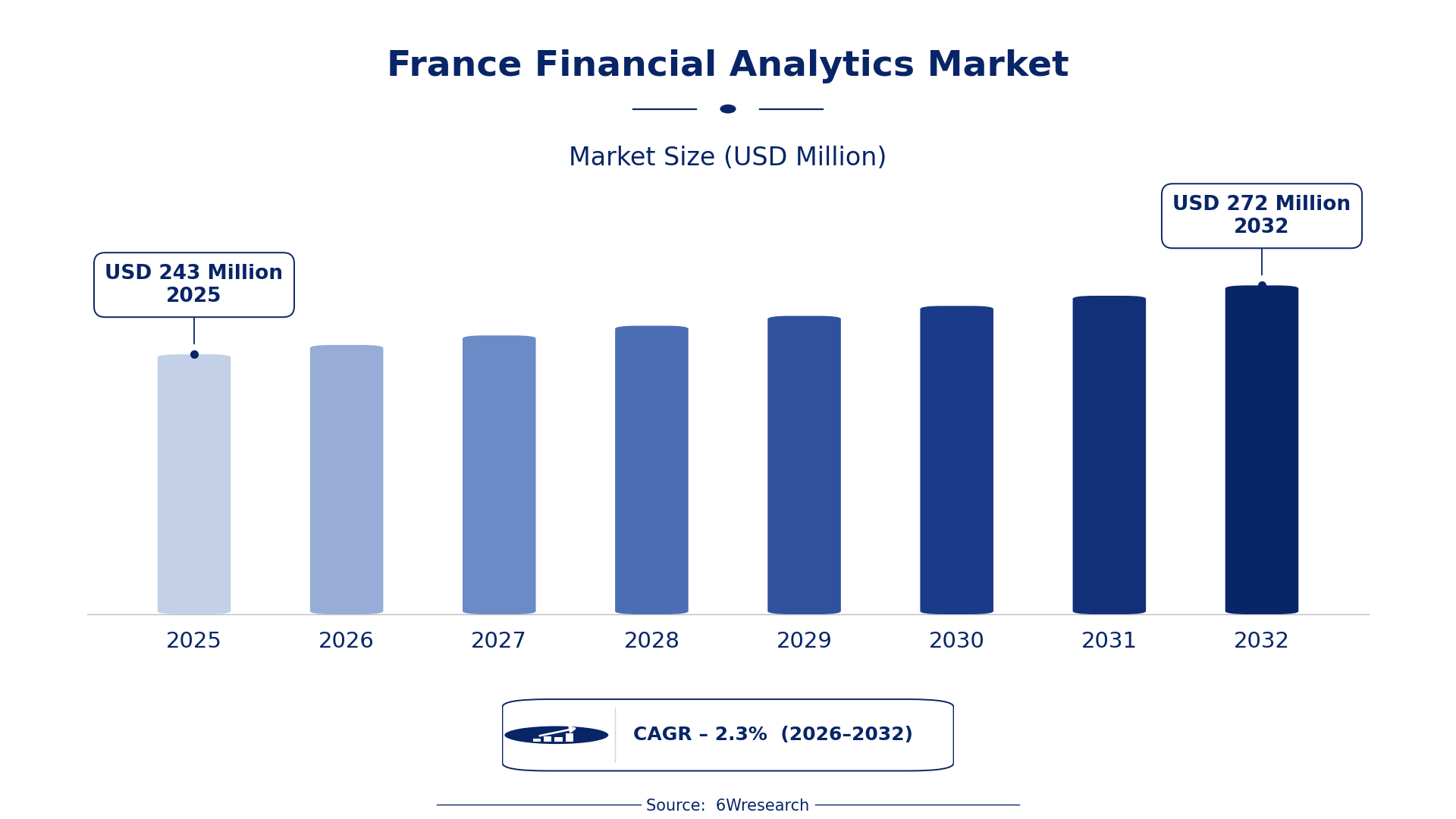
The France Financial Analytics Market was estimated at USD 243 Million in 2025 and is projected to reach USD 272 Million by 2032, growing at a CAGR of 2.3% from 2026 to 2032.
France Financial Analytics Market Synopsis
The financial analytics sector in France is gaining momentum, driven by a surge in demand for advanced analytical tools across banking and insurance sectors. As institutions seek to enhance operational efficiency and risk management, the push for innovative data solutions is reshaping the market.
Looking ahead, the market is expected to transition towards more sophisticated technologies such as artificial intelligence and machine learning. These advancements will not only facilitate better decision-making but will also address the growing need for real-time data insights.
France Financial Analytics Market Year-wise Growth Rate and Key Drivers
This graph illustrates the annual growth rates of the France Financial Analytics Market from 2021 to 2032, highlighting a steady upward trajectory and projected expansion over the forecast period.
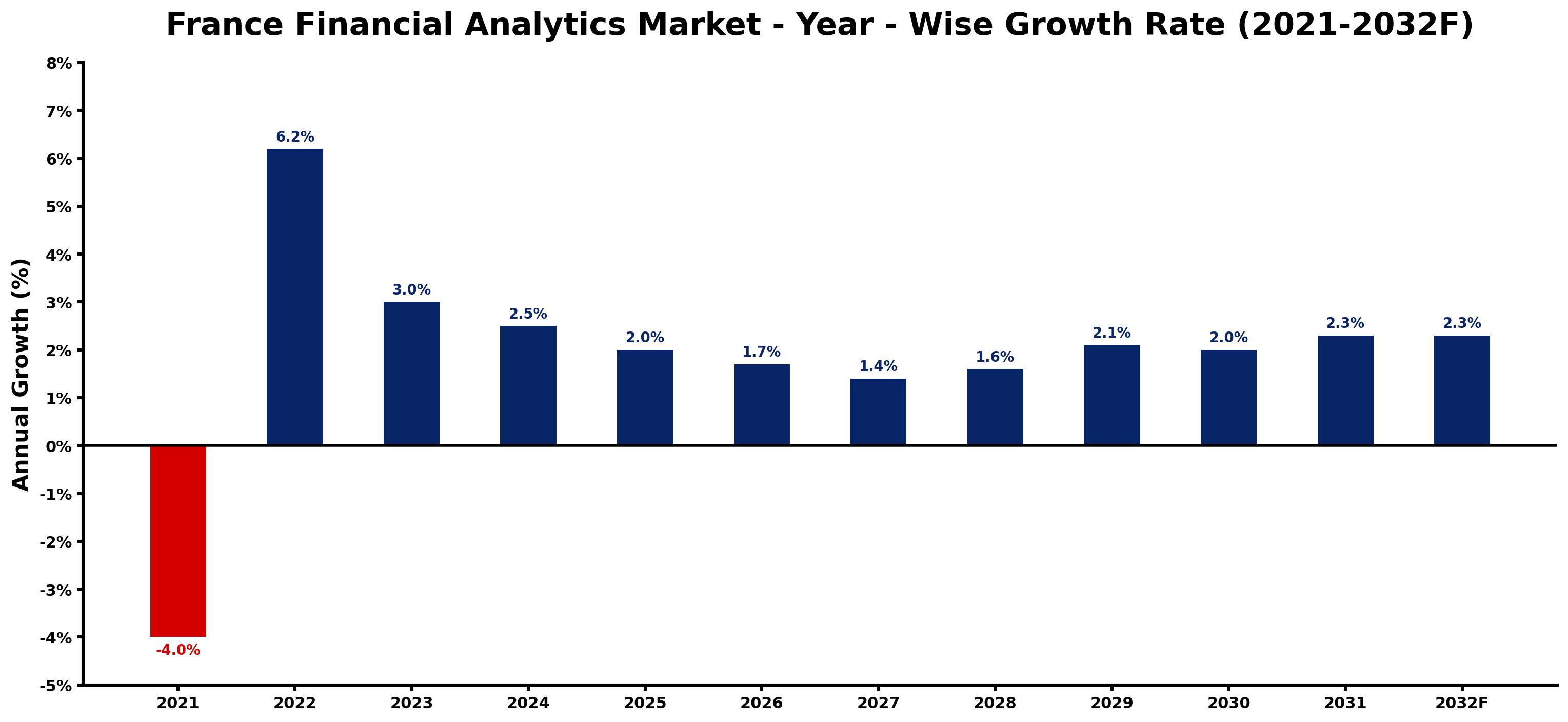
The table below presents the year‑wise growth rates along with the key drivers influencing the market
| Year | Growth Rate | Major Drivers |
| 2021 | -4.0% | French data privacy laws hinder analytics tool adoption. |
| 2022 | 6.2% | Increased demand for ESG reporting and analytics services. |
| 2023 | 3.0% | Adoption of AI-powered financial forecasting tools by companies. |
| 2024 | 2.5% | New regulations on financial transparency from AMF agency. |
| 2025 | 2.0% | Growth in fintech startups offering innovative analytics solutions. |
| 2026 | 1.7% | Rising adoption of cloud-based financial analysis platforms. |
| 2027 | 1.4% | Government incentives for financial technology investments. |
| 2028 | 1.6% | Enhanced focus on data-driven decision making in banks. |
| 2029 | 2.1% | Recovery of retail investment sector boosting analytics needs. |
| 2030 | 2.0% | Emergence of open banking fostering data collaborative ecosystems. |
| 2031 | 2.3% | Increasing cybersecurity mandates driving advanced analytics solutions. |
| 2032 | 2.3% | Continued integration of machine learning in investment strategies. |
Note: Market size estimations and growth projections presented in this report are based on 6Wresearch's proprietary forecasting methodology, utilizing the latest available industry data, government publications, and primary research inputs.
France Financial Analytics Market Key Takeaways
Below are some of the specific key takeaways from the market, including:
- The increasing reliance on real-time analytics is enhancing decision-making processes for financial institutions.
- There is a marked shift towards utilizing AI and machine learning for better risk assessment and investment strategies.
- Regulatory compliance is driving demand for analytics tools that ensure data accuracy and transparency.
- Investment opportunities are emerging in fintech, with startups offering innovative solutions tailored for analytics.
- Data security remains a critical concern, necessitating robust measures for protecting sensitive financial information.
Evaluation of Restraints in France Financial Analytics Market
Despite the growth potential, the France Financial Analytics Market faces notable restraints. Data security and privacy concerns are paramount, particularly in light of stringent regulations like GDPR. Financial institutions are challenged to comply with these regulations while effectively analyzing vast amounts of sensitive data. Additionally, the market grapples with a shortage of skilled professionals capable of interpreting complex financial data. This skills gap can hinder the effective deployment and utilization of advanced analytics tools, thus impacting overall competitiveness.
France Financial Analytics Market Trends
Several trends are emerging in the France Financial Analytics Market that are shaping both demand and technology. The adoption of predictive modeling is becoming more prevalent, allowing firms to anticipate market shifts and adjust strategies accordingly. Real-time data analysis is also gaining traction, as companies strive to stay agile in a rapidly changing environment. on top of that, the integration of AI and machine learning is enabling automation of complex processes, streamlining operations and enhancing analytical capabilities.
France Financial Analytics Market Opportunities
Investment opportunities in the France Financial Analytics Market are abundant, particularly in sectors like banking, insurance, and fintech. As institutions increasingly adopt advanced analytics solutions, there is a growing demand for tools that improve customer experience and operational efficiency. Ventures focusing on innovative analytics software, consultancy services, and cybersecurity measures are likely to see lucrative returns. The focus on regulatory compliance also creates opportunities for analytics solutions specifically designed to address these challenges in the financial sector.
Government Initiatives in the France Financial Analytics Market
The French government plays a critical role in shaping the financial analytics market through various regulatory measures and initiatives. With a focus on protecting consumer data and ensuring market integrity, the government has introduced policies that directly impact how financial institutions utilize analytics. Current regulations aim to promote transparency and accountability, addressing the increasing complexity of financial data management.
- A recent initiative involved the implementation of stricter data protection regulations under GDPR, impacting data collection and processing practices.
- Currently, the French Financial Markets Authority (AMF) is enhancing its oversight of financial analytics tools to ensure compliance and prevent market manipulation.
- A planned public-private partnership aims to bolster the development of digital infrastructure to support advanced analytics solutions by 2028.
- Ongoing workshops and training programs are being developed to address the skills gap in financial analytics, focusing on equipping professionals with necessary expertise.
- The government is assessing the impact of emerging technologies on financial services, with a focus on integrating AI into regulatory frameworks.
Future Insights of the France Financial Analytics Market
The future of the France Financial Analytics Market looks promising, primarily driven by technological advancements in AI and machine learning. As financial institutions increasingly prioritize data-driven insights, the demand for innovative analytics solutions will continue to rise. The emphasis on real-time analytics will be crucial in navigating the uncertainties of the market, allowing firms to make informed decisions swiftly. on top of that, regulatory pressures will likely drive further investment in compliance-focused analytics tools, contributing to market growth.
France Financial Analytics Market Latest Developments
Recent developments in the France Financial Analytics Market illustrate a clear trend towards innovation and enhanced operational capabilities. Over the past year, companies have been actively seeking ways to refine their analytics approaches and integrate cutting-edge technologies.
- A major technology vendor launched a new AI-driven analytics platform in early 2025, aimed at streamlining risk management for financial institutions.
- An ongoing initiative by a prominent consultancy firm is enhancing the capabilities of financial analytics tools through machine learning integration, expected to complete by mid-2026.
- A rollout of a comprehensive training program for financial analysts began in Q3 2025, focusing on the latest data analytics techniques.
- Plans are underway for a national cybersecurity framework targeting analytics tools, with implementation expected to start in late 2026.
- A partnership between two fintech companies is currently underway, aiming to develop a shared platform for real-time financial data analysis, projected for launch in early 2027.
France Financial Analytics Market - Key Attractiveness of the Report
- 10 Years of Market Numbers
- Historical Data Starting from 2022 to 2025
- Base Year: 2025
- Forecast Data until 2032
- Key Performance Indicators Impacting the Market
- Major Upcoming Developments and Projects
Key Highlights of the Report:
- France Financial Analytics Market Outlook
- Market Size of France Financial Analytics Market, 2025
- Forecast of France Financial Analytics Market, 2032
- Historical Data and Forecast of France Financial Analytics Revenues & Volume for the Period 2022-2032F
- France Financial Analytics Market Trend Evolution
- France Financial Analytics Market Drivers and Challenges
- France Financial Analytics Price Trends
- France Financial Analytics Porter's Five Forces
- France Financial Analytics Industry Life Cycle
- Historical Data and Forecast of France Financial Analytics Market Revenues & Volume By Components for the Period 2022-2032F
- Historical Data and Forecast of France Financial Analytics Market Revenues & Volume By Software for the Period 2022-2032F
- Historical Data and Forecast of France Financial Analytics Market Revenues & Volume By Services for the Period 2022-2032F
- Historical Data and Forecast of France Financial Analytics Market Revenues & Volume By Deployment Modes for the Period 2022-2032F
- Historical Data and Forecast of France Financial Analytics Market Revenues & Volume By On-premises for the Period 2022-2032F
- Historical Data and Forecast of France Financial Analytics Market Revenues & Volume By Cloud for the Period 2022-2032F
- Historical Data and Forecast of France Financial Analytics Market Revenues & Volume By Application for the Period 2022-2032F
- Historical Data and Forecast of France Financial Analytics Market Revenues & Volume By Wealth Management for the Period 2022-2032F
- Historical Data and Forecast of France Financial Analytics Market Revenues & Volume By Governance, Risk, and Compliance Management for the Period 2022-2032F
- Historical Data and Forecast of France Financial Analytics Market Revenues & Volume By Financial Forecasting and Budgeting for the Period 2022-2032F
- Historical Data and Forecast of France Financial Analytics Market Revenues & Volume By Customer Management for the Period 2022-2032F
- Historical Data and Forecast of France Financial Analytics Market Revenues & Volume By Transaction Monitoring for the Period 2022-2032F
- Historical Data and Forecast of France Financial Analytics Market Revenues & Volume By Claim Management for the Period 2022-2032F
- Historical Data and Forecast of France Financial Analytics Market Revenues & Volume By Fraud Detection and Prevention for the Period 2022-2032F
- Historical Data and Forecast of France Financial Analytics Market Revenues & Volume By Stock Management for the Period 2022-2032F
- Historical Data and Forecast of France Financial Analytics Market Revenues & Volume By Organization Size for the Period 2022-2032F
- Historical Data and Forecast of France Financial Analytics Market Revenues & Volume By Small and Medium-sized Enterprises (SMEs) for the Period 2022-2032F
- Historical Data and Forecast of France Financial Analytics Market Revenues & Volume By Large Enterprises for the Period 2022-2032F
- Historical Data and Forecast of France Financial Analytics Market Revenues & Volume By Verticals for the Period 2022-2032F
- Historical Data and Forecast of France Financial Analytics Market Revenues & Volume By Banking, Financial Services, and Insurance (BFSI) for the Period 2022-2032F
- Historical Data and Forecast of France Financial Analytics Market Revenues & Volume By Telecom and IT for the Period 2022-2032F
- Historical Data and Forecast of France Financial Analytics Market Revenues & Volume By Government for the Period 2022-2032F
- Historical Data and Forecast of France Financial Analytics Market Revenues & Volume By Energy and Utilities for the Period 2022-2032F
- Historical Data and Forecast of France Financial Analytics Market Revenues & Volume By Manufacturing and Automotive for the Period 2022-2032F
- Historical Data and Forecast of France Financial Analytics Market Revenues & Volume By Healthcare and Pharmaceutical for the Period 2022-2032F
- Historical Data and Forecast of France Financial Analytics Market Revenues & Volume By Retail and eCommerce for the Period 2022-2032F
- Historical Data and Forecast of France Financial Analytics Market Revenues & Volume By Media and Entertainment for the Period 2022-2032F
- France Financial Analytics Import Export Trade Statistics
- Market Opportunity Assessment By Components
- Market Opportunity Assessment By Deployment Modes
- Market Opportunity Assessment By Application
- Market Opportunity Assessment By Organization Size
- Market Opportunity Assessment By Verticals
- France Financial Analytics Top Companies Market Share
- France Financial Analytics Competitive Benchmarking By Technical and Operational Parameters
- France Financial Analytics Company Profiles
- France Financial Analytics Key Strategic Recommendations






































