France Flexible Foam Market Top 5 Importing Countries and Market Competition (HHI) Analysis
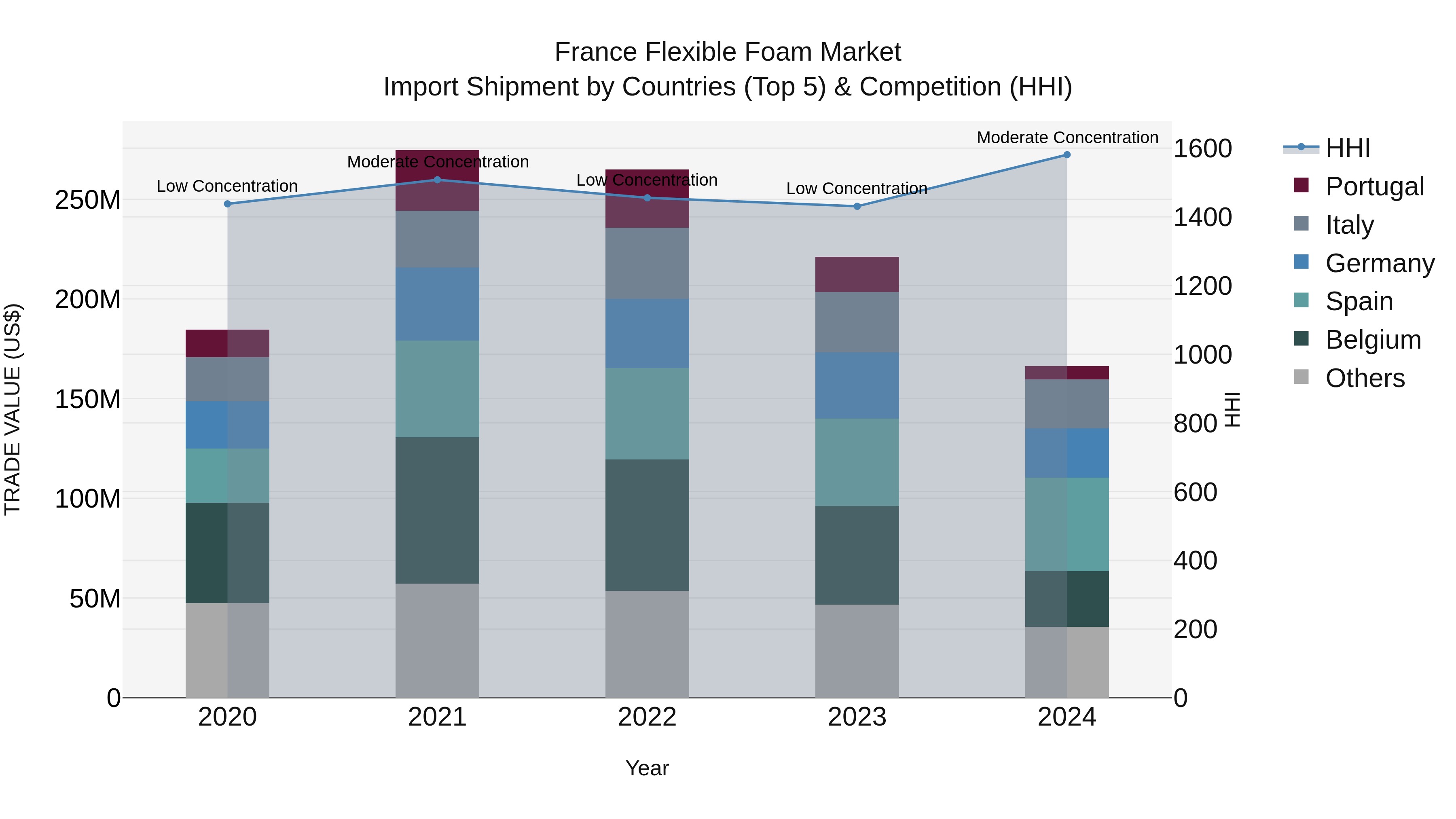
The France flexible foam import market saw a shift in concentration levels from low to moderate in 2024, with top exporters being Spain, Belgium, Germany, Italy, and the UK. Despite a negative compound annual growth rate (CAGR) of -2.56% from 2020 to 2024, the market experienced a significant decline in growth rate of -24.75% from 2023 to 2024. This suggests a challenging environment for importers, potentially influenced by various factors impacting the demand for flexible foam in France. Monitoring market dynamics and adapting strategies will be key for stakeholders in this sector.
France Flexible Foam Market Overview
The Flexible Foam market in France is experiencing steady growth, supported by the increasing demand for lightweight, comfortable, and customizable foam materials in furniture, bedding, automotive interiors, and packaging applications. Flexible foams offer superior cushioning, insulation, and acoustic properties, enhancing the comfort, safety, and performance of various end products across different sectors. These market overviews provide insights into the key trends, drivers, and growth opportunities across various sectors in France, highlighting the diverse opportunities and challenges for businesses operating in these markets.
Drivers of the market
The Flexible Foam market in France is driven by the growing demand for comfortable and lightweight materials in furniture, bedding, automotive seating, and packaging applications. Flexible foams, including polyurethane foam, memory foam, and latex foam, offer advantages such as cushioning, support, and thermal insulation, making them preferred choices for comfort products. The increasing consumer focus on ergonomic design, sustainability, and environmental responsibility drives the demand for flexible foams made from renewable and eco-friendly materials. Moreover, technological advancements enabling the production of high-resilience foams with enhanced durability and breathability contribute to market growth.
Challenges of the market
The France Flexible Foam Market confronts challenges related to environmental regulations, material innovation, and market demand. One significant challenge is the need to develop flexible foam products that meet increasingly stringent regulations regarding emissions, toxicity, and recycling, particularly in applications such as furniture and automotive interiors. Moreover, addressing the demand for lightweight and high-performance foam materials with specific comfort and durability properties poses challenges for manufacturers in terms of formulation and processing techniques. Additionally, fluctuations in consumer preferences and competition from alternative cushioning materials pose challenges for the flexible foam market in adapting to changing market dynamics. These challenges underscore the complexity and dynamism of each market, highlighting the need for strategic planning, innovation, and collaboration to overcome obstacles and drive sustainable growth and competitiveness.
Government Policy of the market
Government policies in France promote energy efficiency and sustainability in the foam insulation industry through regulations and incentives for flexible foam products. Policies aim to improve thermal insulation performance, reduce energy consumption, and mitigate environmental impact in buildings and construction projects.
Key Highlights of the Report:
- France Flexible Foam Market Outlook
- Market Size of France Flexible Foam Market, 2024
- Forecast of France Flexible Foam Market, 2031
- Historical Data and Forecast of France Flexible Foam Revenues & Volume for the Period 2021-2031
- France Flexible Foam Market Trend Evolution
- France Flexible Foam Market Drivers and Challenges
- France Flexible Foam Price Trends
- France Flexible Foam Porter's Five Forces
- France Flexible Foam Industry Life Cycle
- Historical Data and Forecast of France Flexible Foam Market Revenues & Volume By Type for the Period 2021-2031
- Historical Data and Forecast of France Flexible Foam Market Revenues & Volume By Polyurethane for the Period 2021-2031
- Historical Data and Forecast of France Flexible Foam Market Revenues & Volume By Polyethylene for the Period 2021-2031
- Historical Data and Forecast of France Flexible Foam Market Revenues & Volume By Polypropylene for the Period 2021-2031
- Historical Data and Forecast of France Flexible Foam Market Revenues & Volume By Application for the Period 2021-2031
- Historical Data and Forecast of France Flexible Foam Market Revenues & Volume By Furniture & Bedding for the Period 2021-2031
- Historical Data and Forecast of France Flexible Foam Market Revenues & Volume By Transportation for the Period 2021-2031
- Historical Data and Forecast of France Flexible Foam Market Revenues & Volume By Packaging for the Period 2021-2031
- France Flexible Foam Import Export Trade Statistics
- Market Opportunity Assessment By Type
- Market Opportunity Assessment By Application
- France Flexible Foam Top Companies Market Share
- France Flexible Foam Competitive Benchmarking By Technical and Operational Parameters
- France Flexible Foam Company Profiles
- France Flexible Foam Key Strategic Recommendations






































