France Ginseng Market Top 5 Importing Countries and Market Competition (HHI) Analysis
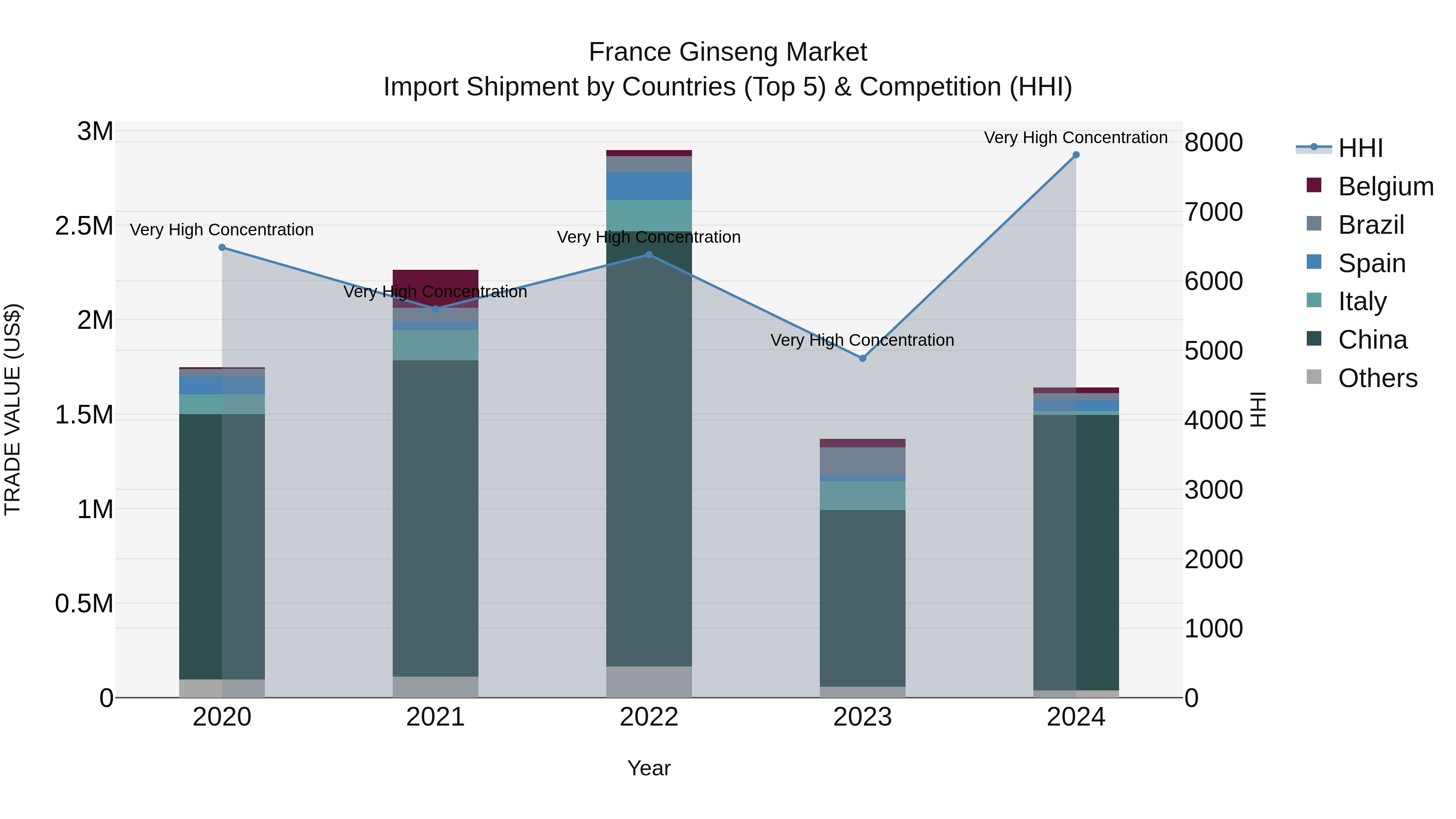
France continues to rely on key ginseng suppliers such as China, Spain, Brazil, South Korea, and Belgium, with a high Herfindahl-Hirschman Index (HHI) indicating market concentration in 2024. Despite a negative compound annual growth rate (CAGR) from 2020-2024, there was a notable growth spike of 19.82% from 2023-2024. This suggests a potential shift in market dynamics and consumer demand for ginseng products in France, warranting further analysis for industry stakeholders.
France Ginseng Market Market Overview
The ginseng market in France is witnessing steady growth due to increasing consumer awareness about the health benefits associated with ginseng consumption, such as improved cognitive function, reduced stress, and increased energy levels. Ginseng products are gaining popularity in the French market as natural remedies for various health issues. The demand for ginseng supplements, teas, and skincare products is on the rise, driven by the growing interest in holistic health and wellness. With a focus on traditional herbal remedies and natural ingredients, French consumers are increasingly turning to ginseng as a supplement to support their overall well-being. The market is expected to continue expanding as more consumers seek out alternative health solutions and premium quality ginseng products.
France Ginseng Market Trends
In the France ginseng market, there is a growing trend towards the consumption of ginseng-based products for their perceived health benefits, particularly in terms of boosting energy levels, improving cognitive function, and enhancing overall well-being. Consumers are increasingly seeking natural and holistic remedies, driving the demand for ginseng supplements, teas, and beauty products that contain ginseng extracts. There is also a rising interest in sustainable and ethically sourced ginseng products, with consumers being more conscious of the environmental and social impact of their purchases. Additionally, the market is witnessing innovation in product formulations, with companies introducing new ginseng-infused products targeting specific health concerns, such as stress relief and immune support. Overall, the France ginseng market is evolving to cater to the growing consumer demand for natural health and wellness solutions.
France Ginseng Market Challenges
In the France ginseng market, some challenges include increasing competition from other herbal supplements, potential regulatory hurdles related to the classification of ginseng as a medicinal herb, and variability in product quality and authenticity. The market is also impacted by consumer skepticism regarding the efficacy of ginseng products and the need for more scientific research to validate its health benefits. Additionally, fluctuations in ginseng prices due to factors like climate change and geopolitical issues can pose challenges for both producers and consumers. Overall, navigating these obstacles requires companies in the France ginseng market to focus on product differentiation, quality control, education about ginseng`s properties, and compliance with regulations to maintain credibility and sustain growth in the competitive landscape.
France Ginseng Market Investment Opportunities
The France ginseng market presents promising investment opportunities due to the growing demand for natural health supplements and traditional remedies. With an increasing focus on health and wellness, consumers are seeking out products like ginseng known for its potential health benefits such as boosting energy levels, improving cognitive function, and reducing stress. Investing in the France ginseng market could be lucrative as the trend towards natural remedies continues to rise. Opportunities exist for investors to support ginseng cultivation, product development, and marketing efforts to capitalize on the growing demand for this herbal supplement in France. Additionally, partnerships with local farmers or suppliers can help ensure a sustainable and reliable source of ginseng for the market.
France Ginseng Market Government Policy
The French government has implemented strict regulations on the ginseng market to protect consumers and ensure product quality. Ginseng products must adhere to European Union regulations on herbal supplements, including labeling requirements and limits on pesticide residues. Additionally, ginseng cultivation is subject to agricultural guidelines set by the French Ministry of Agriculture, which promote sustainable farming practices and environmental protection. Import and export of ginseng are also regulated to prevent illegal trade and ensure traceability of products. Overall, the government`s policies aim to maintain the integrity of the ginseng market in France by upholding quality standards and promoting transparency throughout the supply chain.
France Ginseng Market Future Outlook
The future outlook for the France ginseng market looks promising due to increasing consumer awareness about the health benefits of ginseng and growing demand for natural remedies. As the popularity of traditional and herbal medicines continues to rise, ginseng is expected to gain traction as a sought-after ingredient in various health and wellness products. Additionally, the aging population in France is likely to drive the demand for ginseng products, as it is known for its potential benefits in improving cognitive function and overall vitality. With the rising trend of holistic health practices and the shift towards natural ingredients, the France ginseng market is projected to experience steady growth in the coming years.
Key Highlights of the Report:
- France Ginseng Market Outlook
- Market Size of France Ginseng Market,2024
- Forecast of France Ginseng Market, 2031
- Historical Data and Forecast of France Ginseng Revenues & Volume for the Period 2021-2031
- France Ginseng Market Trend Evolution
- France Ginseng Market Drivers and Challenges
- France Ginseng Price Trends
- France Ginseng Porter's Five Forces
- France Ginseng Industry Life Cycle
- Historical Data and Forecast of France Ginseng Market Revenues & Volume By Origin for the Period 2021-2031
- Historical Data and Forecast of France Ginseng Market Revenues & Volume By American Ginseng for the Period 2021-2031
- Historical Data and Forecast of France Ginseng Market Revenues & Volume By Asian Ginseng for the Period 2021-2031
- Historical Data and Forecast of France Ginseng Market Revenues & Volume By Nature for the Period 2021-2031
- Historical Data and Forecast of France Ginseng Market Revenues & Volume By Cultivated for the Period 2021-2031
- Historical Data and Forecast of France Ginseng Market Revenues & Volume By Wild for the Period 2021-2031
- Historical Data and Forecast of France Ginseng Market Revenues & Volume By Source for the Period 2021-2031
- Historical Data and Forecast of France Ginseng Market Revenues & Volume By Fresh for the Period 2021-2031
- Historical Data and Forecast of France Ginseng Market Revenues & Volume By Processed for the Period 2021-2031
- Historical Data and Forecast of France Ginseng Market Revenues & Volume By End use for the Period 2021-2031
- Historical Data and Forecast of France Ginseng Market Revenues & Volume By Dietary Supplements & Functional Food for the Period 2021-2031
- Historical Data and Forecast of France Ginseng Market Revenues & Volume By Food & Beverage Processing for the Period 2021-2031
- Historical Data and Forecast of France Ginseng Market Revenues & Volume By Distribution Channel for the Period 2021-2031
- Historical Data and Forecast of France Ginseng Market Revenues & Volume By Offline for the Period 2021-2031
- Historical Data and Forecast of France Ginseng Market Revenues & Volume By Online for the Period 2021-2031
- France Ginseng Import Export Trade Statistics
- Market Opportunity Assessment By Origin
- Market Opportunity Assessment By Nature
- Market Opportunity Assessment By Source
- Market Opportunity Assessment By End use
- Market Opportunity Assessment By Distribution Channel
- France Ginseng Top Companies Market Share
- France Ginseng Competitive Benchmarking By Technical and Operational Parameters
- France Ginseng Company Profiles
- France Ginseng Key Strategic Recommendations






































