France Heating Pad Market Size, Share & Growth Rate
The France Heating Pad Market was estimated at USD 194 Million in 2025 and is projected to reach USD 217 Million by 2032, growing at a CAGR of 1.6% from 2026 to 2032. This growth trajectory is significantly influenced by the rising prevalence of muscle-related ailments and back pain among French consumers, prompting a shift towards effective heat therapy solutions. Additionally, the increasing awareness of heat therapy benefits further drives demand, as consumers seek convenient, at-home pain relief options.
France Heating Pad Market Year-wise Growth Rate and Key Drivers
This graph highlights how the France Heating Pad Market has steadily grown over the years, supported by major growth factors.
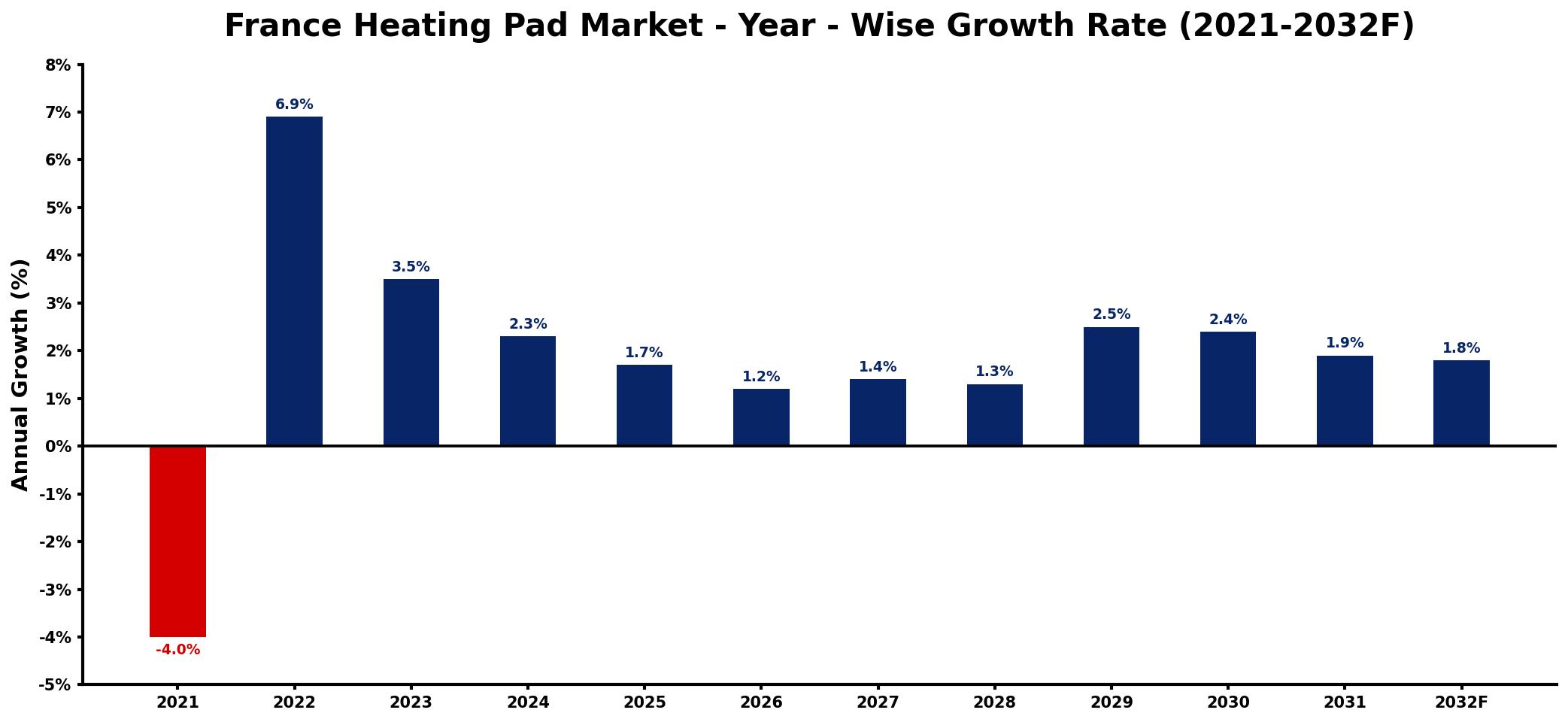
The table below presents the year‑wise growth rates along with the key drivers influencing the market
| Year | Growth Rate | Major Drivers |
| 2021 | -4.0% | decreased consumer spending on wellness |
| 2022 | 6.9% | growing interest in home comfort |
| 2023 | 3.5% | increased awareness of pain relief |
| 2024 | 2.3% | rising demand for self-care products |
| 2025 | 1.7% | expansion of online retail channels |
| 2026 | 1.2% | increased investment in health technologies |
| 2027 | 1.4% | growing popularity of wellness trends |
| 2028 | 1.3% | increased focus on personal health |
| 2029 | 2.5% | growing commercial sector adoption |
| 2030 | 2.4% | growing partnerships with health professionals |
| 2031 | 1.9% | rising consumer interest in relaxation |
| 2032 | 1.8% | increased adoption of home therapies |
Note: Market size estimations and growth projections presented in this report are based on 6Wresearch's proprietary forecasting methodology, utilizing the latest available industry data, government publications, and primary research inputs.
France Heating Pad Market Synopsis
The France Heating Pad Market is currently experiencing a notable shift, as an increasing number of individuals embrace heat therapy as a legitimate method for managing pain. Convenience and effectiveness have become key priorities for consumers, prompting a surge in demand for innovative heating pad products that fit modern lifestyles.
With the rise of portable and rechargeable designs, heating pads are no longer relegated to stationary use. This has opened avenues for manufacturers to cater to on-the-go individuals, reflecting a broader trend of prioritizing consumer comfort and functionality in the ever-evolving wellness landscape.
France Heating Pad Market Key Takeaways
- Steady market growth driven by increasing awareness of heat therapy benefits for pain relief.
- Product innovations focus on portability, advanced features, and eco-friendliness.
- Growing competition prompts companies to enhance product differentiation strategies.
- Challenges include adherence to safety regulations and price sensitivity among consumers.
- Investment opportunities are emerging in smart heating pads and sustainable product lines.
Evaluation of Restraints in France Heating Pad Market
Despite its promising growth, the France Heating Pad Market faces certain restraints that may limit its potential. The influx of both domestic and international brands intensifies competition, leading to aggressive pricing strategies that can erode profit margins. Furthermore, manufacturers must navigate stringent regulations regarding safety standards for electrical heating devices, which may increase production costs and complicate market entry for new players. Additionally, as consumer preferences evolve, the acceptance of alternative pain relief methods could pose challenges to traditional heating pad demand.
France Heating Pad Market Trends
Current trends indicate a strong consumer preference for heating pads equipped with advanced technology, such as adjustable temperature settings, automatic shut-off features, and rapid heating capabilities. Moreover, there is a noticeable shift towards eco-consciousness, with buyers actively seeking products made from organic or recycled materials. This trend towards sustainability, combined with the rise of wearable heating devices, is shaping a new market landscape that prioritizes consumer convenience and environmental responsibility.
France Heating Pad Market Opportunities
The France Heating Pad Market is ripe with investment opportunities, particularly in innovative product segments such as smart heating pads. These devices not only offer adjustable heat settings but also integrate features that allow for enhanced user control. Additionally, the increasing aging population and heightened awareness of therapeutic heat benefits present a compelling case for targeting niche markets, especially those focused on eco-friendly and sustainable products. Partnerships with healthcare providers and e-commerce platforms are also vital strategies for expanding market reach and tapping into new customer bases.
Government Initiatives in the France Heating Pad Market
Government policies in France regarding the Heating Pad Market emphasize consumer safety and product quality. Regulations are in place to ensure that heating pads meet defined safety standards, including temperature controls and adequate insulation. These standards are monitored by relevant governmental agencies to protect consumers from the risk of burns or electrical hazards. Compliance not only promotes safety but also enhances transparency in marketing and product labeling, ensuring consumers receive clear and accurate information about their purchases.
Future Insights of the France Heating Pad Market
Looking ahead to 2026-2032, the France Heating Pad Market is expected to continue its upward trajectory. As more consumers embrace self-care and seek effective, home-based solutions for pain relief, the demand for heating pads is anticipated to rise. Ongoing technological advancements will likely lead to the introduction of products with enhanced functionality, further broadening consumer appeal. The growing recognition of heat therapy as an essential part of wellness routines bodes well for sustained market growth in the coming years.
France Heating Pad Market Latest Developments (2025 - 2026)
Recent developments within the France Heating Pad Market indicate a strong focus on sustainability and technological integration. Companies are increasingly introducing eco-friendly heating pads made from organic materials, aligning with consumer demand for greener products. Additionally, there is a marked shift towards the launch of smart heating pads, equipped with mobile applications for monitoring and customization, reflecting the industry's responsiveness to consumer needs for convenience and efficiency.
France Heating Pad Market - Key Attractiveness of the Report
- 10 Years of Market Numbers
- Historical Data Starting from 2022 to 2025
- Base Year: 2025
- Forecast Data until 2032
- Key Performance Indicators Impacting the Market
- Major Upcoming Developments and Projects
Key Highlights of the Report:
- France Heating Pad Market Outlook
- Market Size of France Heating Pad Market, 2025
- Forecast of France Heating Pad Market, 2032
- Historical Data and Forecast of France Heating Pad Revenues & Volume for the Period 2022-2032F
- France Heating Pad Market Trend Evolution
- France Heating Pad Market Drivers and Challenges
- France Heating Pad Price Trends
- France Heating Pad Porter's Five Forces
- France Heating Pad Industry Life Cycle
- Historical Data and Forecast of France Heating Pad Market Revenues & Volume By Product for the Period 2022-2032F
- Historical Data and Forecast of France Heating Pad Market Revenues & Volume By Microwavable Heating Pad for the Period 2022-2032F
- Historical Data and Forecast of France Heating Pad Market Revenues & Volume By Water Heating Pad for the Period 2022-2032F
- Historical Data and Forecast of France Heating Pad Market Revenues & Volume By Electric Heating Pad for the Period 2022-2032F
- Historical Data and Forecast of France Heating Pad Market Revenues & Volume By Chemical Heating Pad for the Period 2022-2032F
- Historical Data and Forecast of France Heating Pad Market Revenues & Volume By Infrared Heating Pad for the Period 2022-2032F
- Historical Data and Forecast of France Heating Pad Market Revenues & Volume By Others for the Period 2022-2032F
- Historical Data and Forecast of France Heating Pad Market Revenues & Volume By Application for the Period 2022-2032F
- Historical Data and Forecast of France Heating Pad Market Revenues & Volume By Home for the Period 2022-2032F
- Historical Data and Forecast of France Heating Pad Market Revenues & Volume By Medical for the Period 2022-2032F
- Historical Data and Forecast of France Heating Pad Market Revenues & Volume By Commercial for the Period 2022-2032F
- Historical Data and Forecast of France Heating Pad Market Revenues & Volume By Others for the Period 2022-2032F
- Historical Data and Forecast of France Heating Pad Market Revenues & Volume By Selling Channel for the Period 2022-2032F
- Historical Data and Forecast of France Heating Pad Market Revenues & Volume By Direct for the Period 2022-2032F
- Historical Data and Forecast of France Heating Pad Market Revenues & Volume By Indirect for the Period 2022-2032F
- France Heating Pad Import Export Trade Statistics
- Market Opportunity Assessment By Product
- Market Opportunity Assessment By Application
- Market Opportunity Assessment By Selling Channel
- France Heating Pad Top Companies Market Share
- France Heating Pad Competitive Benchmarking By Technical and Operational Parameters
- France Heating Pad Company Profiles
- France Heating Pad Key Strategic Recommendations






































