France Higher Education Market Size & Growth Rate (2026-2032)
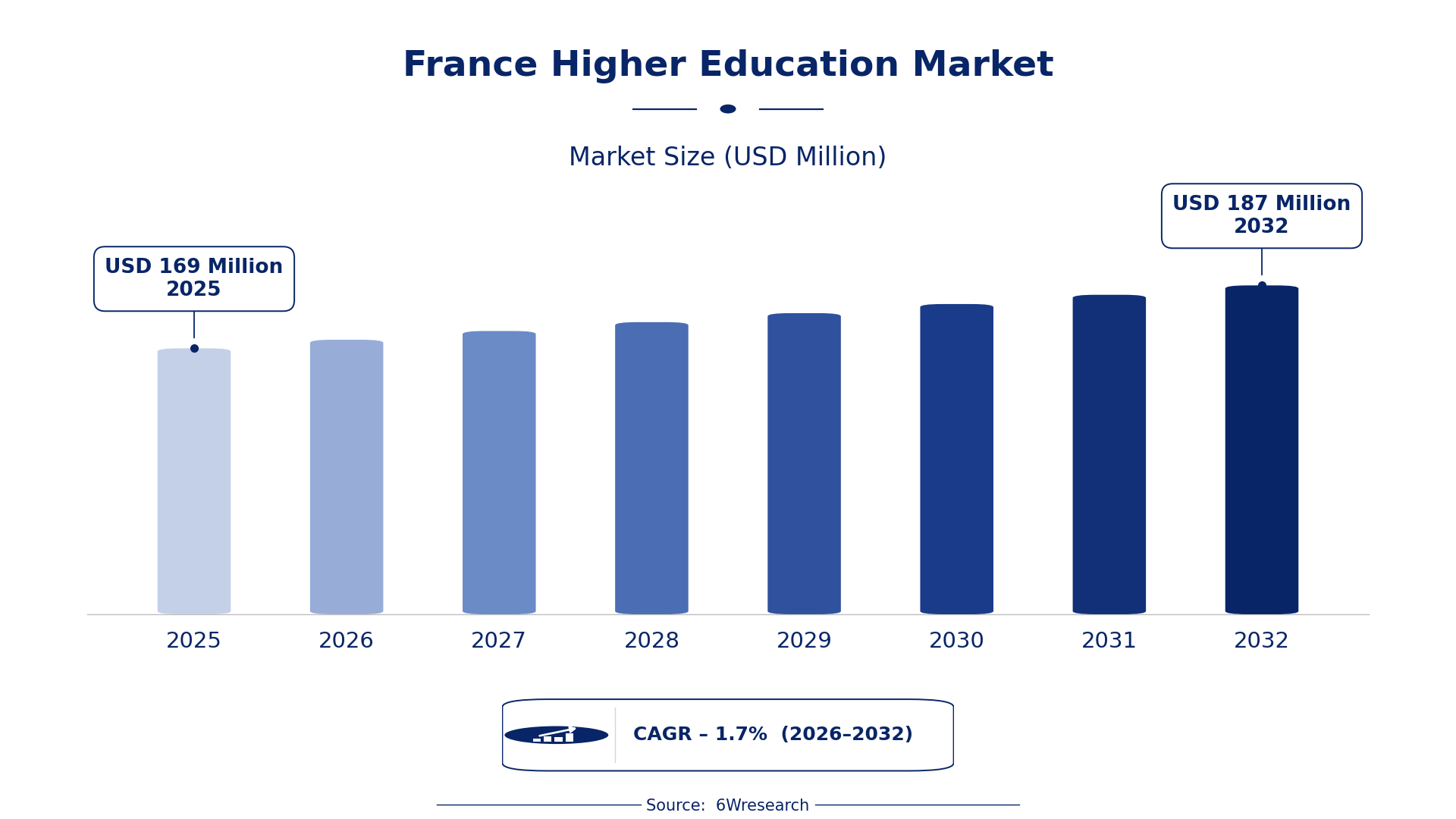
The France Higher Education Market was estimated at USD 169 Million in 2025 and is projected to reach USD 187 Million by 2032, growing at a CAGR of 1.7% from 2026 to 2032.
France Higher Education Market Synopsis
The France Higher Education Market is currently navigating a transformative phase characterized by rapid digitalization and increasing internationalization. As traditional methods of education face challenges from innovative models, institutions must evolve to meet the demands of a diverse and global student body.
Looking ahead, the market is set for steady growth fueled by government investments and a clear push towards modernization. As educational institutions embrace technology and forge partnerships with industry, they are laying the groundwork for a competitive and forward-thinking higher education sector in France.
France Higher Education Market Year-wise Growth Rate and Key Drivers
This graph illustrates the annual growth rates of the France Higher Education Market from 2021 to 2032, highlighting a steady upward trajectory and projected expansion over the forecast period.
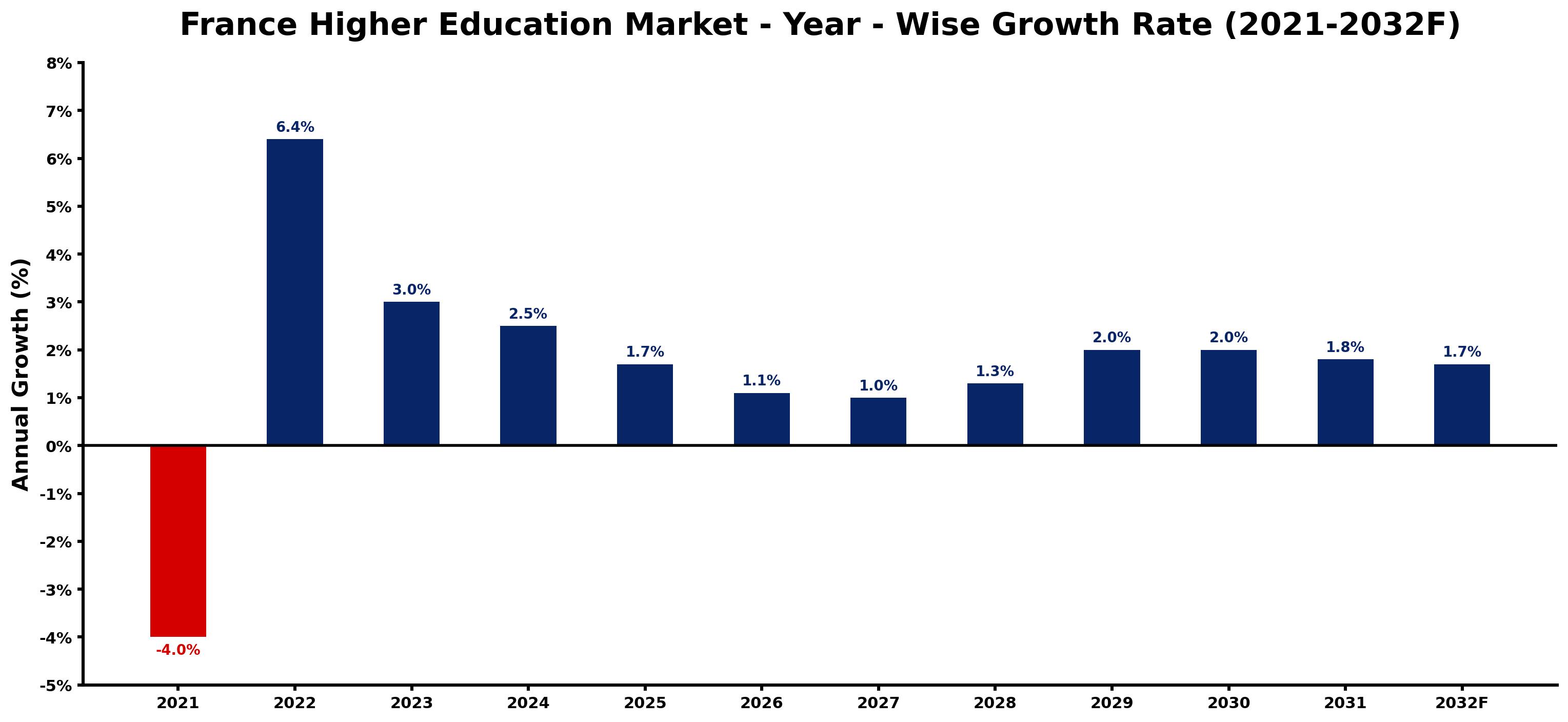
The table below presents the year‑wise growth rates along with the key drivers influencing the market
| Year | Growth Rate | Major Drivers |
| 2021 | -4.0% | Government budget cuts for higher education funding |
| 2022 | 6.4% | Increased emphasis on lifelong learning policies by France. |
| 2023 | 3.0% | Government grants supporting STEM education initiatives at universities. |
| 2024 | 2.5% | Growing interest in French culture among foreign students. |
| 2025 | 1.7% | Higher education reform enhancing vocational training pathways. |
| 2026 | 1.1% | Rising popularity of hybrid learning models post-pandemic. |
| 2027 | 1.0% | Investment in university infrastructure for research collaboration. |
| 2028 | 1.3% | Increased scholarships for underrepresented demographics in education. |
| 2029 | 2.0% | Local companies partnering with universities for talent development. |
| 2030 | 2.0% | Government promotion of study abroad programs for students. |
| 2031 | 1.8% | Surge in demand for entrepreneurship courses in universities. |
| 2032 | 1.7% | Enhanced digital infrastructure supporting remote learning capabilities. |
Note: Market size estimations and growth projections presented in this report are based on 6Wresearch's proprietary forecasting methodology, utilizing the latest available industry data, government publications, and primary research inputs.
France Higher Education Market Key Takeaways
Below are some of the specific key takeaways from the market, including:
- The growing demand for English-taught programs is attracting international students.
- Government initiatives are focused on improving access to higher education and enhancing academic quality.
- Technological advancements in e-learning platforms are reshaping educational delivery methods.
- Partnerships between academia and industry are essential for skill development and research collaboration.
- Funding constraints pose ongoing challenges for institutions aiming to innovate.
Evaluation of Restraints in France Higher Education Market
Budget constraints are a pressing concern for many higher education institutions in France. As funding sources become tighter, schools are forced to prioritize financial stability over innovation, which can stifle the development of new programs. Additionally, disparities in access to quality education remain an issue, particularly for marginalized groups. These challenges hinder the ability of institutions to adapt swiftly to the changing demands of the labor market.
France Higher Education Market Trends
Digital transformation is a defining trend reshaping the France Higher Education Market. Institutions are increasingly incorporating blended learning models to accommodate diverse student needs. The rise of online education platforms has introduced a competitive edge, prompting traditional universities to innovate. on top of that, there is a noticeable shift toward interdisciplinary programs that combine various fields to better prepare students for the complexities of the modern workforce.
France Higher Education Market Opportunities
With the government's renewed focus on innovation and academic excellence, significant growth opportunities exist. Expanding partnerships with technology firms for enhanced e-learning experiences can attract a broader student base. Additionally, developing niche programs catering to emerging industries will be crucial for institutions aiming to differentiate themselves. The emphasis on research collaboration with industry players presents another avenue for growth.
Government Initiatives in the France Higher Education Market
Government policy plays a critical role in shaping the higher education sector in France. Recent reforms aim to boost investment in education, ensuring that institutions can provide quality education while addressing access disparities. The emphasis on international collaboration and skill development aligns with France's commitment to fostering a competitive educational environment.
- A national program launched in early 2025 aimed to enhance digital infrastructure across universities, focusing on improved access to online resources.
- Currently, initiatives are underway to develop partnerships between higher education institutions and tech companies to foster innovation in curriculum design.
- A planned initiative expected to roll out by 2028 will focus on expanding scholarship programs for underrepresented students, enhancing equity in access to education.
- In 2026, a regulatory framework will be introduced to streamline accreditation processes and ensure quality standards across institutions.
- Ongoing efforts are directed towards creating more flexible learning environments that cater to non-traditional students.
Future Insights of the France Higher Education Market
The outlook for the France Higher Education Market between 2026 and 2032 appears positive, driven by ongoing governmental reforms and an increasing focus on technology integration. Institutions will need to adapt to the evolving educational landscape by prioritizing innovative teaching methodologies and fostering international collaborations. The emphasis on skill development relevant to emerging job markets will further enhance the sector's appeal and relevance.
France Higher Education Market Latest Developments
Recent months have seen a surge of activity within the France Higher Education Market as institutions respond to the need for modernization and improved access. Collaborations with industry partners are becoming more prevalent, aimed at aligning academic programs with market demands.
- An initiative that began in early 2025 focuses on integrating artificial intelligence tools into the classroom, enhancing personalized learning experiences.
- A major technology vendor announced a partnership with several universities in Q1 2026 to develop advanced online learning platforms.
- In 2025, a significant research collaboration project was launched, uniting multiple universities to tackle climate change through innovative academic programs.
- Another ongoing project involves the rollout of a national data-sharing platform designed to enhance academic research collaboration across institutions.
- Upcoming in late 2026, a public-private partnership is expected to enhance vocational training programs within universities.
France Higher Education Market - Key Attractiveness of the Report
- 10 Years of Market Numbers
- Historical Data Starting from 2022 to 2025
- Base Year: 2025
- Forecast Data until 2032
- Key Performance Indicators Impacting the Market
- Major Upcoming Developments and Projects
Key Highlights of the Report:
- France Higher Education Market Outlook
- Market Size of France Higher Education Market, 2025
- Forecast of France Higher Education Market, 2032
- Historical Data and Forecast of France Higher Education Revenues & Volume for the Period 2022-2032F
- France Higher Education Market Trend Evolution
- France Higher Education Market Drivers and Challenges
- France Higher Education Price Trends
- France Higher Education Porter's Five Forces
- France Higher Education Industry Life Cycle
- Historical Data and Forecast of France Higher Education Market Revenues & Volume By Component for the Period 2022-2032F
- Historical Data and Forecast of France Higher Education Market Revenues & Volume By Solutions for the Period 2022-2032F
- Historical Data and Forecast of France Higher Education Market Revenues & Volume By Services for the Period 2022-2032F
- Historical Data and Forecast of France Higher Education Market Revenues & Volume By Deployment Type for the Period 2022-2032F
- Historical Data and Forecast of France Higher Education Market Revenues & Volume By On-premises for the Period 2022-2032F
- Historical Data and Forecast of France Higher Education Market Revenues & Volume By Cloud for the Period 2022-2032F
- Historical Data and Forecast of France Higher Education Market Revenues & Volume By Vertical for the Period 2022-2032F
- Historical Data and Forecast of France Higher Education Market Revenues & Volume By State Universities for the Period 2022-2032F
- Historical Data and Forecast of France Higher Education Market Revenues & Volume By Community Colleges for the Period 2022-2032F
- Historical Data and Forecast of France Higher Education Market Revenues & Volume By Private Colleges for the Period 2022-2032F
- France Higher Education Import Export Trade Statistics
- Market Opportunity Assessment By Component
- Market Opportunity Assessment By Deployment Type
- Market Opportunity Assessment By Vertical
- France Higher Education Top Companies Market Share
- France Higher Education Competitive Benchmarking By Technical and Operational Parameters
- France Higher Education Company Profiles
- France Higher Education Key Strategic Recommendations






































