France Hyaluronic Acid Market Top 5 Importing Countries and Market Competition (HHI) Analysis
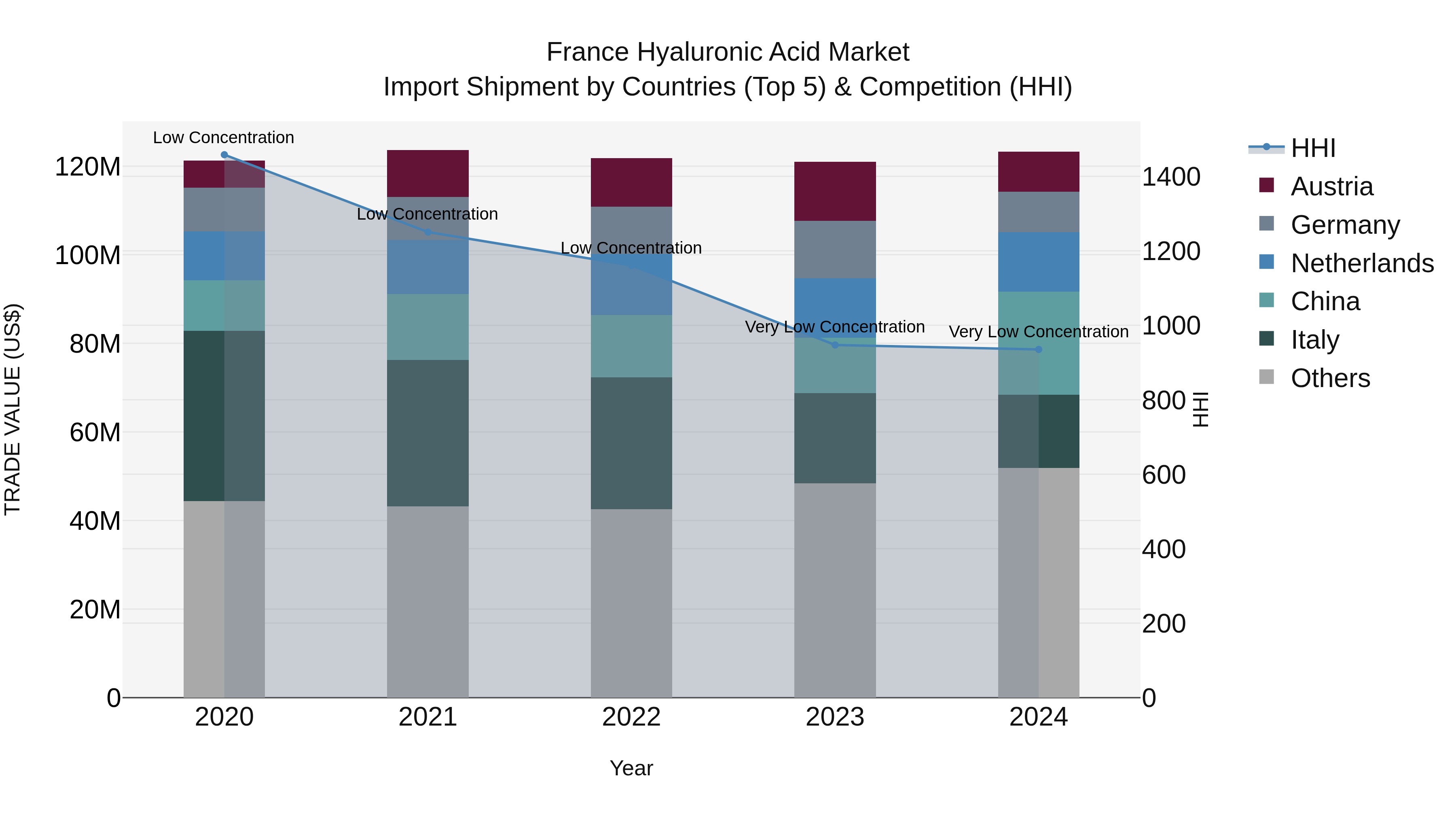
In 2024, France continued to see hyaluronic acid import shipments primarily sourced from China, Italy, Netherlands, Germany, and Austria. The market showed a low concentration with a stable Herfindahl-Hirschman Index (HHI). The compound annual growth rate (CAGR) from 2020 to 2024 was modest at 0.4%, while the growth rate from 2023 to 2024 saw a slight uptick at 1.88%. This indicates a steady but gradual increase in the demand for hyaluronic acid products in France, driven by imports from key exporting countries.
France Hyaluronic Acid Market Overview
The France hyaluronic acid market is experiencing steady growth driven by the rising demand for cosmetic procedures such as dermal fillers and anti-aging treatments. Hyaluronic acid is widely used in the beauty and skincare industry due to its hydrating and anti-aging properties. The market is witnessing increasing adoption in both medical and cosmetic applications, with a growing number of consumers seeking non-invasive beauty treatments. Key players in the market include pharmaceutical companies, cosmetic manufacturers, and medical device suppliers. The market is also supported by advancements in technology and research, leading to the development of innovative hyaluronic acid-based products. Overall, the France hyaluronic acid market is expected to continue its growth trajectory, driven by the increasing focus on personal care and aesthetics.
France Hyaluronic Acid Market Trends
The hyaluronic acid market in France is experiencing significant growth due to the rising demand for skincare products and aesthetic treatments. Consumers are increasingly seeking out hyaluronic acid-based products for their anti-aging and hydrating properties. In addition, the popularity of non-invasive cosmetic procedures such as dermal fillers using hyaluronic acid has contributed to the market`s expansion. Companies are focusing on developing innovative formulations and expanding their product portfolios to cater to the diverse needs of consumers. The market is also witnessing a trend towards natural and organic hyaluronic acid products, driven by growing consumer awareness and preferences for clean beauty products. Overall, the France hyaluronic acid market is poised for continued growth in the foreseeable future.
France Hyaluronic Acid Market Challenges
In the France hyaluronic acid market, some of the key challenges include intense competition among manufacturers and suppliers, leading to price wars and pressure on profit margins. Additionally, regulatory hurdles and stringent requirements for product approval and marketing authorization can pose obstacles for new market entrants. Consumer education and awareness efforts are also needed to overcome misconceptions and promote the benefits of hyaluronic acid products effectively. Furthermore, the market is constantly evolving with the introduction of new technologies and product innovations, requiring companies to stay updated and invest in research and development to remain competitive. Overall, navigating these challenges require strategic planning, strong branding, and a deep understanding of consumer preferences and market dynamics.
France Hyaluronic Acid Market Investment Opportunities
The France hyaluronic acid market presents promising investment opportunities due to the growing demand for cosmetic and medical applications. With an increasing aging population and rising awareness about skincare, there is a rising trend in the use of hyaluronic acid in anti-aging treatments, dermal fillers, and skincare products. Additionally, hyaluronic acid is being widely used in the medical field for joint injections, ophthalmic surgery, and wound healing. Investing in companies that specialize in producing and distributing hyaluronic acid products, as well as research and development for innovative applications, could yield favorable returns in the French market. Keeping abreast of regulatory changes, technological advancements, and consumer preferences will be key in identifying and capitalizing on lucrative opportunities in the hyaluronic acid sector.
France Hyaluronic Acid Market Government Policy
In France, the hyaluronic acid market is regulated by government policies primarily focused on ensuring product safety and efficacy. The use of hyaluronic acid in cosmetic products is subject to strict regulations set by the European Union, which France adheres to. The French regulatory authorities, including the National Agency for the Safety of Medicines and Health Products (ANSM) and the Directorate General for Competition, Consumer Affairs, and Fraud Control (DGCCRF), oversee the marketing and distribution of hyaluronic acid-based products to ensure compliance with quality standards. Additionally, healthcare providers must adhere to guidelines issued by the French Society of Plastic, Reconstructive, and Aesthetic Surgery (SOF.CPRE) when using hyaluronic acid for medical purposes, such as dermal fillers. Overall, these government policies aim to protect consumer safety and uphold the quality of hyaluronic acid products in the French market.
France Hyaluronic Acid Market Future Outlook
The future outlook for the hyaluronic acid market in France looks promising, with steady growth anticipated in the coming years. Factors such as increasing consumer demand for anti-aging and skincare products, rising awareness about the benefits of hyaluronic acid in cosmetics, and advancements in technology for hyaluronic acid production are expected to drive market expansion. Additionally, the growing trend of non-invasive cosmetic procedures and the rising preference for natural and organic beauty products are likely to further boost the demand for hyaluronic acid-based skincare solutions in the French market. With a strong emphasis on beauty and wellness in the region, coupled with a growing aging population, the France hyaluronic acid market is poised for sustained growth and innovation in the foreseeable future.
Key Highlights of the Report:
- France Hyaluronic Acid Market Outlook
- Market Size of France Hyaluronic Acid Market,2024
- Forecast of France Hyaluronic Acid Market, 2031
- Historical Data and Forecast of France Hyaluronic Acid Revenues & Volume for the Period 2021-2031
- France Hyaluronic Acid Market Trend Evolution
- France Hyaluronic Acid Market Drivers and Challenges
- France Hyaluronic Acid Price Trends
- France Hyaluronic Acid Porter's Five Forces
- France Hyaluronic Acid Industry Life Cycle
- Historical Data and Forecast of France Hyaluronic Acid Market Revenues & Volume By Type for the Period 2021-2031
- Historical Data and Forecast of France Hyaluronic Acid Market Revenues & Volume By High Molecular Weight for the Period 2021-2031
- Historical Data and Forecast of France Hyaluronic Acid Market Revenues & Volume By Medium Molecular Weight for the Period 2021-2031
- Historical Data and Forecast of France Hyaluronic Acid Market Revenues & Volume By Low Molecular Weight for the Period 2021-2031
- Historical Data and Forecast of France Hyaluronic Acid Market Revenues & Volume By Cross-Linked for the Period 2021-2031
- Historical Data and Forecast of France Hyaluronic Acid Market Revenues & Volume By Non-Cross-Linked for the Period 2021 - 2029
- Historical Data and Forecast of France Hyaluronic Acid Market Revenues & Volume By Application for the Period 2021-2031
- Historical Data and Forecast of France Hyaluronic Acid Market Revenues & Volume By Dermatology for the Period 2021-2031
- Historical Data and Forecast of France Hyaluronic Acid Market Revenues & Volume By Ophthalmology for the Period 2021-2031
- Historical Data and Forecast of France Hyaluronic Acid Market Revenues & Volume By Orthopedics for the Period 2021-2031
- Historical Data and Forecast of France Hyaluronic Acid Market Revenues & Volume By Wound Healing for the Period 2021-2031
- Historical Data and Forecast of France Hyaluronic Acid Market Revenues & Volume By Cosmetics for the Period 2021 - 2029
- Historical Data and Forecast of France Hyaluronic Acid Market Revenues & Volume By End Use for the Period 2021-2031
- Historical Data and Forecast of France Hyaluronic Acid Market Revenues & Volume By Personal Care for the Period 2021-2031
- Historical Data and Forecast of France Hyaluronic Acid Market Revenues & Volume By Pharmaceuticals for the Period 2021-2031
- Historical Data and Forecast of France Hyaluronic Acid Market Revenues & Volume By Dietary Supplements for the Period 2021-2031
- Historical Data and Forecast of France Hyaluronic Acid Market Revenues & Volume By Food & Beverages for the Period 2021-2031
- Historical Data and Forecast of France Hyaluronic Acid Market Revenues & Volume By Biotech Research for the Period 2021 - 2029
- Historical Data and Forecast of France Hyaluronic Acid Market Revenues & Volume By Form for the Period 2021-2031
- Historical Data and Forecast of France Hyaluronic Acid Market Revenues & Volume By Powder for the Period 2021-2031
- Historical Data and Forecast of France Hyaluronic Acid Market Revenues & Volume By Liquid for the Period 2021-2031
- Historical Data and Forecast of France Hyaluronic Acid Market Revenues & Volume By Gel for the Period 2021-2031
- Historical Data and Forecast of France Hyaluronic Acid Market Revenues & Volume By Solution for the Period 2021-2031
- Historical Data and Forecast of France Hyaluronic Acid Market Revenues & Volume By Injectable for the Period 2021 - 2029
- Historical Data and Forecast of France Hyaluronic Acid Market Revenues & Volume By Source for the Period 2021-2031
- Historical Data and Forecast of France Hyaluronic Acid Market Revenues & Volume By Synthetic for the Period 2021-2031
- Historical Data and Forecast of France Hyaluronic Acid Market Revenues & Volume By Natural (Fermentation) for the Period 2021-2031
- Historical Data and Forecast of France Hyaluronic Acid Market Revenues & Volume By Animal-Based for the Period 2021-2031
- Historical Data and Forecast of France Hyaluronic Acid Market Revenues & Volume By Plant-Based for the Period 2021 - 2029
- Historical Data and Forecast of France Hyaluronic Acid Market Revenues & Volume By Microbial Fermentation for the Period 2021 - 2029
- France Hyaluronic Acid Import Export Trade Statistics
- Market Opportunity Assessment By Type
- Market Opportunity Assessment By Application
- Market Opportunity Assessment By End Use
- Market Opportunity Assessment By Form
- Market Opportunity Assessment By Source
- France Hyaluronic Acid Top Companies Market Share
- France Hyaluronic Acid Competitive Benchmarking By Technical and Operational Parameters
- France Hyaluronic Acid Company Profiles
- France Hyaluronic Acid Key Strategic Recommendations






































