France Industrial Chain Market Top 5 Importing Countries and Market Competition (HHI) Analysis
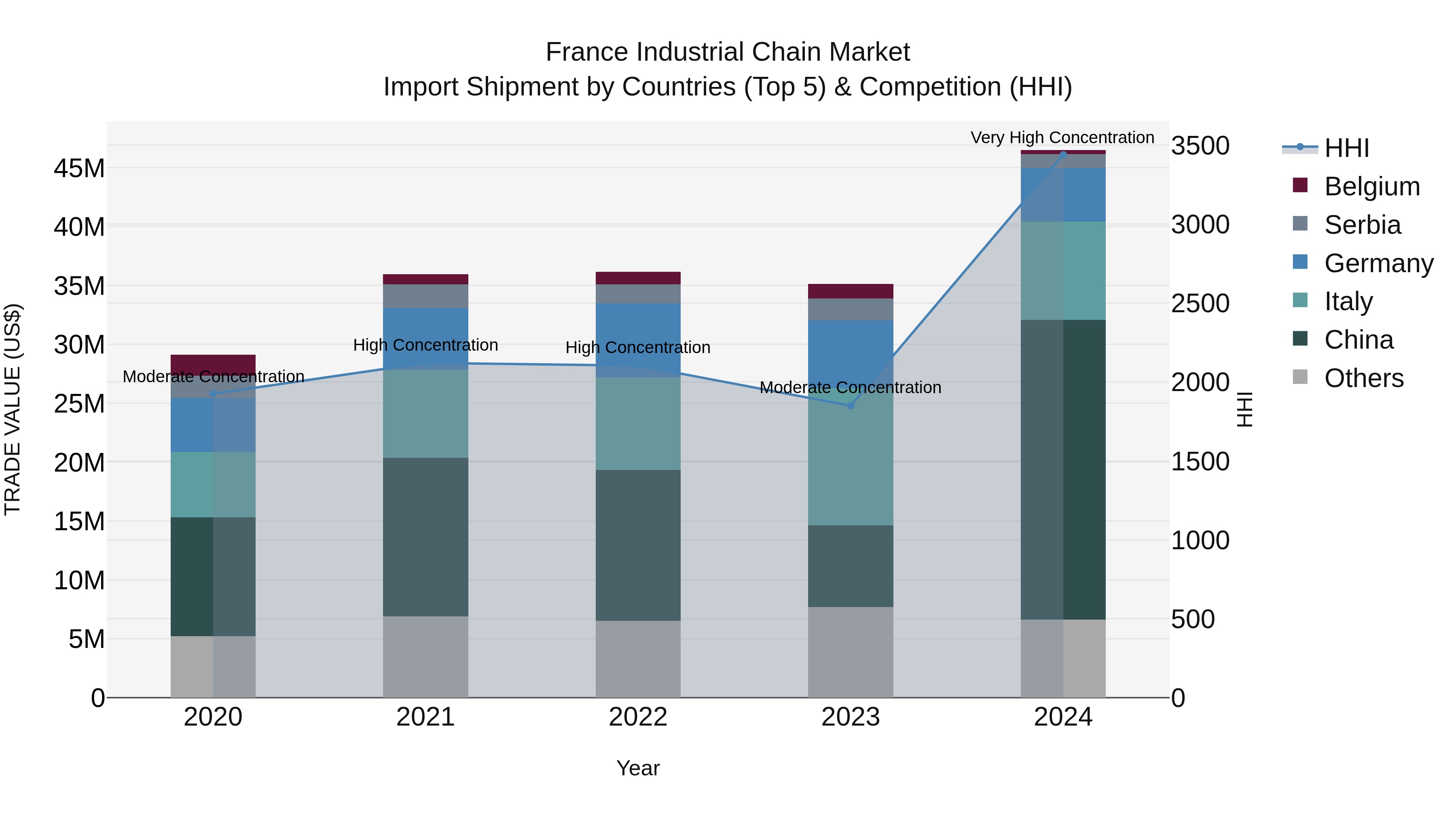
France`s industrial chain import shipments saw a significant shift in 2024, with China, Italy, Germany, Serbia, and Spain emerging as the top exporting countries. The market exhibited a notable increase in concentration, moving from moderate to very high in just a year. The impressive compound annual growth rate of 12.41% from 2020 to 2024, coupled with a remarkable growth rate of 32.31% in 2024, indicates a robust and rapidly expanding market for industrial chain imports in France. This data suggests a dynamic and evolving landscape for international trade in the industrial sector.
France Industrial Chain Market Market Overview
The industrial chain market in France is characterized by a diverse range of industries including automotive, aerospace, chemicals, machinery, and electronics. The country`s well-developed infrastructure, skilled labor force, and strong emphasis on innovation have made it a key player in the global industrial chain market. French companies are known for their high-quality products, advanced manufacturing techniques, and commitment to sustainability. The industrial chain market in France is supported by a robust network of suppliers, manufacturers, and service providers, creating a competitive ecosystem that drives growth and innovation. With a focus on digital transformation and Industry 4.0 technologies, the French industrial chain market continues to evolve and adapt to meet the changing demands of the global economy.
France Industrial Chain Market Trends
In the France industrial chain market, there are several key trends emerging. One significant trend is the increasing adoption of automation and digitalization across the supply chain to enhance efficiency and streamline operations. This includes the implementation of technologies such as Artificial Intelligence, Internet of Things, and data analytics to optimize production processes and improve overall performance. Another notable trend is the focus on sustainability and environmental responsibility, with companies seeking to reduce their carbon footprint and implement eco-friendly practices throughout the industrial chain. Additionally, there is a growing emphasis on collaboration and partnerships within the industry to drive innovation and address complex challenges collectively. Overall, these trends are shaping the France industrial chain market towards a more advanced, sustainable, and interconnected ecosystem.
France Industrial Chain Market Challenges
In the France industrial chain market, some key challenges include increasing competition from other global players, rising production costs, stringent regulatory requirements, and the need for continuous innovation to stay ahead. Companies in the industrial chain sector are also facing pressure to adopt sustainable practices and reduce their carbon footprint to align with environmental regulations and consumer preferences. Additionally, disruptions in the global supply chain, such as trade tensions and the impact of the COVID-19 pandemic, have highlighted the importance of building resilience and flexibility in operations. Overall, navigating these challenges requires companies to invest in technology, streamline processes, and adapt quickly to changing market dynamics to remain competitive and sustainable in the long term.
France Industrial Chain Market Investment Opportunities
In the France industrial chain market, there are several investment opportunities worth considering. Firstly, the renewable energy sector presents promising prospects, with increasing focus on sustainability and government incentives driving growth in areas such as wind and solar power generation. Additionally, the advanced manufacturing sector, particularly in industries like aerospace and automotive, offers opportunities for investment in cutting-edge technologies and automation solutions. Investing in logistics and supply chain management companies can also be lucrative, given France`s strategic location in Europe and the growing demand for efficient transportation services. Lastly, with the rise of Industry 4.0, investing in digital transformation and IoT solutions for industrial applications can provide long-term returns as companies modernize their operations. Overall, the France industrial chain market offers diverse opportunities for investors looking to capitalize on innovation and growth trends.
France Industrial Chain Market Government Policy
In France, government policies related to the industrial chain market focus on promoting innovation, sustainability, and competitiveness. The French government has implemented measures to support the development of key industries through investment in research and development, as well as fostering collaboration between businesses and research institutions. Additionally, there are initiatives in place to encourage the adoption of digital technologies and the transition towards a more sustainable economy. The government also provides support for small and medium-sized enterprises (SMEs) to help them grow and compete in the global market. Overall, the policies aim to strengthen the industrial chain market in France by fostering innovation, sustainability, and competitiveness in key sectors.
France Industrial Chain Market Future Outlook
The future outlook for the France industrial chain market appears promising, driven by factors such as increasing industrialization, technological advancements, and a growing focus on sustainability. With a strong manufacturing sector and emphasis on innovation, the demand for industrial chains is expected to remain robust in various industries such as automotive, aerospace, and construction. Additionally, the adoption of automation and Industry 4.0 practices is likely to drive the need for high-quality and durable industrial chains to ensure efficient operations. As companies strive to enhance productivity and reduce downtime, there is a growing trend towards customized and specialized industrial chains, presenting opportunities for market growth and innovation in the France industrial chain sector.
Key Highlights of the Report:
- France Industrial Chain Market Outlook
- Market Size of France Industrial Chain Market,2024
- Forecast of France Industrial Chain Market, 2031
- Historical Data and Forecast of France Industrial Chain Revenues & Volume for the Period 2021-2031
- France Industrial Chain Market Trend Evolution
- France Industrial Chain Market Drivers and Challenges
- France Industrial Chain Price Trends
- France Industrial Chain Porter's Five Forces
- France Industrial Chain Industry Life Cycle
- Historical Data and Forecast of France Industrial Chain Market Revenues & Volume By Chain Type for the Period 2021-2031
- Historical Data and Forecast of France Industrial Chain Market Revenues & Volume By Roller Chains for the Period 2021-2031
- Historical Data and Forecast of France Industrial Chain Market Revenues & Volume By Leaf Chains for the Period 2021-2031
- Historical Data and Forecast of France Industrial Chain Market Revenues & Volume By Silent Chains for the Period 2021-2031
- Historical Data and Forecast of France Industrial Chain Market Revenues & Volume By Engineered Chains for the Period 2021-2031
- Historical Data and Forecast of France Industrial Chain Market Revenues & Volume By Material Used for the Period 2021-2031
- Historical Data and Forecast of France Industrial Chain Market Revenues & Volume By Stainless Steel for the Period 2021-2031
- Historical Data and Forecast of France Industrial Chain Market Revenues & Volume By Carbon Steel for the Period 2021-2031
- Historical Data and Forecast of France Industrial Chain Market Revenues & Volume By Alloy Steel for the Period 2021-2031
- Historical Data and Forecast of France Industrial Chain Market Revenues & Volume By Nickel-Plated Steel for the Period 2021-2031
- Historical Data and Forecast of France Industrial Chain Market Revenues & Volume By Application for the Period 2021-2031
- Historical Data and Forecast of France Industrial Chain Market Revenues & Volume By Conveyor Systems for the Period 2021-2031
- Historical Data and Forecast of France Industrial Chain Market Revenues & Volume By Power Transmission for the Period 2021-2031
- Historical Data and Forecast of France Industrial Chain Market Revenues & Volume By Lifting Applications for the Period 2021-2031
- Historical Data and Forecast of France Industrial Chain Market Revenues & Volume By Mining & Drilling for the Period 2021-2031
- Historical Data and Forecast of France Industrial Chain Market Revenues & Volume By End User for the Period 2021-2031
- Historical Data and Forecast of France Industrial Chain Market Revenues & Volume By Manufacturing for the Period 2021-2031
- Historical Data and Forecast of France Industrial Chain Market Revenues & Volume By Automotive for the Period 2021-2031
- Historical Data and Forecast of France Industrial Chain Market Revenues & Volume By Construction for the Period 2021-2031
- Historical Data and Forecast of France Industrial Chain Market Revenues & Volume By Oil & Gas for the Period 2021-2031
- Historical Data and Forecast of France Industrial Chain Market Revenues & Volume By Sales Model for the Period 2021-2031
- Historical Data and Forecast of France Industrial Chain Market Revenues & Volume By Direct Sales for the Period 2021-2031
- Historical Data and Forecast of France Industrial Chain Market Revenues & Volume By Distributors for the Period 2021-2031
- Historical Data and Forecast of France Industrial Chain Market Revenues & Volume By Online Suppliers for the Period 2021-2031
- Historical Data and Forecast of France Industrial Chain Market Revenues & Volume By Industrial Suppliers for the Period 2021 - 2029
- France Industrial Chain Import Export Trade Statistics
- Market Opportunity Assessment By Chain Type
- Market Opportunity Assessment By Material Used
- Market Opportunity Assessment By Application
- Market Opportunity Assessment By End User
- Market Opportunity Assessment By Sales Model
- France Industrial Chain Top Companies Market Share
- France Industrial Chain Competitive Benchmarking By Technical and Operational Parameters
- France Industrial Chain Company Profiles
- France Industrial Chain Key Strategic Recommendations






































