France Industrial Vacuum Cleaner Market Size, Share & Growth Rate
The France Industrial Vacuum Cleaner Market was estimated at USD 204 Million in 2025 and is projected to reach USD 229 Million by 2032, growing at a CAGR of 1.7% from 2026 to 2032. This growth trajectory is primarily driven by an increasing emphasis on workplace hygiene and the enforcement of safety regulations in various industrial sectors. As enterprises recognize the importance of maintaining a clean working environment, the demand for high-performance industrial vacuum cleaners continues to rise, particularly in manufacturing and healthcare settings.
France Industrial Vacuum Cleaner Market Year-wise Growth Rate and Key Drivers
This graph highlights how the France Industrial Vacuum Cleaner Market has steadily grown over the years, supported by major growth factors.
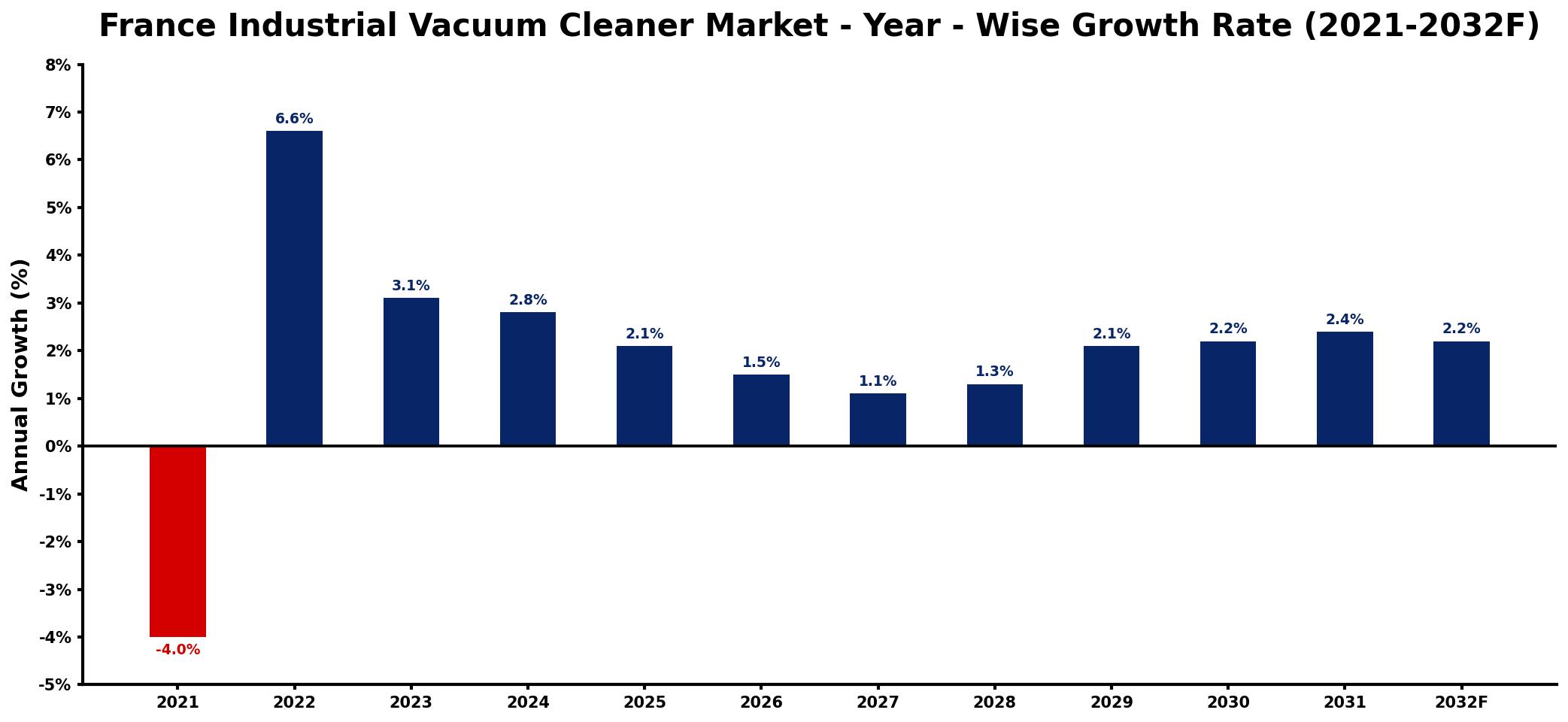
The table below presents the year‑wise growth rates along with the key drivers influencing the market
| Year | Growth Rate | Major Drivers |
| 2021 | -4.0% | decrease in manufacturing activities |
| 2022 | 6.6% | rising demand in construction sector |
| 2023 | 3.1% | growth in logistics and warehouses |
| 2024 | 2.8% | increased focus on sustainability practices |
| 2025 | 2.1% | expansion of food processing facilities |
| 2026 | 1.5% | investment in healthcare infrastructure |
| 2027 | 1.1% | emergence of smart factories |
| 2028 | 1.3% | strengthening international trade flows |
| 2029 | 2.1% | increased regulations on waste management |
| 2030 | 2.2% | development of green technologies |
| 2031 | 2.4% | enhanced automation in production |
| 2032 | 2.2% | rising importance of hygiene standards |
Note: Market size estimations and growth projections presented in this report are based on 6Wresearch's proprietary forecasting methodology, utilizing the latest available industry data, government publications, and primary research inputs.
France Industrial Vacuum Cleaner Market Synopsis
The French industrial landscape is witnessing a significant shift towards advanced cleaning solutions that incorporate high suction power and HEPA filtration. With stringent regulations promoting environmental sustainability, the adoption of industrial vacuum cleaners is increasingly becoming integral to operational efficiency across sectors such as construction and food processing.
Furthermore, innovations in vacuum technology are enhancing the appeal of industrial vacuums, making them not only more efficient but also energy-conscious. These developments are crucial for industries aiming to optimize operational costs while adhering to health and safety standards.
France Industrial Vacuum Cleaner Market Key Takeaways
- The market is bolstered by a legislative push towards improved workplace safety and hygiene practices.
- Technological advancements such as HEPA filtration systems are gaining traction among industrial users.
- Demand for specialized vacuum equipment is rising due to increasing automation in manufacturing.
- Environmental regulations are reshaping product designs and operational practices.
- High suction power and rugged construction are essential features driving purchasing decisions.
Evaluation of Restraints in France Industrial Vacuum Cleaner Market
Despite the robust growth potential, the France Industrial Vacuum Cleaner Market faces notable challenges. One significant restraint is the optimization of suction power tailored for diverse industrial debris types, which requires continual innovation. Additionally, addressing noise and vibration concerns remains a priority, particularly in sectors sensitive to operational disruptions. Manufacturers must also focus on ensuring the durability and reliability of vacuum cleaners in harsh industrial environments, which could limit market expansion if not adequately addressed.
France Industrial Vacuum Cleaner Market Trends
The market is currently influenced by trends toward greater automation and the integration of smart technologies in vacuum cleaning solutions. Many manufacturers are investing in Internet of Things (IoT) capabilities that enable remote monitoring and control, which enhances operational efficiency. Additionally, there is a clear shift towards eco-friendly designs, with firms prioritizing energy-efficient motors and sustainable materials, reflecting broader environmental objectives.
France Industrial Vacuum Cleaner Market Opportunities
Opportunities abound in the France Industrial Vacuum Cleaner Market, particularly in sectors that are expanding rapidly, such as cleanroom technology in pharmaceuticals and biotechnology. Companies can leverage this growth by developing specialized vacuum systems that cater to the stringent cleanliness standards required in these environments. Moreover, as industries invest in automation, the demand for vacuum solutions that seamlessly integrate with robotic systems is expected to surge, marking a significant growth avenue for innovative manufacturers.
Government Initiatives in the France Industrial Vacuum Cleaner Market
French government policies increasingly emphasize workplace safety, which directly impacts the industrial vacuum cleaner market. Initiatives aimed at improving operational standards often include strict safety regulations for equipment usage and mandatory training programs for operators. Additionally, environmental protection regulations compel manufacturers to focus on emission controls and eco-friendly disposal practices, aligning with both national and EU sustainability goals.
Future Insights of the France Industrial Vacuum Cleaner Market
Looking ahead to 2026-2032, the France Industrial Vacuum Cleaner Market is poised for continued growth, primarily driven by technological advancements and evolving regulatory landscapes. The increasing awareness of health risks associated with poor air quality will further bolster the demand for effective industrial cleaning solutions. Companies that innovate in energy efficiency and filtration technology will likely capture a significant share of the market as businesses pursue both compliance and sustainability.
France Industrial Vacuum Cleaner Market Latest Developments (2025 - 2026)
Recent developments in the industrial vacuum cleaner sector indicate a strong focus on enhancing the performance and adaptability of cleaning solutions. Innovations in filtration technology are being rapidly adopted, alongside improvements in noise reduction features to meet industry demands. Additionally, manufacturers are increasingly exploring collaborative partnerships to enhance product offerings and expand into emerging sectors, ensuring they remain competitive in a shifting landscape.
France Industrial Vacuum Cleaner Market - Key Attractiveness of the Report
- 10 Years of Market Numbers
- Historical Data Starting from 2022 to 2025
- Base Year: 2025
- Forecast Data until 2032
- Key Performance Indicators Impacting the Market
- Major Upcoming Developments and Projects
Key Highlights of the Report:
- France Industrial Vacuum Cleaner Market Outlook
- Market Size of France Industrial Vacuum Cleaner Market, 2025
- Forecast of France Industrial Vacuum Cleaner Market, 2032
- Historical Data and Forecast of France Industrial Vacuum Cleaner Revenues & Volume for the Period 2022-2032F
- France Industrial Vacuum Cleaner Market Trend Evolution
- France Industrial Vacuum Cleaner Market Drivers and Challenges
- France Industrial Vacuum Cleaner Price Trends
- France Industrial Vacuum Cleaner Porter's Five Forces
- France Industrial Vacuum Cleaner Industry Life Cycle
- Historical Data and Forecast of France Industrial Vacuum Cleaner Market Revenues & Volume By Type for the Period 2022-2032F
- Historical Data and Forecast of France Industrial Vacuum Cleaner Market Revenues & Volume By Dry for the Period 2022-2032F
- Historical Data and Forecast of France Industrial Vacuum Cleaner Market Revenues & Volume By Wet & Dry for the Period 2022-2032F
- Historical Data and Forecast of France Industrial Vacuum Cleaner Market Revenues & Volume By Power Source for the Period 2022-2032F
- Historical Data and Forecast of France Industrial Vacuum Cleaner Market Revenues & Volume By Electric for the Period 2022-2032F
- Historical Data and Forecast of France Industrial Vacuum Cleaner Market Revenues & Volume By Pneumatic for the Period 2022-2032F
- Historical Data and Forecast of France Industrial Vacuum Cleaner Market Revenues & Volume By Industry for the Period 2022-2032F
- Historical Data and Forecast of France Industrial Vacuum Cleaner Market Revenues & Volume By Food & Beverages for the Period 2022-2032F
- Historical Data and Forecast of France Industrial Vacuum Cleaner Market Revenues & Volume By Metalworking for the Period 2022-2032F
- Historical Data and Forecast of France Industrial Vacuum Cleaner Market Revenues & Volume By Pharmaceuticals for the Period 2022-2032F
- Historical Data and Forecast of France Industrial Vacuum Cleaner Market Revenues & Volume By Manufacturing for the Period 2022-2032F
- Historical Data and Forecast of France Industrial Vacuum Cleaner Market Revenues & Volume By Building & Construction for the Period 2022-2032F
- Historical Data and Forecast of France Industrial Vacuum Cleaner Market Revenues & Volume By Others for the Period 2022-2032F
- France Industrial Vacuum Cleaner Import Export Trade Statistics
- Market Opportunity Assessment By Type
- Market Opportunity Assessment By Power Source
- Market Opportunity Assessment By Industry
- France Industrial Vacuum Cleaner Top Companies Market Share
- France Industrial Vacuum Cleaner Competitive Benchmarking By Technical and Operational Parameters
- France Industrial Vacuum Cleaner Company Profiles
- France Industrial Vacuum Cleaner Key Strategic Recommendations






































