France Inorganic Chemicals Market Size (2020-2030)
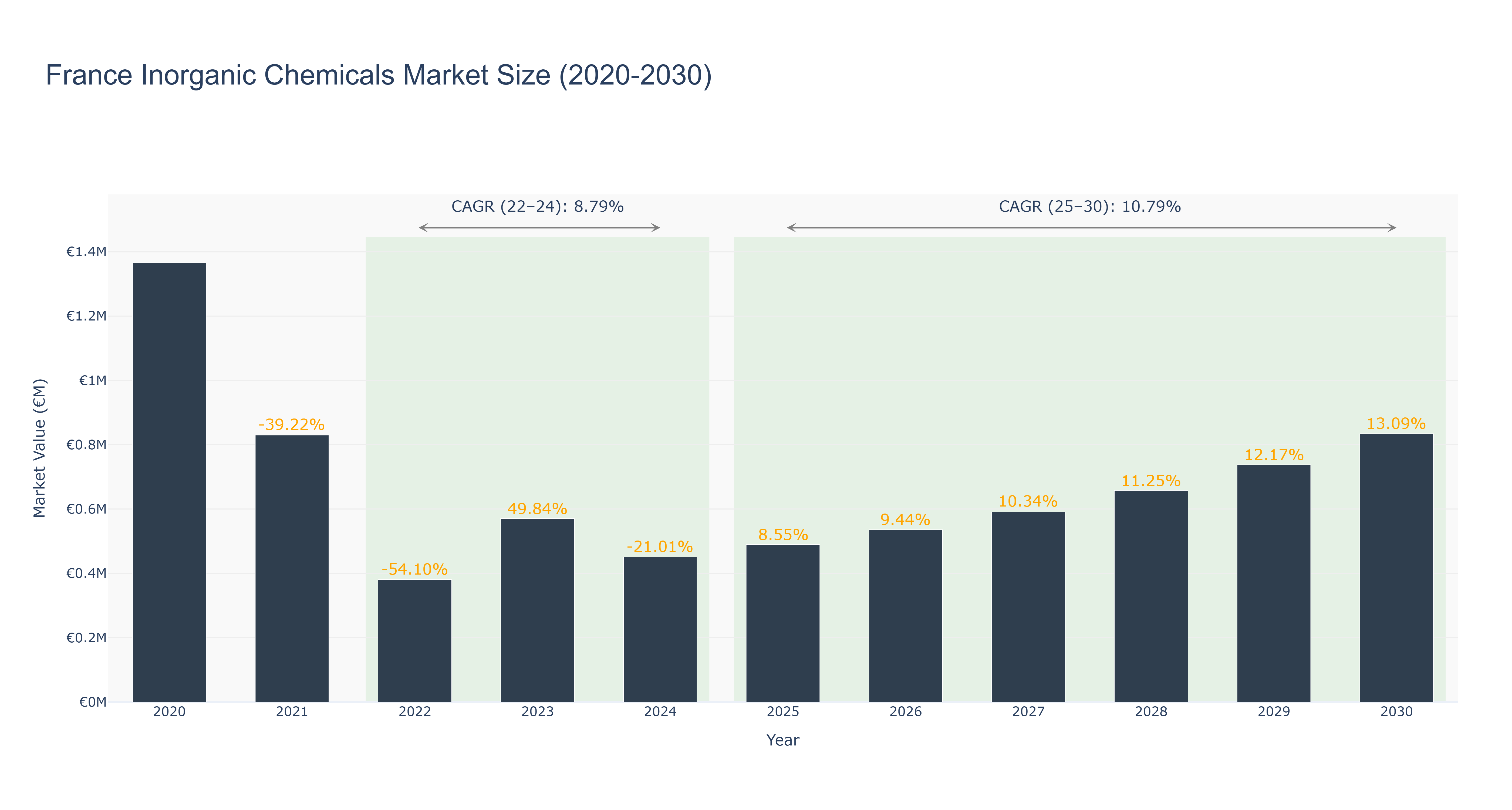
France Inorganic Chemicals Market has seen a fluctuating trend in market size over the years. The peak market size of €1.37 million was recorded in 2020. However, from 2020 to 2024, the market size decreased steadily, reaching €0.45 million in 2024. The forecasted market size shows a positive growth trend from 2025 to 2030, with an estimated size of €0.83 million in 2030. The CAGR for the period 2022-24 is 8.79%, while for 2025-30, it is projected to be 10.79%. The decline in market size in the early 2020s can be attributed to global economic slowdowns, while the expected growth in the coming years is driven by increasing demand for inorganic chemicals in various industries. Recent developments in sustainable production methods are expected to drive further growth in the French inorganic chemicals market.
France Inorganic Chemicals Market: Production & Trade Performance (2019-2025)
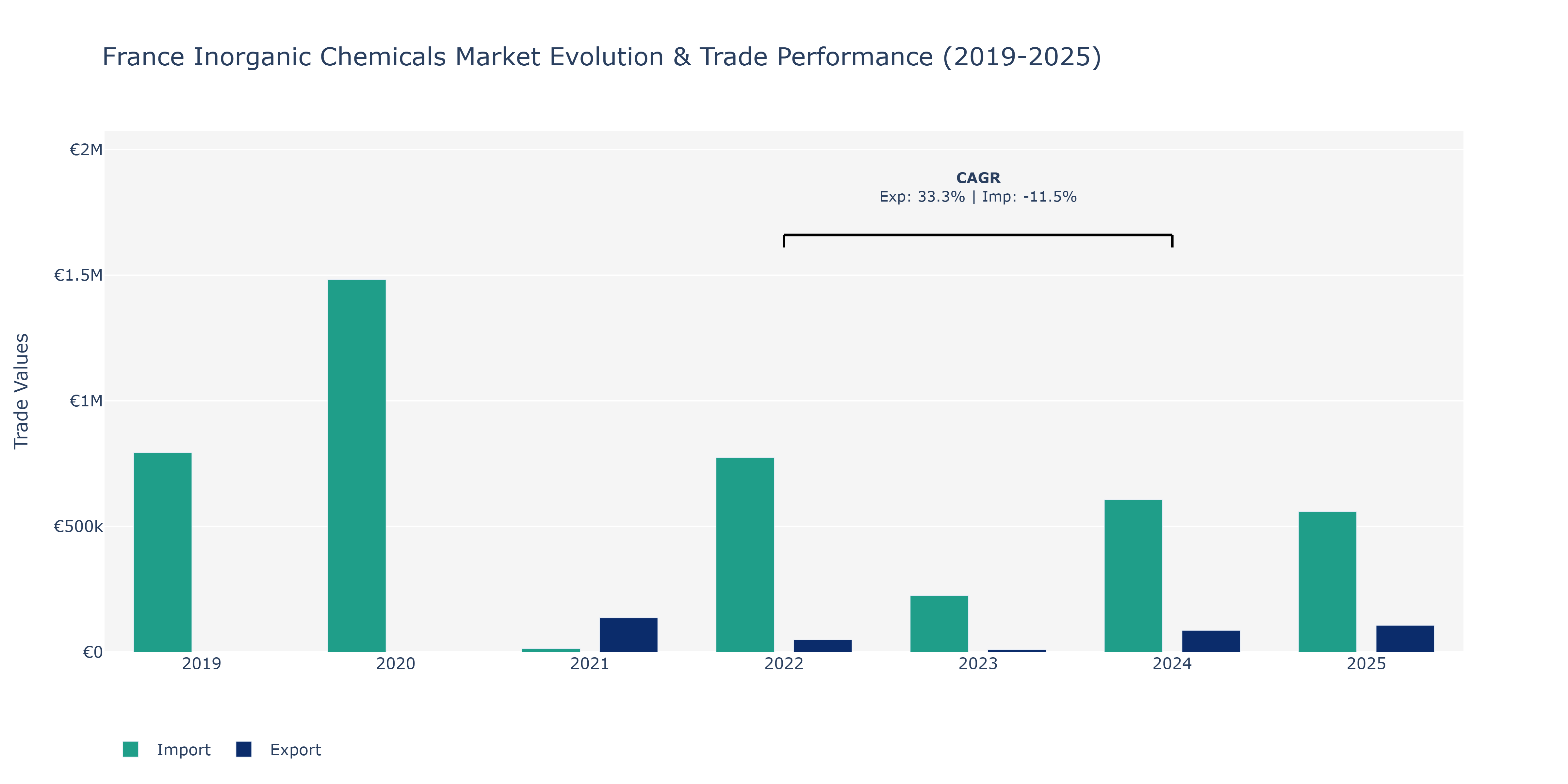
Between 2022 and 2025, France's Inorganic Chemicals Market witnessed fluctuations in both exports and imports. Exports started at €48.58 thousand in 2022, increased to €106.44 thousand in 2025, marking a notable growth trajectory. Conversely, imports were at €774.43 thousand in 2022, decreased to €559.25 thousand in 2025. The peak point for exports was noted in 2025, while imports peaked in 2020. The decline in imports post-2022 could be attributed to shifting global supply chains, where manufacturers might be diversifying sourcing strategies. The steady growth in exports can be linked to the rising demand for French inorganic chemicals in international markets due to technological advancements and environmental regulations favoring environmentally friendly products. These trends suggest that France's market players are adapting to global market dynamics by focusing on enhancing export competitiveness while managing import dependencies effectively.
Key Highlights of the Report:
- France Inorganic Chemicals Market Outlook
- Market Size of France Inorganic Chemicals Market, 2025
- Forecast of France Inorganic Chemicals Market, 2032
- Historical Data and Forecast of France Inorganic Chemicals Revenues & Volume for the Period 2022 - 2032F
- France Inorganic Chemicals Market Trend Evolution
- France Inorganic Chemicals Market Drivers and Challenges
- France Inorganic Chemicals Price Trends
- France Inorganic Chemicals Porter's Five Forces
- France Inorganic Chemicals Industry Life Cycle
- Historical Data and Forecast of France Inorganic Chemicals Market Revenues & Volume By Type for the Period 2022 - 2032F
- Historical Data and Forecast of France Inorganic Chemicals Market Revenues & Volume By Ammonia for the Period 2022 - 2032F
- Historical Data and Forecast of France Inorganic Chemicals Market Revenues & Volume By Chlor alkali for the Period 2022 - 2032F
- Historical Data and Forecast of France Inorganic Chemicals Market Revenues & Volume By Ammonium nitrate for the Period 2022 - 2032F
- Historical Data and Forecast of France Inorganic Chemicals Market Revenues & Volume By Ammonium sulfate for the Period 2022 - 2032F
- Historical Data and Forecast of France Inorganic Chemicals Market Revenues & Volume By Inorganic acid for the Period 2022 - 2032F
- Historical Data and Forecast of France Inorganic Chemicals Market Revenues & Volume By Sodium hydroxide for the Period 2022 - 2032F
- Historical Data and Forecast of France Inorganic Chemicals Market Revenues & Volume By Hydrogen peroxide for the Period 2022 - 2032F
- Historical Data and Forecast of France Ammonia Inorganic Chemicals Market Revenues & Volume By Oxygen for the Period 2022 - 2032F
- France Inorganic Chemicals Import Export Trade Statistics
- Market Opportunity Assessment By Type
- France Inorganic Chemicals Top Companies Market Share
- France Inorganic Chemicals Competitive Benchmarking By Technical and Operational Parameters
- France Inorganic Chemicals Company Profiles
- France Inorganic Chemicals Key Strategic Recommendations






































