France Insect Repellent Market Top 5 Importing Countries and Market Competition (HHI) Analysis
In 2024, France continued to rely on imports of insect repellent with key suppliers being Spain, Belgium, Italy, Germany, and the Netherlands. Despite a moderate concentration level indicated by the Herfindahl-Hirschman Index (HHI), the market experienced a decline with a negative compound annual growth rate (CAGR) of -4.91% from 2020 to 2024. Furthermore, the growth rate in 2024 dropped by 7.73% compared to the previous year, reflecting a challenging environment for the insect repellent import market in France.
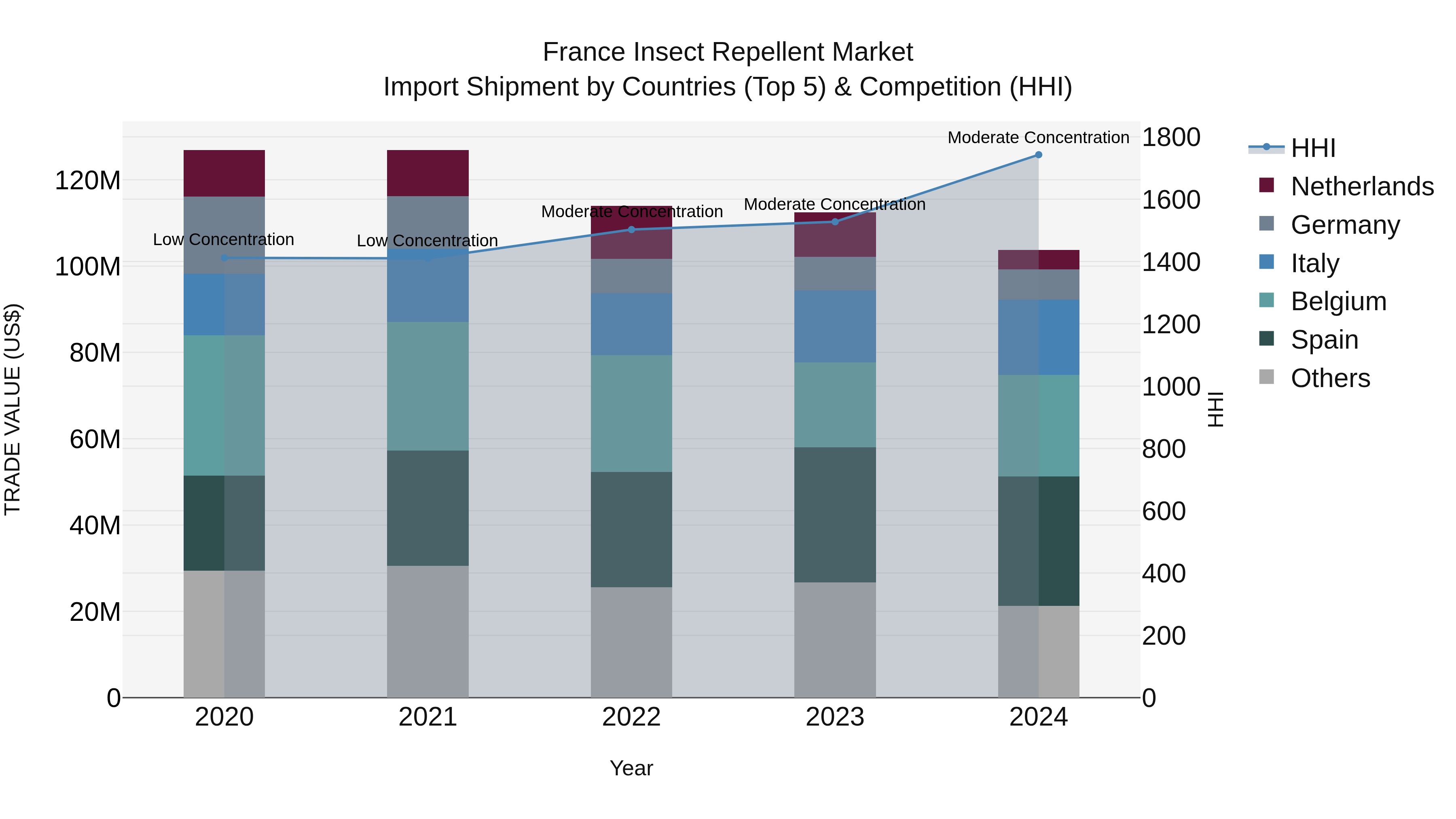
France Insect Repellent Market Overview
The France Insect Repellent market is experiencing steady growth driven by increasing awareness about the importance of protection against insect-borne diseases such as Zika virus and Lyme disease. Key players in the market are investing in innovative product formulations and packaging to cater to the diverse consumer preferences. The demand for natural and DEET-free repellents is also on the rise, with consumers seeking effective yet safe alternatives. Outdoor activities, travel, and the desire for eco-friendly options are driving the growth in the market. Major distribution channels include supermarkets, pharmacies, and online retailers, offering a wide range of insect repellent products such as sprays, lotions, and wearable devices. The market is competitive, with companies focusing on product differentiation and strategic marketing to gain a competitive edge.
France Insect Repellent Market Trends and Opportunities
The France Insect Repellent Market is experiencing a surge in demand due to increasing concerns about mosquito-borne diseases like Zika and dengue fever. Consumers are seeking natural and DEET-free repellent options, driving the market towards plant-based ingredients such as lemon eucalyptus and citronella. Eco-friendly and sustainable products are also gaining popularity among environmentally conscious consumers. Manufacturers are innovating with new delivery formats like wearable devices and long-lasting formulations to cater to various consumer preferences. Opportunities exist for companies to expand their product offerings, enhance marketing strategies focusing on health benefits, and leverage e-commerce channels for wider reach. Collaborations with retailers and health organizations for awareness campaigns could further boost market growth in the insect repellent sector in France.
France Insect Repellent Market Challenges
In the France Insect Repellent Market, challenges include increasing consumer demand for natural and environmentally-friendly products, which has led to a shift away from traditional chemical-based repellents. This trend requires manufacturers to invest in research and development to create effective natural insect repellent alternatives. Additionally, regulatory hurdles, such as stringent approval processes for new products, can pose challenges for companies looking to introduce innovative solutions to the market. Competition among existing brands and the need to differentiate products to stand out in a crowded market also present obstacles. Furthermore, changing weather patterns and the spread of new insect-borne diseases may impact consumer preferences and drive the need for more advanced repellent formulations.
France Insect Repellent Market Drivers
The France Insect Repellent Market is primarily driven by increasing awareness about insect-borne diseases such as Zika virus, dengue fever, and Lyme disease. Growing concerns about the health risks associated with insect bites have led to a rise in demand for insect repellent products. Additionally, the rising popularity of outdoor recreational activities and travel among the French population has further fueled the demand for effective insect repellents. The availability of a wide range of innovative products, including natural and DEET-free options, also contributes to market growth. Furthermore, the influence of media campaigns, government initiatives promoting public health, and the emphasis on preventive measures against insect-borne illnesses are significant factors driving the France Insect Repellent Market.
France Insect Repellent Market Government Policies
The French government has regulations in place to ensure the safety and efficacy of insect repellent products in the market. These regulations are primarily overseen by the French Agency for Food, Environmental and Occupational Health & Safety (ANSES). Insect repellents are considered as biocidal products, and their marketing and use are subject to approval and compliance with specific regulations. The government sets maximum limits for active ingredients in insect repellents to ensure they are safe for consumers and the environment. Additionally, labeling requirements are in place to provide consumers with clear information on proper usage and potential risks. Overall, government policies aim to protect public health and the environment while promoting the availability of effective insect repellent products in the market.
France Insect Repellent Market Future Outlook
The France Insect Repellent Market is expected to witness steady growth in the coming years due to increasing awareness about vector-borne diseases and rising concerns over the use of chemical insecticides. Consumers are increasingly opting for natural and eco-friendly insect repellent products, driving demand for organic and plant-based formulations. Additionally, the growing popularity of outdoor activities and travel among French consumers is expected to fuel the demand for insect repellents. Manufacturers are likely to focus on product innovation, such as long-lasting and effective formulations, as well as convenient packaging options to cater to changing consumer preferences. Overall, the France Insect Repellent Market is poised for growth as consumers prioritize health and environmental sustainability in their purchasing decisions.
Key Highlights of the Report:
- France Insect Repellent Market Outlook
- Market Size of France Insect Repellent Market, 2024
- Forecast of France Insect Repellent Market, 2031
- Historical Data and Forecast of France Insect Repellent Revenues & Volume for the Period 2021- 2031
- France Insect Repellent Market Trend Evolution
- France Insect Repellent Market Drivers and Challenges
- France Insect Repellent Price Trends
- France Insect Repellent Porter's Five Forces
- France Insect Repellent Industry Life Cycle
- Historical Data and Forecast of France Insect Repellent Market Revenues & Volume By Type for the Period 2021- 2031
- Historical Data and Forecast of France Insect Repellent Market Revenues & Volume By Mosquito Repellent for the Period 2021- 2031
- Historical Data and Forecast of France Insect Repellent Market Revenues & Volume By Bugs Repellent for the Period 2021- 2031
- Historical Data and Forecast of France Insect Repellent Market Revenues & Volume By Fly Repellent for the Period 2021- 2031
- Historical Data and Forecast of France Insect Repellent Market Revenues & Volume By Others for the Period 2021- 2031
- Historical Data and Forecast of France Insect Repellent Market Revenues & Volume By Product Type for the Period 2021- 2031
- Historical Data and Forecast of France Insect Repellent Market Revenues & Volume By Vaporizers for the Period 2021- 2031
- Historical Data and Forecast of France Insect Repellent Market Revenues & Volume By Spray for the Period 2021- 2031
- Historical Data and Forecast of France Insect Repellent Market Revenues & Volume By Cream for the Period 2021- 2031
- Historical Data and Forecast of France Insect Repellent Market Revenues & Volume By Others for the Period 2021- 2031
- France Insect Repellent Import Export Trade Statistics
- Market Opportunity Assessment By Type
- Market Opportunity Assessment By Product Type
- France Insect Repellent Top Companies Market Share
- France Insect Repellent Competitive Benchmarking By Technical and Operational Parameters
- France Insect Repellent Company Profiles
- France Insect Repellent Key Strategic Recommendations






































