France Instrumentation Valves and Fittings Market Top 5 Importing Countries and Market Competition (HHI) Analysis
France`s instrumentation valves and fittings import market in 2024 continued to be dominated by key exporters such as the USA, Germany, Italy, Areas, nes, and Switzerland. High Herfindahl-Hirschman Index (HHI) values indicated a concentrated market landscape. Despite a negative compound annual growth rate (CAGR) of -13.25% from 2020 to 2024, the steep decline in growth rate of -51.44% from 2023 to 2024 suggests a challenging environment for import shipments in this sector. Stakeholders should closely monitor market dynamics and adapt strategies to navigate these fluctuations effectively.
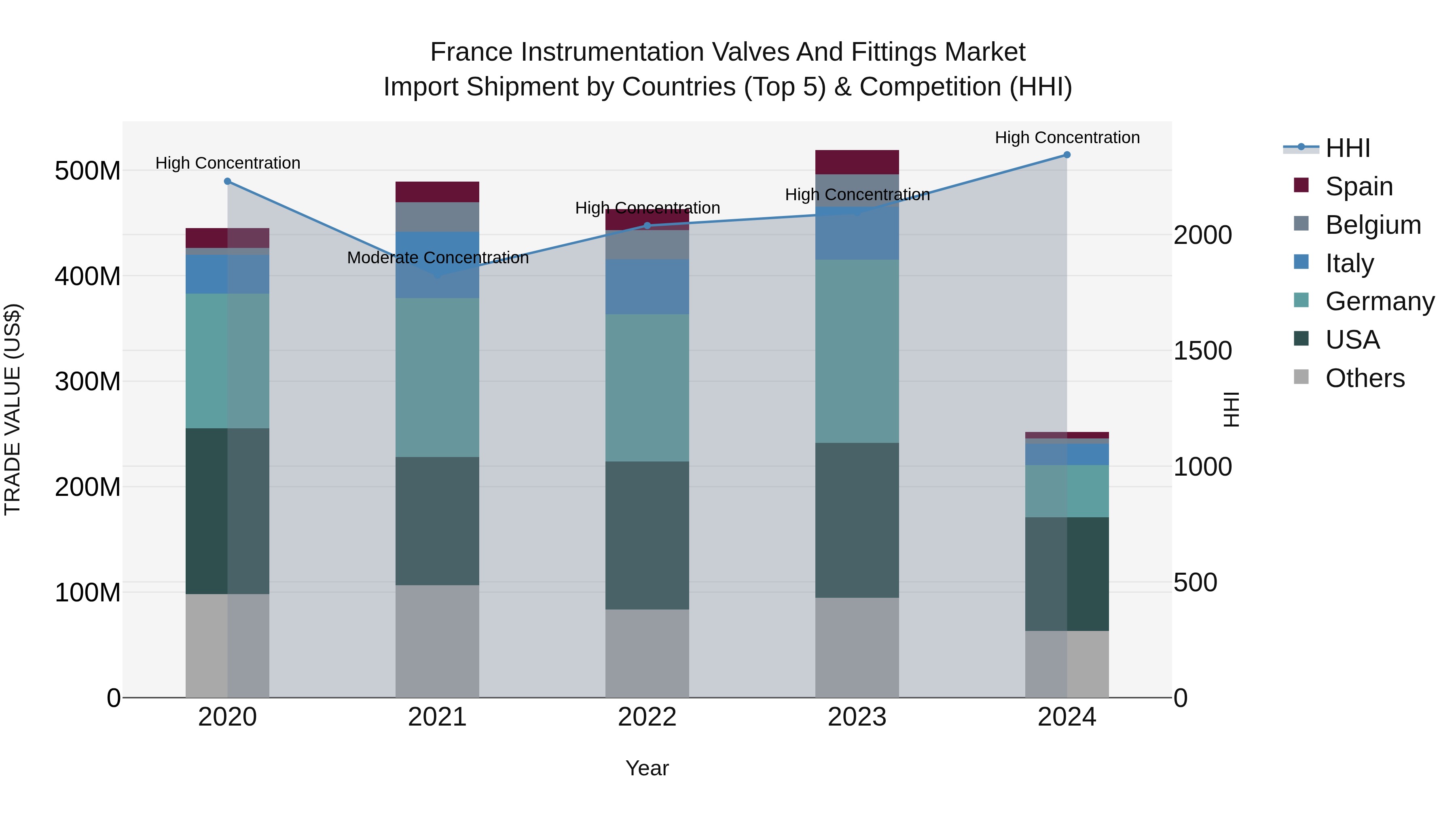
France Instrumentation Valves and Fittings Market Overview
France instrumentation valves and fittings market serves industries such as oil and gas, petrochemicals, pharmaceuticals, and semiconductor manufacturing, providing components for fluid control and measurement in process instrumentation systems. Instrumentation valves and fittings include ball valves, needle valves, manifolds, and tubing fittings, offering precision, reliability, and compatibility with instrumentation tubing and connectors. With stringent requirements for leak-tightness, pressure control, and corrosion resistance, there is a steady demand for high-quality instrumentation valves and fittings in France, driven by requirements for process safety, efficiency, and regulatory compliance.
Drivers of the market
The instrumentation valves and fittings market in France is driven by several key factors. Firstly, the increasing demand for precision control and measurement solutions in industrial processes fuels the adoption of instrumentation valves and fittings for regulating flow, pressure, and temperature parameters. Instrumentation valves and fittings play a crucial role in process control systems, analytical instrumentation, and fluid handling applications, driving market expansion. Moreover, advancements in valve and fitting design, materials, and sealing technologies contribute to the development of next-generation products with improved performance, reliability, and compatibility with harsh operating conditions. Additionally, the growing emphasis on safety and environmental compliance drives the adoption of instrumentation valves and fittings that meet industry standards and regulatory requirements for leak-tightness, fire safety, and corrosion resistance. Furthermore, the increasing adoption of automation and digitalization technologies such as IIoT (Industrial Internet of Things) and SCADA (Supervisory Control and Data Acquisition) creates opportunities for market growth as instrumentation valves and fittings enable remote monitoring, control, and predictive maintenance of industrial processes and equipment.
Challenges of the market
Challenges in the France instrumentation valves and fittings market include ensuring compatibility and reliability in critical industrial applications, addressing leakage and corrosion issues, and meeting quality and performance standards for safety and reliability.
Government Policy of the market
Regulations in France concerning industrial safety, equipment standards, and product certifications impact the instrumentation valves and fittings market. Government policies may include safety standards for valve and fitting design, equipment certification requirements for industrial applications, and quality control guidelines for manufacturing processes to ensure the safety, reliability, and compliance of instrumentation systems.
Key Highlights of the Report:
- France Instrumentation Valves and Fittings Market Outlook
- Market Size of France Instrumentation Valves and Fittings Market, 2024
- Forecast of France Instrumentation Valves and Fittings Market, 2031
- Historical Data and Forecast of France Instrumentation Valves and Fittings Revenues & Volume for the Period 2021-2031
- France Instrumentation Valves and Fittings Market Trend Evolution
- France Instrumentation Valves and Fittings Market Drivers and Challenges
- France Instrumentation Valves and Fittings Price Trends
- France Instrumentation Valves and Fittings Porter's Five Forces
- France Instrumentation Valves and Fittings Industry Life Cycle
- Historical Data and Forecast of France Instrumentation Valves and Fittings Market Revenues & Volume By Types for the Period 2021-2031
- Historical Data and Forecast of France Instrumentation Valves and Fittings Market Revenues & Volume By Tube for the Period 2021-2031
- Historical Data and Forecast of France Instrumentation Valves and Fittings Market Revenues & Volume By Pipe for the Period 2021-2031
- Historical Data and Forecast of France Instrumentation Valves and Fittings Market Revenues & Volume By Biopharm for the Period 2021-2031
- Historical Data and Forecast of France Instrumentation Valves and Fittings Market Revenues & Volume By Hose for the Period 2021-2031
- Historical Data and Forecast of France Instrumentation Valves and Fittings Market Revenues & Volume By Weld for the Period 2021-2031
- Historical Data and Forecast of France Instrumentation Valves and Fittings Market Revenues & Volume By Others for the Period 2021-2031
- Historical Data and Forecast of France Instrumentation Valves and Fittings Market Revenues & Volume By Applications for the Period 2021-2031
- Historical Data and Forecast of France Instrumentation Valves and Fittings Market Revenues & Volume By Oil & Gas for the Period 2021-2031
- Historical Data and Forecast of France Instrumentation Valves and Fittings Market Revenues & Volume By Marine & Shipbuilding for the Period 2021-2031
- Historical Data and Forecast of France Instrumentation Valves and Fittings Market Revenues & Volume By Industrial for the Period 2021-2031
- Historical Data and Forecast of France Instrumentation Valves and Fittings Market Revenues & Volume By Others for the Period 2021-2031
- Historical Data and Forecast of France Instrumentation Valves and Fittings Market Revenues & Volume By Products for the Period 2021-2031
- Historical Data and Forecast of France Instrumentation Valves and Fittings Market Revenues & Volume By Instrumentation Valves for the Period 2021-2031
- Historical Data and Forecast of France Instrumentation Valves and Fittings Market Revenues & Volume By Instrumentation Fittings for the Period 2021-2031
- France Instrumentation Valves and Fittings Import Export Trade Statistics
- Market Opportunity Assessment By Types
- Market Opportunity Assessment By Applications
- Market Opportunity Assessment By Products
- France Instrumentation Valves and Fittings Top Companies Market Share
- France Instrumentation Valves and Fittings Competitive Benchmarking By Technical and Operational Parameters
- France Instrumentation Valves and Fittings Company Profiles
- France Instrumentation Valves and Fittings Key Strategic Recommendations






































