France Integration Platform as a Service Market Size & Growth Rate (2026-2032)
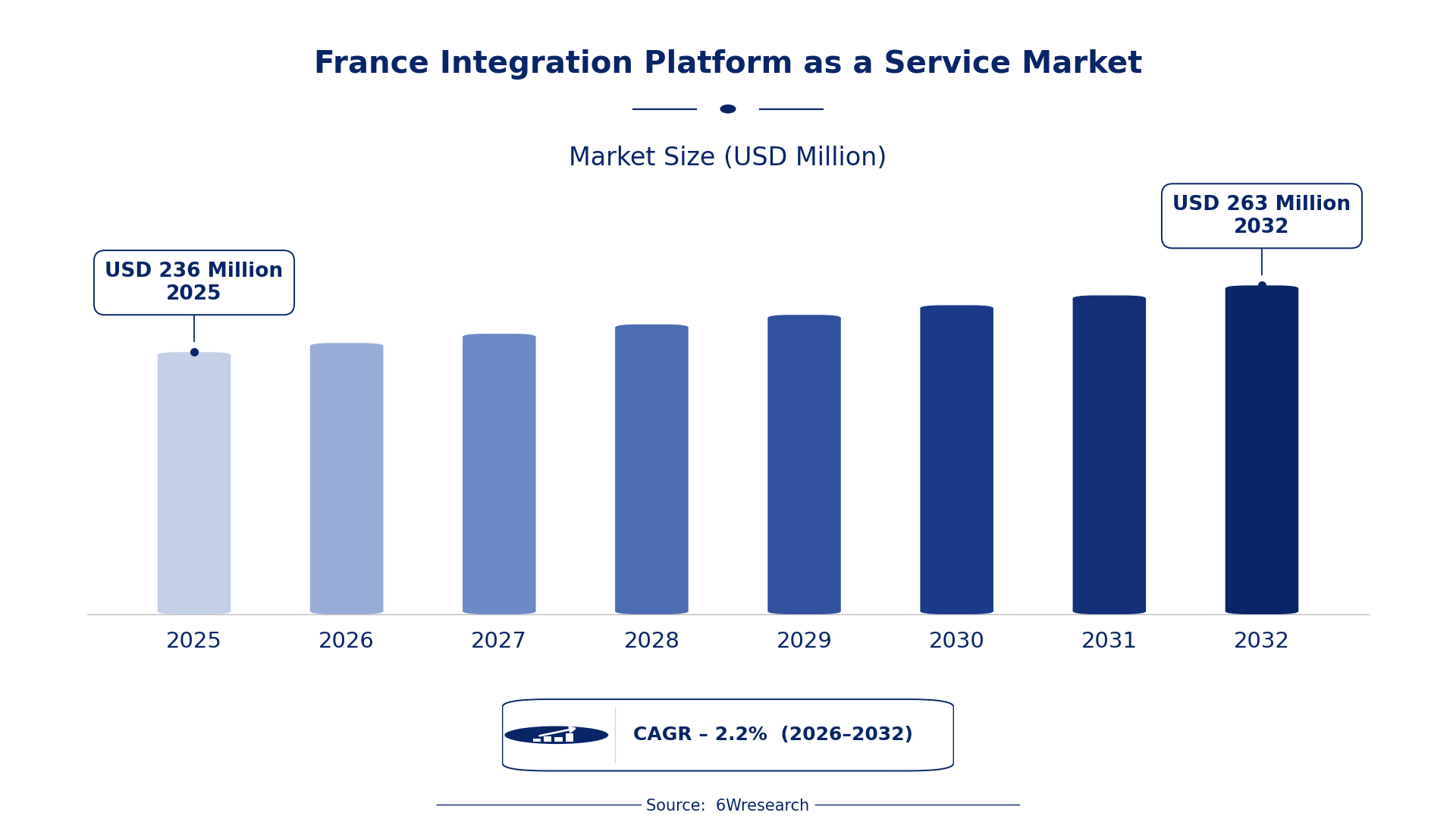
The France Integration Platform as a Service Market was estimated at USD 236 Million in 2025 and is projected to reach USD 263 Million by 2032, growing at a CAGR of 2.2% from 2026 to 2032.
France Integration Platform as a Service Market Synopsis
The French market for Integration Platform as a Service (iPaaS) is on an upward trajectory, primarily driven by enterprises' urgent need for efficient and scalable integration solutions. As businesses in France increasingly adopt cloud services, the demand for platforms that can unify disparate applications and data sources is surging, reflecting a shift towards more agile operational frameworks.
Organizations are recognizing that iPaaS can play a crucial role in streamlining workflows and enhancing collaboration across departments. This has led to a wave of investment in iPaaS technologies, as companies seek to reduce complexity in their IT ecosystems while fostering innovation through improved data management and integration capabilities.
France Integration Platform as a Service Market Year-wise Growth Rate and Key Drivers
This graph illustrates the annual growth rates of the France Integration Platform as a Service Market from 2021 to 2032, highlighting a steady upward trajectory and projected expansion over the forecast period.
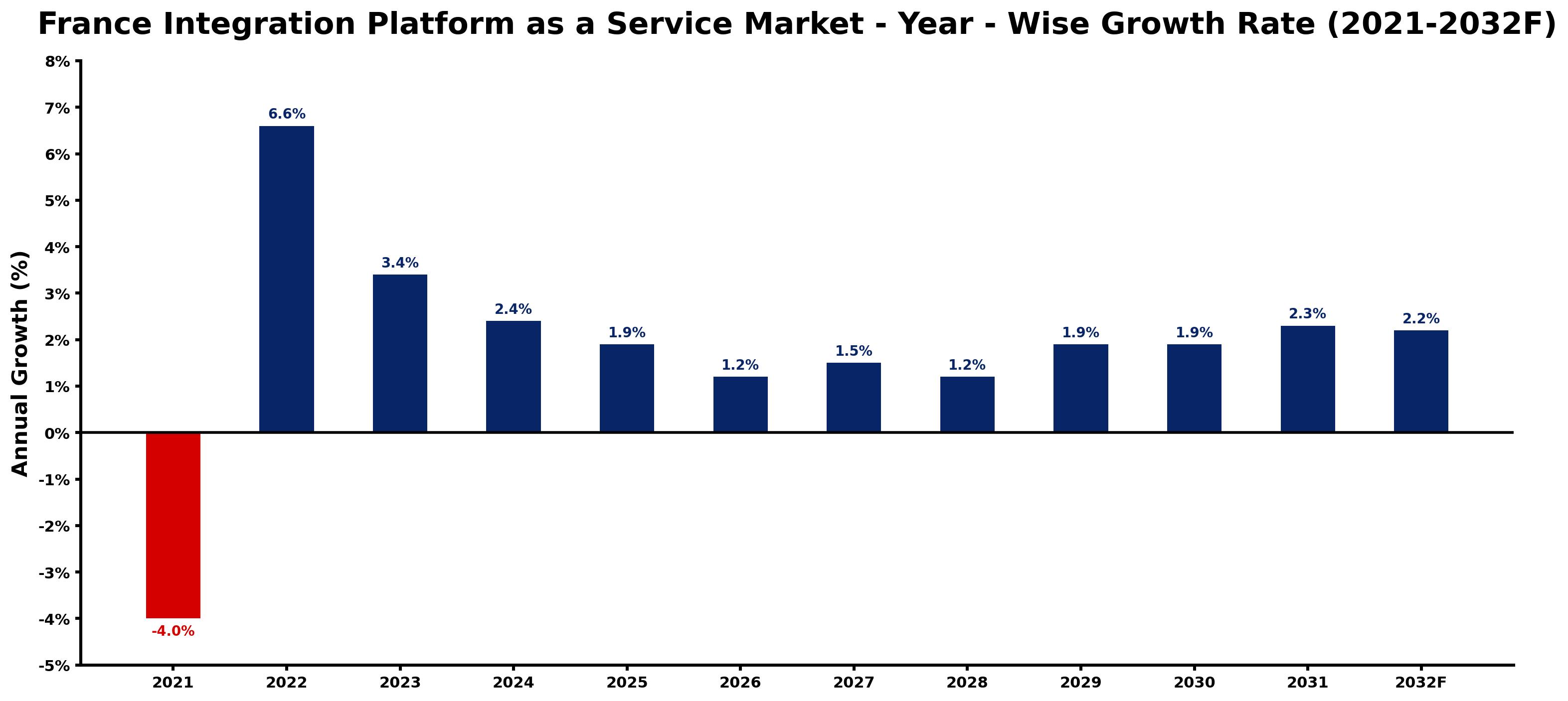
The table below presents the year‑wise growth rates along with the key drivers influencing the market
| Year | Growth Rate | Major Drivers |
| 2021 | -4.0% | French government delays cloud integration regulation rollout |
| 2022 | 6.6% | Increased investment in digital transformation by French SMEs. |
| 2023 | 3.4% | EU GDPR regulations driving demand for secure data integration. |
| 2024 | 2.4% | Launch of public sector projects utilizing integration platforms. |
| 2025 | 1.9% | Growing adoption of AI analytics in French enterprises. |
| 2026 | 1.2% | Rising focus on customer experience in retail applications. |
| 2027 | 1.5% | Support from French government for tech innovation startups. |
| 2028 | 1.2% | Integration of cloud services by French financial institutions. |
| 2029 | 1.9% | Demand for interoperability in public health systems increased. |
| 2030 | 1.9% | Local IT service providers expanding integration capabilities. |
| 2031 | 2.3% | Emergence of FinTech firms requiring seamless data connectivity. |
| 2032 | 2.2% | Evolving tech landscape prompting integration in e-commerce platforms. |
Note: Market size estimations and growth projections presented in this report are based on 6Wresearch's proprietary forecasting methodology, utilizing the latest available industry data, government publications, and primary research inputs.
France Integration Platform as a Service Market Key Takeaways
Below are some of the specific key takeaways from the market, including:
- The iPaaS market in France is driven by the need for seamless integration of cloud and on-premises applications.
- Advancements in API management and data governance are enhancing the capabilities of iPaaS solutions.
- Businesses are increasingly adopting hybrid and multi-cloud strategies, propelling the demand for iPaaS.
- Data privacy and security remain paramount concerns influencing the integration strategies of organizations.
- Government regulations on cloud computing are shaping the landscape for iPaaS providers in France.
Evaluation of Restraints in France Integration Platform as a Service Market
Despite its growth potential, the iPaaS market in France faces certain challenges that may hinder its progress. Organizations often grapple with the complexity of integrating various systems, especially when dealing with legacy infrastructures. Compatibility issues can create significant roadblocks, leading to increased costs and extended implementation timelines. Additionally, concerns regarding data security and privacy in cloud environments are heightened, making companies cautious in their integration strategies. These issues necessitate robust support and customization options from iPaaS providers to address user needs effectively.
France Integration Platform as a Service Market Trends
The trend towards digital transformation continues to gain momentum, with many organizations prioritizing agility and operational efficiency. iPaaS solutions are increasingly being recognized for their ability to facilitate faster data integration and process automation. The emergence of low-code and no-code development environments is also shaping iPaaS offerings, allowing users with limited technical expertise to create integrations independently. on top of that, the rise of artificial intelligence and machine learning capabilities within iPaaS platforms is enhancing data analytics, enabling businesses to derive actionable insights from their integrated systems.
France Integration Platform as a Service Market Opportunities
There are substantial growth opportunities within the iPaaS market in France, particularly as organizations transition to hybrid cloud environments. Companies are increasingly looking for solutions that can bridge gaps between on-premises and cloud applications, thus expanding the addressable market for iPaaS providers. Additionally, as the number of SaaS applications proliferates, businesses will require advanced integration capabilities to streamline operations. Investment in security features and compliance-related functionalities will also present opportunities for providers who can assure customers of data integrity and protection.
Government Initiatives in the France Integration Platform as a Service Market
Government policies in France are playing a significant role in shaping the integration platform as a service market. Regulatory frameworks that focus on data protection, cybersecurity, and cloud computing standards are critical for fostering a secure and compliant environment for iPaaS solutions. These initiatives not only ensure compliance but also encourage innovation within the sector.
- A national data protection regulation established in 2024 mandates strict compliance for cloud service providers, impacting iPaaS deployment strategies.
- Current initiatives to enhance cybersecurity measures for cloud infrastructure are underway, focusing on improving data privacy standards.
- A recently completed program aimed at establishing interoperability standards across cloud services has streamlined the integration process for companies.
- Upcoming plans for a public-private partnership are expected to drive investments in digital infrastructure, enhancing access to iPaaS solutions.
- Ongoing government support for digital transformation initiatives is encouraging companies to adopt advanced integration technologies.
Future Insights of the France Integration Platform as a Service Market
Looking ahead to 2026-2032, the France Integration Platform as a Service market is expected to evolve significantly. The increasing complexity of IT environments will drive demand for more sophisticated integration solutions. As businesses continue to embrace digital transformation, iPaaS platforms will become essential for enhancing operational efficiency and data interoperability. The focus on security and compliance will intensify, compelling providers to innovate and offer solutions that not only integrate but also safeguard data integrity. on top of that, the integration of AI and automation within iPaaS offerings is set to revolutionize how organizations manage their data and processes.
France Integration Platform as a Service Market Latest Developments
Recent months have seen notable activity within the France Integration Platform as a Service market, with companies adapting their strategies to meet the demands of a rapidly changing environment. As organizations increasingly prioritize integration solutions, the market is witnessing a flurry of developments aimed at enhancing service offerings and capabilities.
- A major technology vendor launched a new iPaaS solution in early 2025, designed to support multi-cloud architectures and facilitate seamless application integration.
- An initiative that began in mid-2025 and remains underway is focused on enhancing data governance frameworks for cloud-based integrations.
- A strategic partnership between two leading regional operators was formed in late 2025 to bolster their integration capabilities across various sectors.
- A rollout expected to begin in the second half of 2026 aims to expand access to iPaaS solutions for small and medium-sized enterprises across France.
- Current upgrades to existing iPaaS platforms are enhancing API management features, set to be completed by early 2026.
France Integration Platform as a Service Market - Key Attractiveness of the Report
- 10 Years of Market Numbers
- Historical Data Starting from 2022 to 2025
- Base Year: 2025
- Forecast Data until 2032
- Key Performance Indicators Impacting the Market
- Major Upcoming Developments and Projects
Key Highlights of the Report:
- France Integration Platform as a Service Market Outlook
- Market Size of France Integration Platform as a Service Market, 2025
- Forecast of France Integration Platform as a Service Market, 2032
- Historical Data and Forecast of France Integration Platform as a Service Revenues & Volume for the Period 2022-2032F
- France Integration Platform as a Service Market Trend Evolution
- France Integration Platform as a Service Market Drivers and Challenges
- France Integration Platform as a Service Price Trends
- France Integration Platform as a Service Porter's Five Forces
- France Integration Platform as a Service Industry Life Cycle
- Historical Data and Forecast of France Integration Platform as a Service Market Revenues & Volume By Service Type for the Period 2022-2032F
- Historical Data and Forecast of France Integration Platform as a Service Market Revenues & Volume By API Management for the Period 2022-2032F
- Historical Data and Forecast of France Integration Platform as a Service Market Revenues & Volume By B2B Integration for the Period 2022-2032F
- Historical Data and Forecast of France Integration Platform as a Service Market Revenues & Volume By Data Integration for the Period 2022-2032F
- Historical Data and Forecast of France Integration Platform as a Service Market Revenues & Volume By Cloud Integration for the Period 2022-2032F
- Historical Data and Forecast of France Integration Platform as a Service Market Revenues & Volume By Application Integration for the Period 2022-2032F
- Historical Data and Forecast of France Integration Platform as a Service Market Revenues & Volume By Other Services (EDI Integration and Cloud Service Orchestration) for the Period 2022-2032F
- Historical Data and Forecast of France Integration Platform as a Service Market Revenues & Volume By Deployment Model for the Period 2022-2032F
- Historical Data and Forecast of France Integration Platform as a Service Market Revenues & Volume By Public Cloud for the Period 2022-2032F
- Historical Data and Forecast of France Integration Platform as a Service Market Revenues & Volume By Private Cloud for the Period 2022-2032F
- Historical Data and Forecast of France Integration Platform as a Service Market Revenues & Volume By Organization Size for the Period 2022-2032F
- Historical Data and Forecast of France Integration Platform as a Service Market Revenues & Volume By Large Enterprises for the Period 2022-2032F
- Historical Data and Forecast of France Integration Platform as a Service Market Revenues & Volume By SMEs for the Period 2022-2032F
- Historical Data and Forecast of France Integration Platform as a Service Market Revenues & Volume By Vertical for the Period 2022-2032F
- Historical Data and Forecast of France Integration Platform as a Service Market Revenues & Volume By Banking, Financial Services, and Insurance (BFSI) for the Period 2022-2032F
- Historical Data and Forecast of France Integration Platform as a Service Market Revenues & Volume By Energy and Utilities for the Period 2022-2032F
- Historical Data and Forecast of France Integration Platform as a Service Market Revenues & Volume By Government and Public Sector for the Period 2022-2032F
- Historical Data and Forecast of France Integration Platform as a Service Market Revenues & Volume By Healthcare and Life Sciences for the Period 2022-2032F
- Historical Data and Forecast of France Integration Platform as a Service Market Revenues & Volume By Manufacturing for the Period 2022-2032F
- Historical Data and Forecast of France Integration Platform as a Service Market Revenues & Volume By Retail and Consumer Goods for the Period 2022-2032F
- Historical Data and Forecast of France Integration Platform as a Service Market Revenues & Volume By Telecommunications for the Period 2022-2032F
- Historical Data and Forecast of France Integration Platform as a Service Market Revenues & Volume By Others for the Period 2022-2032F
- France Integration Platform as a Service Import Export Trade Statistics
- Market Opportunity Assessment By Service Type
- Market Opportunity Assessment By Deployment Model
- Market Opportunity Assessment By Organization Size
- Market Opportunity Assessment By Vertical
- France Integration Platform as a Service Top Companies Market Share
- France Integration Platform as a Service Competitive Benchmarking By Technical and Operational Parameters
- France Integration Platform as a Service Company Profiles
- France Integration Platform as a Service Key Strategic Recommendations






































