France Mass Spectrometry Market Size, Share & Growth Rate
The France Mass Spectrometry Market was estimated at USD 80 Million in 2025 and is projected to reach USD 89 Million by 2032, growing at a CAGR of 1.5% from 2026 to 2032. This growth trajectory is primarily driven by the increasing demand for precision in analytical testing across various sectors, particularly in pharmaceuticals and biotechnology. The rising complexity of samples, coupled with stringent regulatory standards, necessitates the adoption of advanced mass spectrometry technologies for accurate analysis.
France Mass Spectrometry Market Year-wise Growth Rate and Key Drivers
This graph highlights how the France Mass Spectrometry Market has steadily grown over the years, supported by major growth factors.
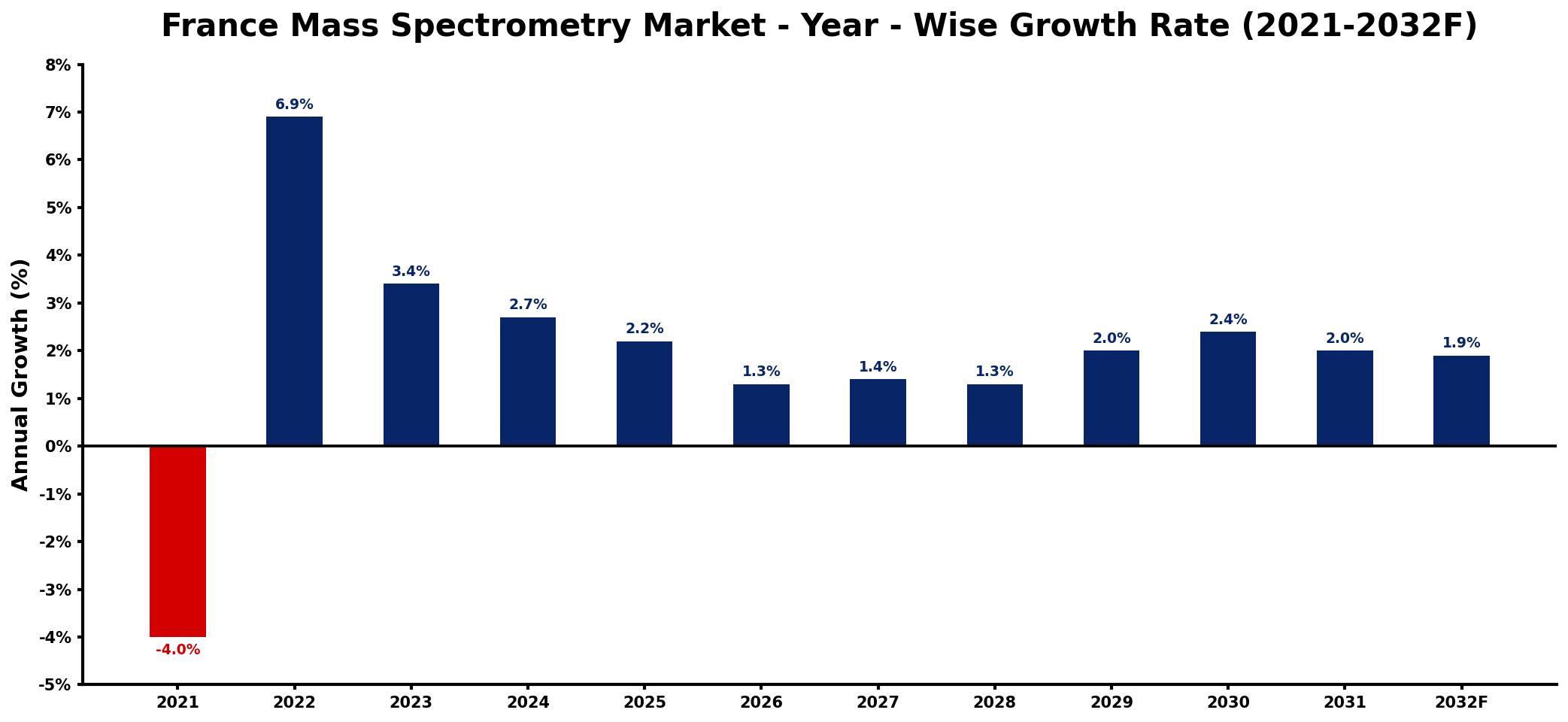
The table below presents the year‑wise growth rates along with the key drivers influencing the market
| Year | Growth Rate | Major Drivers |
| 2021 | -4.0% | decrease in laboratory funding |
| 2022 | 6.9% | rise in healthcare investments |
| 2023 | 3.4% | expansion of research initiatives |
| 2024 | 2.7% | rising procurement volume requirements |
| 2025 | 2.2% | growth in environmental monitoring |
| 2026 | 1.3% | surge in pharmaceutical developments |
| 2027 | 1.4% | advancements in analytical techniques |
| 2028 | 1.3% | increased demand for quality control |
| 2029 | 2.0% | expanding manufacturing base activity |
| 2030 | 2.4% | strengthening international trade flows |
| 2031 | 2.0% | improved processing technologies adoption |
| 2032 | 1.9% | increased focus on food safety |
Note: Market size estimations and growth projections presented in this report are based on 6Wresearch's proprietary forecasting methodology, utilizing the latest available industry data, government publications, and primary research inputs.
France Mass Spectrometry Market Synopsis
The demand for mass spectrometry in France is significantly influenced by the pharmaceutical sector, where rigorous quality control measures are essential. As drug discovery and development become more intricate, the need for sophisticated analytical solutions is paramount, fostering growth in the mass spectrometry market.
Additionally, the environmental testing sector is also pushing for advanced mass spectrometry applications, particularly concerning the analysis of pollutants and contaminants. This trend reflects a broader societal focus on health and safety, driving further investment in analytical technologies across the industry.
France Mass Spectrometry Market Key Takeaways
- The market is expected to grow steadily due to increased R&D activities and stringent regulatory demands.
- High-resolution and hybrid mass spectrometry systems are becoming increasingly popular among end-users.
- Investment in automation and miniaturization technologies is on the rise to enhance laboratory efficiency.
- Collaborations between industry and academia are key to driving innovation in the mass spectrometry space.
- There is a significant focus on developing portable mass spectrometry solutions for real-time analysis in various applications.
Evaluation of Restraints in France Mass Spectrometry Market
Despite the optimistic outlook for the France Mass Spectrometry Market, several real constraints persist. The intense competition among market players often leads to pricing pressures, which can limit profitability. Furthermore, the escalating complexity of analytical samples necessitates continuous technological advancements, imposing a financial burden on companies striving to remain competitive. Regulatory compliance also adds layers of complexity, requiring significant investment in R&D to meet evolving standards. As data generation escalates, the market is faced with challenges in data interpretation and integration, necessitating effective data management solutions to harness the full potential of mass spectrometry.
France Mass Spectrometry Market Trends
The France Mass Spectrometry Market is currently characterized by several noteworthy trends. There is an increasing shift towards the integration of advanced mass spectrometry technologies within both research and clinical laboratories, particularly for applications in proteomics, metabolomics, and drug development. This movement is underpinned by a demand for high-resolution systems that offer superior sensitivity and accuracy.
Moreover, hybrid mass spectrometry systems are gaining traction, as they combine various ionization techniques and mass analyzers, providing comprehensive analytical capabilities. The push for miniaturization and automation within mass spectrometry systems is also shaping the landscape, aiming to enhance throughput while maintaining precision.
France Mass Spectrometry Market Opportunities
Investment opportunities within the France Mass Spectrometry Market are particularly promising. With the expanding demand for advanced analytical technologies across the pharmaceutical, biotechnology, and food & beverage sectors, the market is ripe for innovation. Key areas for investment include high-resolution mass spectrometry systems, which are essential for nuanced analysis, and mass spectrometry software solutions that enhance data interpretation capabilities. Additionally, there is growing interest in ambient ionization techniques and portable mass spectrometers, catering to the evolving needs of field testing and diagnostics.
Government Initiatives in the France Mass Spectrometry Market
Government initiatives in France play a pivotal role in the growth of the Mass Spectrometry Market. The French government has introduced various funding programs and partnerships aimed at promoting research and innovation in analytical technologies, including mass spectrometry. Regulatory frameworks are in place to ensure the quality and safety of mass spectrometry applications in healthcare, environmental monitoring, and food safety. By fostering collaboration between academia and industry, these initiatives are set to enhance France's competitiveness in the global mass spectrometry arena.
Future Insights of the France Mass Spectrometry Market
Looking forward to the period of 2026-2032, the France Mass Spectrometry Market is poised for robust growth. The increasing emphasis on personalized medicine and the demand for precise analytical techniques in drug discovery are key factors propelling market expansion. As technological advancements continue to improve the sensitivity, accuracy, and speed of mass spectrometry instruments, the adoption of these technologies is likely to increase across various sectors. Furthermore, ongoing collaborations among research institutions and government initiatives aimed at healthcare innovation will significantly contribute to shaping the market's future.
France Mass Spectrometry Market Latest Developments (2025 - 2026)
In recent months, the France Mass Spectrometry Market has witnessed a surge in technological advancements aimed at enhancing analytical capabilities. Many industry stakeholders are focusing on developing next-generation mass spectrometers that offer improved resolution and sensitivity. Collaborations between universities and research laboratories are fostering innovation, particularly in the areas of proteomics and metabolomics. There has also been a notable increase in workshops and seminars discussing data management solutions, underscoring the importance of effective data handling in mass spectrometry.
France Mass Spectrometry Market - Key Attractiveness of the Report
- 10 Years of Market Numbers
- Historical Data Starting from 2022 to 2025
- Base Year: 2025
- Forecast Data until 2032
- Key Performance Indicators Impacting the Market
- Major Upcoming Developments and Projects
Key Highlights of the Report:
- France Mass Spectrometry Market Outlook
- Market Size of France Mass Spectrometry Market, 2025
- Forecast of France Mass Spectrometry Market, 2032
- Historical Data and Forecast of France Mass Spectrometry Revenues & Volume for the Period 2022-2032F
- France Mass Spectrometry Market Trend Evolution
- France Mass Spectrometry Market Drivers and Challenges
- France Mass Spectrometry Price Trends
- France Mass Spectrometry Porter's Five Forces
- France Mass Spectrometry Industry Life Cycle
- Historical Data and Forecast of France Mass Spectrometry Market Revenues & Volume By Technology for the Period 2022-2032F
- Historical Data and Forecast of France Mass Spectrometry Market Revenues & Volume By Hybrid Mass Spectrometry for the Period 2022-2032F
- Historical Data and Forecast of France Mass Spectrometry Market Revenues & Volume By Single Mass Spectrometry for the Period 2022-2032F
- Historical Data and Forecast of France Mass Spectrometry Market Revenues & Volume By Application for the Period 2022-2032F
- Historical Data and Forecast of France Mass Spectrometry Market Revenues & Volume By Pharmaceutical for the Period 2022-2032F
- Historical Data and Forecast of France Mass Spectrometry Market Revenues & Volume By Biotechnology for the Period 2022-2032F
- Historical Data and Forecast of France Mass Spectrometry Market Revenues & Volume By Security for the Period 2022-2032F
- Historical Data and Forecast of France Mass Spectrometry Market Revenues & Volume By Industrial chemistry for the Period 2022-2032F
- Historical Data and Forecast of France Mass Spectrometry Market Revenues & Volume By Environmental testing for the Period 2022-2032F
- Historical Data and Forecast of France Mass Spectrometry Market Revenues & Volume By Food & beverage testing for the Period 2022-2032F
- Historical Data and Forecast of France Mass Spectrometry Market Revenues & Volume By Forensic for the Period 2022-2032F
- Historical Data and Forecast of France Mass Spectrometry Market Revenues & Volume By Clinical for the Period 2022-2032F
- France Mass Spectrometry Import Export Trade Statistics
- Market Opportunity Assessment By Technology
- Market Opportunity Assessment By Application
- France Mass Spectrometry Top Companies Market Share
- France Mass Spectrometry Competitive Benchmarking By Technical and Operational Parameters
- France Mass Spectrometry Company Profiles
- France Mass Spectrometry Key Strategic Recommendations






































