France Office Chair Market Top 5 Importing Countries and Market Competition (HHI) Analysis
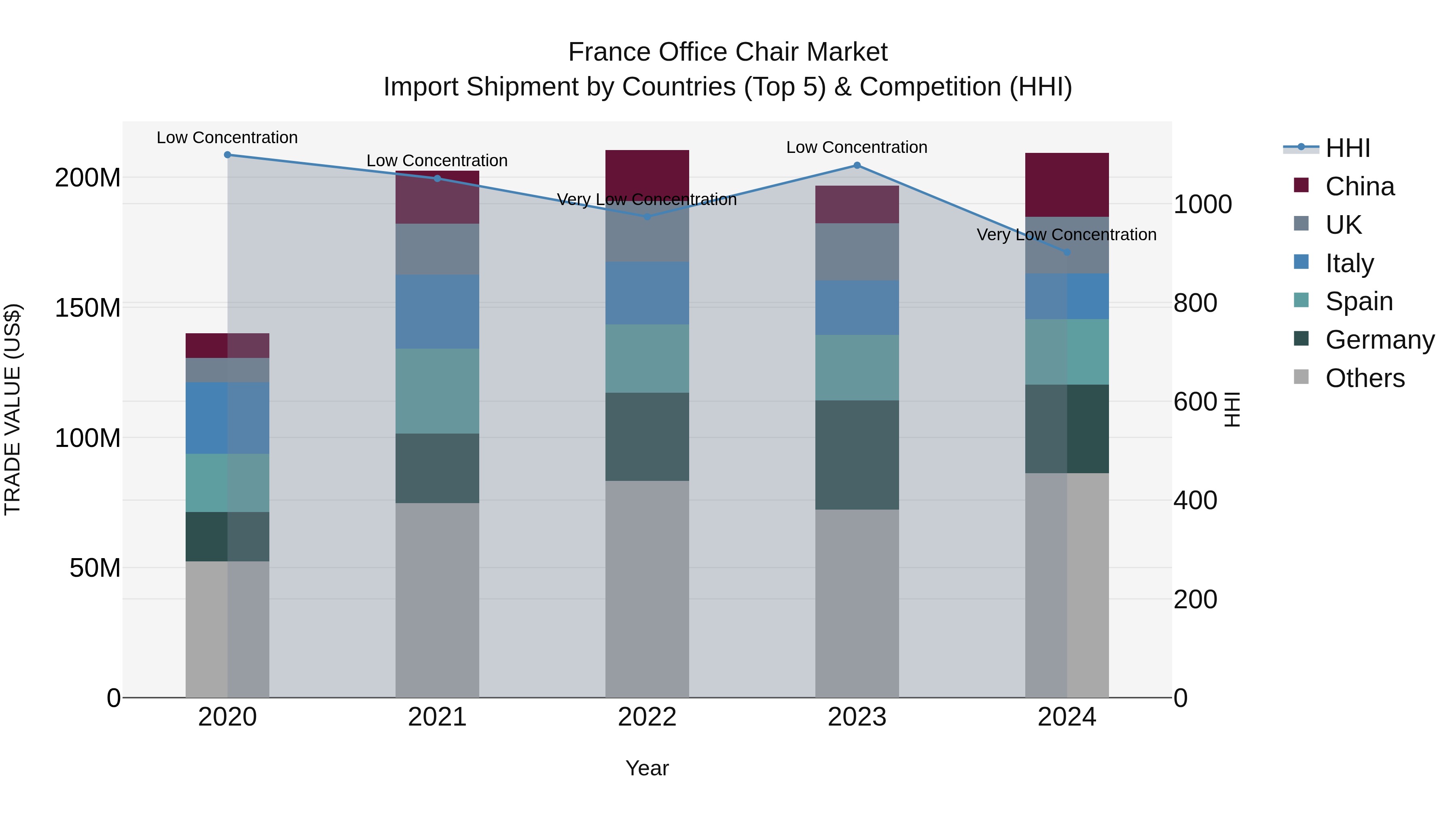
The France office chair import market continues to see a diverse range of sources, with top exporters in 2024 including Germany, Spain, China, UK, and Italy. The market shows a trend towards lower concentration, indicating a more competitive landscape. The impressive compound annual growth rate (CAGR) of 10.58% from 2020 to 2024 highlights a strong and steady expansion. Moreover, the growth rate of 6.39% from 2023 to 2024 suggests sustained momentum in the sector. France remains a key destination for office chair imports, benefiting from a variety of supply channels and consistent growth.
France Office Chair Market Synopsis
The France office chair market is experiencing steady growth driven by increasing demand for ergonomic and stylish seating solutions in workplaces. With a focus on employee health and productivity, there is a rising preference for adjustable chairs with lumbar support and customizable features. The market is characterized by a wide range of players offering various designs, materials, and price points to cater to diverse consumer preferences. Sustainable and eco-friendly office chairs are also gaining traction among environmentally conscious businesses. E-commerce platforms are playing a significant role in expanding the market reach, allowing consumers to conveniently browse and purchase a variety of office chair options online. Overall, the France office chair market is poised for further expansion as companies prioritize employee well-being and workspace aesthetics.
France Office Chair Market Trends
In the France Office Chair Market, current trends include a growing emphasis on ergonomic design to support employee health and comfort, as well as a shift towards sustainable materials and production methods in response to increasing environmental awareness. The demand for versatile and multifunctional office chairs that can accommodate flexible work arrangements, such as hot-desking and remote work, is also on the rise. Additionally, there is a noticeable preference for modern and stylish designs that enhance the aesthetics of the office space. With the ongoing trend of remote and hybrid work models, there is an increasing focus on portable and lightweight office chairs that can easily be moved between home and office settings. Overall, the France Office Chair Market is evolving to meet the changing needs and preferences of modern workplaces.
France Office Chair Market Challenges
In the France Office Chair Market, one of the main challenges faced is intense competition among both domestic and international manufacturers. This competition often leads to price wars, making it difficult for companies to maintain profit margins. Additionally, companies in this market need to continually innovate and offer ergonomic designs to meet the evolving preferences of consumers for comfort and functionality. Regulatory requirements regarding materials used in manufacturing office chairs also pose a challenge, as companies need to ensure compliance with strict environmental and safety standards. Furthermore, the recent shift towards remote work due to the COVID-19 pandemic has altered the demand dynamics for office chairs, with more focus now on home office solutions. Adapting to these changing trends and consumer preferences while navigating competition and regulatory challenges poses significant hurdles for companies in the France Office Chair Market.
France Office Chair Market Investment Opportunities
The France office chair market presents several investment opportunities due to the growing demand for ergonomic and stylish office furniture. With an increasing number of companies focusing on employee well-being and productivity, there is a rising need for high-quality, comfortable office chairs. Investors can capitalize on this trend by offering innovative designs that prioritize comfort, durability, and sustainability. Additionally, there is potential for growth in the online office furniture sector, as more consumers opt for convenient shopping experiences. Collaborating with sustainable materials suppliers and incorporating smart features such as adjustable height and lumbar support can further differentiate offerings in the market. Overall, investing in the France office chair market offers opportunities for companies to cater to the evolving needs of modern workplaces and stand out in a competitive industry.
Jordan Agar Market Government Policies
In France, government policies related to the office chair market primarily focus on ensuring consumer safety, promoting sustainable practices, and adhering to labor regulations. The government has implemented strict product safety standards to protect consumers from any potential risks associated with office chairs. Additionally, there are regulations in place to promote eco-friendly manufacturing processes and materials to reduce environmental impact. Labor laws also play a crucial role in the office chair market, ensuring fair treatment of workers and compliance with employee rights. Overall, the government`s policies aim to create a competitive and ethical market environment for office chair manufacturers and consumers in France.
France Office Chair Market Future Outlook
The France Office Chair Market is expected to witness steady growth in the coming years, driven by factors such as the increasing adoption of ergonomic office furniture to promote employee health and productivity, the rise in remote working trends due to the COVID-19 pandemic, and the emphasis on workplace aesthetics. The market is likely to see a growing demand for adjustable and customizable office chairs that cater to the diverse needs of modern workplaces. Additionally, the incorporation of advanced technologies such as smart features and eco-friendly materials in office chair design is anticipated to further propel market growth. Overall, the France Office Chair Market is poised for expansion as businesses focus on creating comfortable and efficient work environments for their employees.
Key Highlights of the Report:
- France Office Chair Market Outlook
- Market Size of France Office Chair Market, 2021
- Forecast of France Office Chair Market, 2031
- Historical Data and Forecast of France Office Chair Revenues & Volume for the Period 2018 - 2031
- France Office Chair Market Trend Evolution
- France Office Chair Market Drivers and Challenges
- France Office Chair Price Trends
- France Office Chair Porter's Five Forces
- France Office Chair Industry Life Cycle
- Historical Data and Forecast of France Office Chair Market Revenues & Volume By Product Type for the Period 2018 - 2031
- Historical Data and Forecast of France Office Chair Market Revenues & Volume By Executive Office for the Period 2018 - 2031
- Historical Data and Forecast of France Office Chair Market Revenues & Volume By Ergonomic for the Period 2018 - 2031
- Historical Data and Forecast of France Office Chair Market Revenues & Volume By Conference for the Period 2018 - 2031
- Historical Data and Forecast of France Office Chair Market Revenues & Volume By Material for the Period 2018 - 2031
- Historical Data and Forecast of France Office Chair Market Revenues & Volume By Mesh for the Period 2018 - 2031
- Historical Data and Forecast of France Office Chair Market Revenues & Volume By Lather for the Period 2018 - 2031
- Historical Data and Forecast of France Office Chair Market Revenues & Volume By Plastic for the Period 2018 - 2031
- Historical Data and Forecast of France Office Chair Market Revenues & Volume By Fabric for the Period 2018 - 2031
- Historical Data and Forecast of France Office Chair Market Revenues & Volume By Sales Channel for the Period 2018 - 2031
- Historical Data and Forecast of France Office Chair Market Revenues & Volume By Offline for the Period 2018 - 2031
- Historical Data and Forecast of France Office Chair Market Revenues & Volume By Online for the Period 2018 - 2031
- France Office Chair Import Export Trade Statistics
- Market Opportunity Assessment By Product Type
- Market Opportunity Assessment By Material
- Market Opportunity Assessment By Sales Channel
- France Office Chair Top Companies Market Share
- France Office Chair Competitive Benchmarking By Technical and Operational Parameters
- France Office Chair Company Profiles
- France Office Chair Key Strategic Recommendations






































