France Organic Poultry Market Size, Share & Growth Rate
The France Organic Poultry Market was estimated at USD 234 Million in 2025 and is projected to reach USD 261 Million by 2032, growing at a CAGR of 1.6% from 2026 to 2032. This growth trajectory is predominantly fueled by a shift in consumer preferences towards organic and ethically sourced food options, driven by heightened awareness of health and environmental issues. As more consumers prioritize food safety, animal welfare, and sustainable practices, the market is positioned for continuous expansion.
France Organic Poultry Market Year-wise Growth Rate and Key Drivers
This graph highlights how the France Organic Poultry Market has steadily grown over the years, supported by major growth factors.
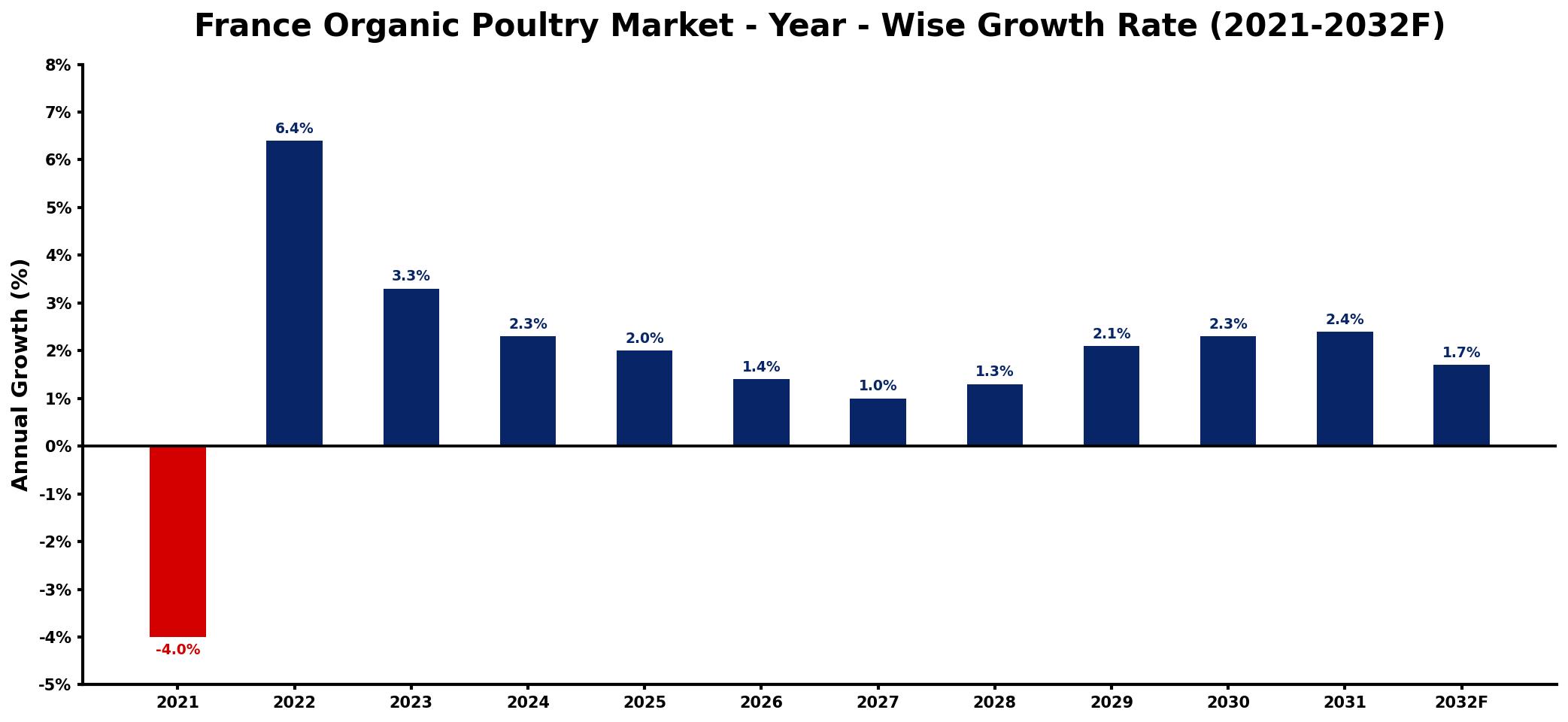
The table below presents the year‑wise growth rates along with the key drivers influencing the market
| Year | Growth Rate | Major Drivers |
| 2021 | -4.0% | Shifts in consumer preferences observed |
| 2022 | 6.4% | Rising health consciousness among consumers |
| 2023 | 3.3% | Expansion of retail distribution channels |
| 2024 | 2.3% | Increased investment in sustainable practices |
| 2025 | 2.0% | Growing popularity of ethical sourcing |
| 2026 | 1.4% | Emergence of innovative farming techniques |
| 2027 | 1.0% | Strengthened supply chain partnerships formed |
| 2028 | 1.3% | Enhanced marketing strategies implemented |
| 2029 | 2.1% | Development of new product offerings |
| 2030 | 2.3% | increased domestic production output |
| 2031 | 2.4% | Increased focus on traceability measures |
| 2032 | 1.7% | Broader consumer awareness campaigns launched |
Note: Market size estimations and growth projections presented in this report are based on 6Wresearch's proprietary forecasting methodology, utilizing the latest available industry data, government publications, and primary research inputs.
France Organic Poultry Market Synopsis
Consumer demand for organic poultry products is the strongest force currently shaping the France Organic Poultry Market. A growing awareness of the benefits of organic agriculture and its positive implications for health and sustainability are prompting more consumers to seek out these products. This trend is particularly pronounced among health-conscious individuals who are keen on high-quality, premium poultry offerings.
The market is diverse, encompassing a range of organic poultry types, including chicken, turkey, and duck, with an emphasis on free-range and pasture-raised options. Producers are actively engaging in innovative practices and sustainable supply chain management to meet consumer demands and adhere to government regulations surrounding organic certification.
France Organic Poultry Market Key Takeaways
- The market is projected to grow steadily due to rising consumer awareness and preference for organic poultry products.
- Free-range and pasture-raised poultry options are increasingly favored, aligning with consumer concerns over animal welfare.
- Innovative product offerings are emerging, such as organic chicken snacks and ready-to-cook meals, catering to health-conscious consumers.
- Investment opportunities in organic farming and processing are expanding as the demand for sustainable food products grows.
- Government policies support organic farming initiatives, creating a conducive environment for market growth.
Evaluation of Restraints in France Organic Poultry Market
Despite its promising outlook, the France Organic Poultry Market faces several notable constraints. The rigorous regulations and certification requirements governing organic poultry production can heighten operational costs, presenting a financial barrier for many producers. Additionally, limited access to organic feed sources often leads to increased feed costs and complicates supply chain logistics. Furthermore, while consumer interest in organic products is on the rise, there remains a segment of the market reluctant to absorb the higher price points associated with organic poultry, particularly in comparison to conventional alternatives.
France Organic Poultry Market Trends
Current trends in the France Organic Poultry Market reflect a clear consumer shift towards sustainable, high-quality food products. There is a marked rise in demand for locally sourced organic poultry, with an emphasis on certifications from reputable bodies. Alongside this, innovative product developments, such as organic poultry convenience foods and ready-to-cook meals, are gaining traction among busy, health-oriented consumers. The focus on environmentally responsible practices is not just influencing purchasing decisions but is also prompting producers to adapt their methods to meet this evolving demand.
France Organic Poultry Market Opportunities
The France Organic Poultry Market presents a variety of genuine growth and investment opportunities. With rising consumer preferences for sustainable and organic food products, opportunities abound in organic poultry farming, processing, and retail distribution. Investors can benefit from modernizing farming techniques and adopting innovative processing technologies to enhance product offerings. Moreover, forming partnerships with retailers, restaurants, and digital platforms can broaden market access and elevate brand visibility, tapping into the increasing consumer shift towards convenience without compromising quality.
Government Initiatives in the France Organic Poultry Market
In France, government policies are significantly aligned with the promotion of organic farming practices. The government actively supports poultry producers through financial incentives, facilitating a smoother transition to organic production. Programs focused on sustainable agriculture, along with strict animal welfare regulations, underpin the organic certification process, ensuring that consumers receive high-quality products. Such policies not only bolster producer confidence but also enhance consumer trust in organic poultry products, fostering market expansion.
Future Insights of the France Organic Poultry Market
Looking ahead to the period from 2026 to 2032, the France Organic Poultry Market appears poised for steady growth. The trajectory will likely be driven by consumers increasingly prioritizing health, sustainability, and ethical sourcing in their dietary choices. The ongoing shift towards organic poultry, along with government backing for sustainable practices, will enhance market dynamics. Strategic innovations and expansions in product offerings will further capitalize on burgeoning demand, setting a favorable stage for the sector's development.
France Organic Poultry Market Latest Developments (2025 - 2026)
In recent months, the France Organic Poultry Market has observed a series of strategic moves aimed at reinforcing its growth trajectory. Trends indicate a rise in companies adopting innovative farming techniques to enhance organic production efficiencies. Additionally, there has been a notable uptick in collaborations between producers and retailers to boost the visibility of organic poultry products in mainstream markets. These developments reflect a commitment to meeting evolving consumer preferences while advancing sustainable practices across the industry.
France Organic Poultry Market - Key Attractiveness of the Report
- 10 Years of Market Numbers
- Historical Data Starting from 2022 to 2025
- Base Year: 2025
- Forecast Data until 2032
- Key Performance Indicators Impacting the Market
- Major Upcoming Developments and Projects
Key Highlights of the Report:
- France Organic Poultry Market Outlook
- Market Size of France Organic Poultry Market, 2025
- Forecast of France Organic Poultry Market, 2032
- Historical Data and Forecast of France Organic Poultry Revenues & Volume for the Period 2022-2032F
- France Organic Poultry Market Trend Evolution
- France Organic Poultry Market Drivers and Challenges
- France Organic Poultry Price Trends
- France Organic Poultry Porter's Five Forces
- France Organic Poultry Industry Life Cycle
- Historical Data and Forecast of France Organic Poultry Market Revenues & Volume By Type for the Period 2022-2032F
- Historical Data and Forecast of France Organic Poultry Market Revenues & Volume By Organic Eggs for the Period 2022-2032F
- Historical Data and Forecast of France Organic Poultry Market Revenues & Volume By Organic Meat for the Period 2022-2032F
- Historical Data and Forecast of France Organic Poultry Market Revenues & Volume By Sales Channel for the Period 2022-2032F
- Historical Data and Forecast of France Organic Poultry Market Revenues & Volume By Business To Business for the Period 2022-2032F
- Historical Data and Forecast of France Organic Poultry Market Revenues & Volume By Business To Consumer for the Period 2022-2032F
- France Organic Poultry Import Export Trade Statistics
- Market Opportunity Assessment By Type
- Market Opportunity Assessment By Sales Channel
- France Organic Poultry Top Companies Market Share
- France Organic Poultry Competitive Benchmarking By Technical and Operational Parameters
- France Organic Poultry Company Profiles
- France Organic Poultry Key Strategic Recommendations






































