France Photosensitive Semiconductor Device Market Size, Share & Growth Rate
The France Photosensitive Semiconductor Device Market was estimated at USD 259 Million in 2025 and is projected to reach USD 328 Million by 2032, growing at a CAGR of 3.4% from 2026 to 2032. This growth trajectory is primarily driven by the escalating demand for imaging sensors across key sectors, including automotive, healthcare, and consumer electronics. The market's expansion is further fueled by increasing investments in advanced imaging technologies, as well as the integration of smart applications in surveillance and IoT.
France Photosensitive Semiconductor Device Market Year-wise Growth Rate and Key Drivers
This graph highlights how the France Photosensitive Semiconductor Device Market has steadily grown over the years, supported by major growth factors.
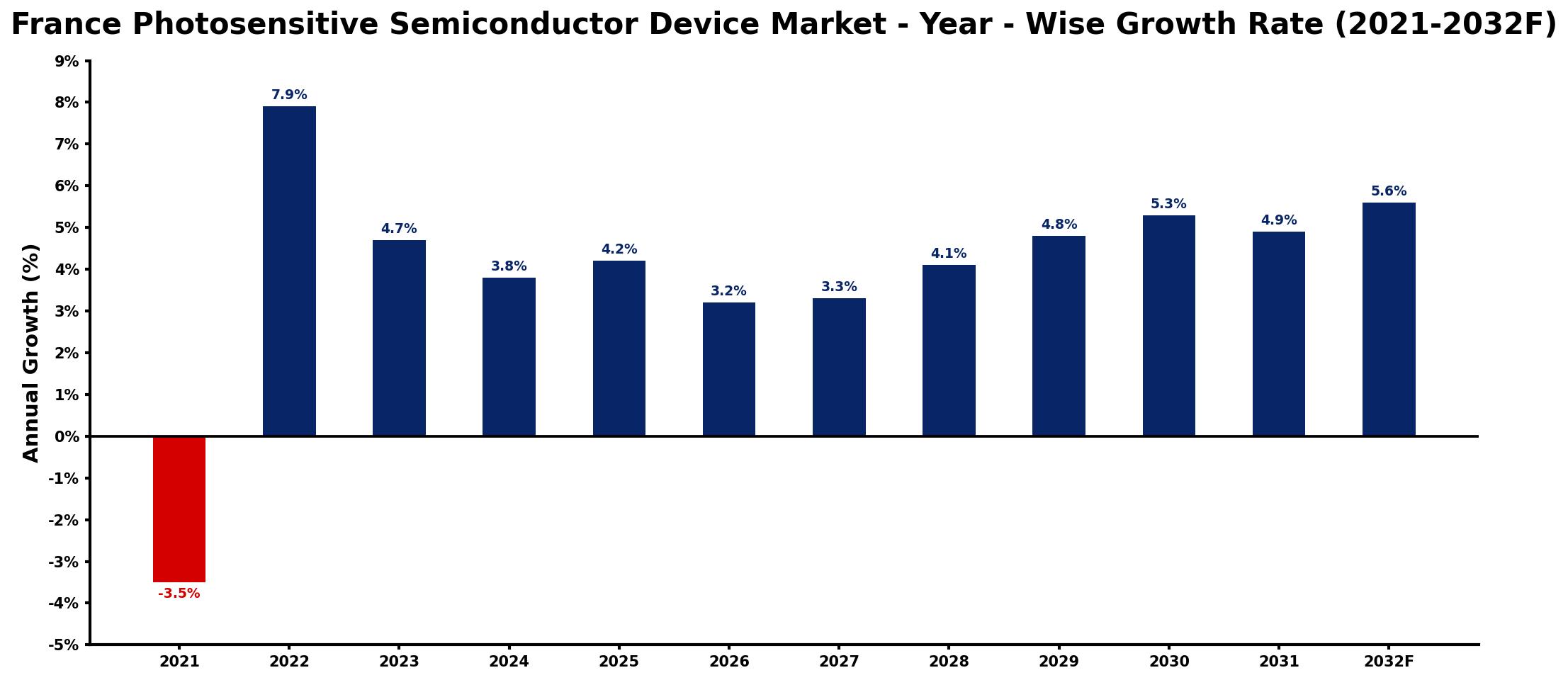
The table below presents the year‑wise growth rates along with the key drivers influencing the market
| Year | Growth Rate | Major Drivers |
| 2021 | -3.5% | decreased consumer electronics demand |
| 2022 | 7.9% | increased renewable energy investments |
| 2023 | 4.7% | growing automotive sector applications |
| 2024 | 3.8% | expansion of smart technology integration |
| 2025 | 4.2% | rising demand for energy efficiency |
| 2026 | 3.2% | enhanced research and development funding |
| 2027 | 3.3% | broader adoption in industrial automation |
| 2028 | 4.1% | surge in consumer electronics production |
| 2029 | 4.8% | growing interest in sustainable solutions |
| 2030 | 5.3% | increased focus on smart cities |
| 2031 | 4.9% | expanding manufacturing base activity |
| 2032 | 5.6% | increased overall sector activity |
Note: Market size estimations and growth projections presented in this report are based on 6Wresearch's proprietary forecasting methodology, utilizing the latest available industry data, government publications, and primary research inputs.
France Photosensitive Semiconductor Device Market Synopsis
The demand for high-performance imaging sensors is particularly significant in the French automotive sector, where safety and efficiency are paramount. Manufacturers are actively seeking innovative solutions that enhance image quality while minimizing power consumption, aligning with trends toward more sustainable technologies.
Additionally, the consumer electronics industry is witnessing a shift towards compact, sophisticated imaging solutions, driven by consumer preference for enhanced features in smartphones and digital cameras. This trend is stimulating investments in research and development, as companies strive to deliver superior products that meet evolving consumer expectations.
France Photosensitive Semiconductor Device Market Key Takeaways
- The market is benefiting from increased adoption of imaging technology across various industries.
- Research and development investments are crucial for maintaining competitiveness amid rapid technological advancements.
- Government initiatives support the integration of semiconductor devices in smart city projects.
- High demand for advanced sensors fuels innovation in image quality and power efficiency.
- Economic fluctuations pose a challenge but also create opportunities for agile companies.
Evaluation of Restraints in France Photosensitive Semiconductor Device Market
Despite its growth potential, the France Photosensitive Semiconductor Device Market faces several restraints. Intense competition from established players creates pressure to innovate constantly, as newer technologies quickly change market dynamics. Companies must also navigate complex regulatory landscapes, which can be particularly challenging for newcomers or smaller enterprises. Additionally, economic uncertainties and demand fluctuations can impact investment decisions, forcing companies to be more strategic in their approaches to growth and development.
France Photosensitive Semiconductor Device Market Trends
A significant trend shaping the France Photosensitive Semiconductor Device Market is the rapid adoption of CMOS and back-illuminated sensors, which provide higher resolution and sensitivity. This shift is particularly prominent in smartphones and security systems, where superior imaging capabilities are in high demand. Furthermore, the move towards smaller form factors and lower power consumption continues to drive innovation in the sector, reflecting a broader trend towards efficiency in electronics.
France Photosensitive Semiconductor Device Market Opportunities
Investors looking for growth in the France Photosensitive Semiconductor Device Market will find promising opportunities in the areas of facial recognition technology and autonomous vehicles. These applications are expected to grow substantially, creating a surge in demand for advanced imaging technologies. Furthermore, the increasing integration of artificial intelligence and machine learning in imaging devices represents another frontier for investment, as companies strive to enhance functionalities and deliver state-of-the-art solutions.
Government Initiatives in the France Photosensitive Semiconductor Device Market
The French government actively supports the growth of the Photosensitive Semiconductor Device Market through various initiatives aimed at ensuring consumer safety and promoting energy efficiency. Regulations such as the RoHS Directive restrict the use of hazardous substances in electronic products, while the Energy Transition for Green Growth Act encourages the development of energy-efficient technologies. These policies not only help safeguard the environment but also position the market for sustainable growth.
Future Insights of the France Photosensitive Semiconductor Device Market
Looking ahead to the period from 2026 to 2032, the France Photosensitive Semiconductor Device Market is likely to see sustained growth driven by continuous advancements in technology and increasing applications in emerging sectors. The incorporation of photosensitive devices in AI, IoT, and autonomous vehicles suggests a robust expansion of capabilities. As companies enhance their research and development efforts, we can anticipate not only improved performance but also a broader range of applications, ensuring that the market remains vibrant and responsive to consumer needs.
France Photosensitive Semiconductor Device Market Latest Developments (2025 - 2026)
Recent developments within the France Photosensitive Semiconductor Device Market showcase a trend toward greater collaboration between industry and research institutions. This partnership aims to accelerate innovation cycles and develop next-generation imaging solutions. Moreover, there is a noticeable emphasis on sustainability, with companies exploring environmentally friendly materials and production processes as part of their product development strategies.
France Photosensitive Semiconductor Device Market - Key Attractiveness of the Report
- 10 Years of Market Numbers
- Historical Data Starting from 2022 to 2025
- Base Year: 2025
- Forecast Data until 2032
- Key Performance Indicators Impacting the Market
- Major Upcoming Developments and Projects
Key Highlights of the Report:
- France Photosensitive Semiconductor Device Market Outlook
- Market Size of France Photosensitive Semiconductor Device Market, 2025
- Forecast of France Photosensitive Semiconductor Device Market, 2032
- Historical Data and Forecast of France Photosensitive Semiconductor Device Revenues & Volume for the Period 2022-2032F
- France Photosensitive Semiconductor Device Market Trend Evolution
- France Photosensitive Semiconductor Device Market Drivers and Challenges
- France Photosensitive Semiconductor Device Price Trends
- France Photosensitive Semiconductor Device Porter's Five Forces
- France Photosensitive Semiconductor Device Industry Life Cycle
- Historical Data and Forecast of France Photosensitive Semiconductor Device Market Revenues & Volume By Device for the Period 2022-2032F
- Historical Data and Forecast of France Photosensitive Semiconductor Device Market Revenues & Volume By Photocell for the Period 2022-2032F
- Historical Data and Forecast of France Photosensitive Semiconductor Device Market Revenues & Volume By Photodiode for the Period 2022-2032F
- Historical Data and Forecast of France Photosensitive Semiconductor Device Market Revenues & Volume By Phototransistor for the Period 2022-2032F
- Historical Data and Forecast of France Photosensitive Semiconductor Device Market Revenues & Volume By Photoresistor for the Period 2022-2032F
- Historical Data and Forecast of France Photosensitive Semiconductor Device Market Revenues & Volume By Photo IC for the Period 2022-2032F
- Historical Data and Forecast of France Photosensitive Semiconductor Device Market Revenues & Volume By End User for the Period 2022-2032F
- Historical Data and Forecast of France Photosensitive Semiconductor Device Market Revenues & Volume By Automotive and Transportation for the Period 2022-2032F
- Historical Data and Forecast of France Photosensitive Semiconductor Device Market Revenues & Volume By Consumer Electronics for the Period 2022-2032F
- Historical Data and Forecast of France Photosensitive Semiconductor Device Market Revenues & Volume By Aerospace and Defence for the Period 2022-2032F
- Historical Data and Forecast of France Photosensitive Semiconductor Device Market Revenues & Volume By Healthcare for the Period 2022-2032F
- Historical Data and Forecast of France Photosensitive Semiconductor Device Market Revenues & Volume By Industrial for the Period 2022-2032F
- Historical Data and Forecast of France Photosensitive Semiconductor Device Market Revenues & Volume By Security and Survelliance for the Period 2022-2032F
- France Photosensitive Semiconductor Device Import Export Trade Statistics
- Market Opportunity Assessment By Device
- Market Opportunity Assessment By End User
- France Photosensitive Semiconductor Device Top Companies Market Share
- France Photosensitive Semiconductor Device Competitive Benchmarking By Technical and Operational Parameters
- France Photosensitive Semiconductor Device Company Profiles
- France Photosensitive Semiconductor Device Key Strategic Recommendations






































