France Pneumatic Equipment Market Top 5 Importing Countries and Market Competition (HHI) Analysis
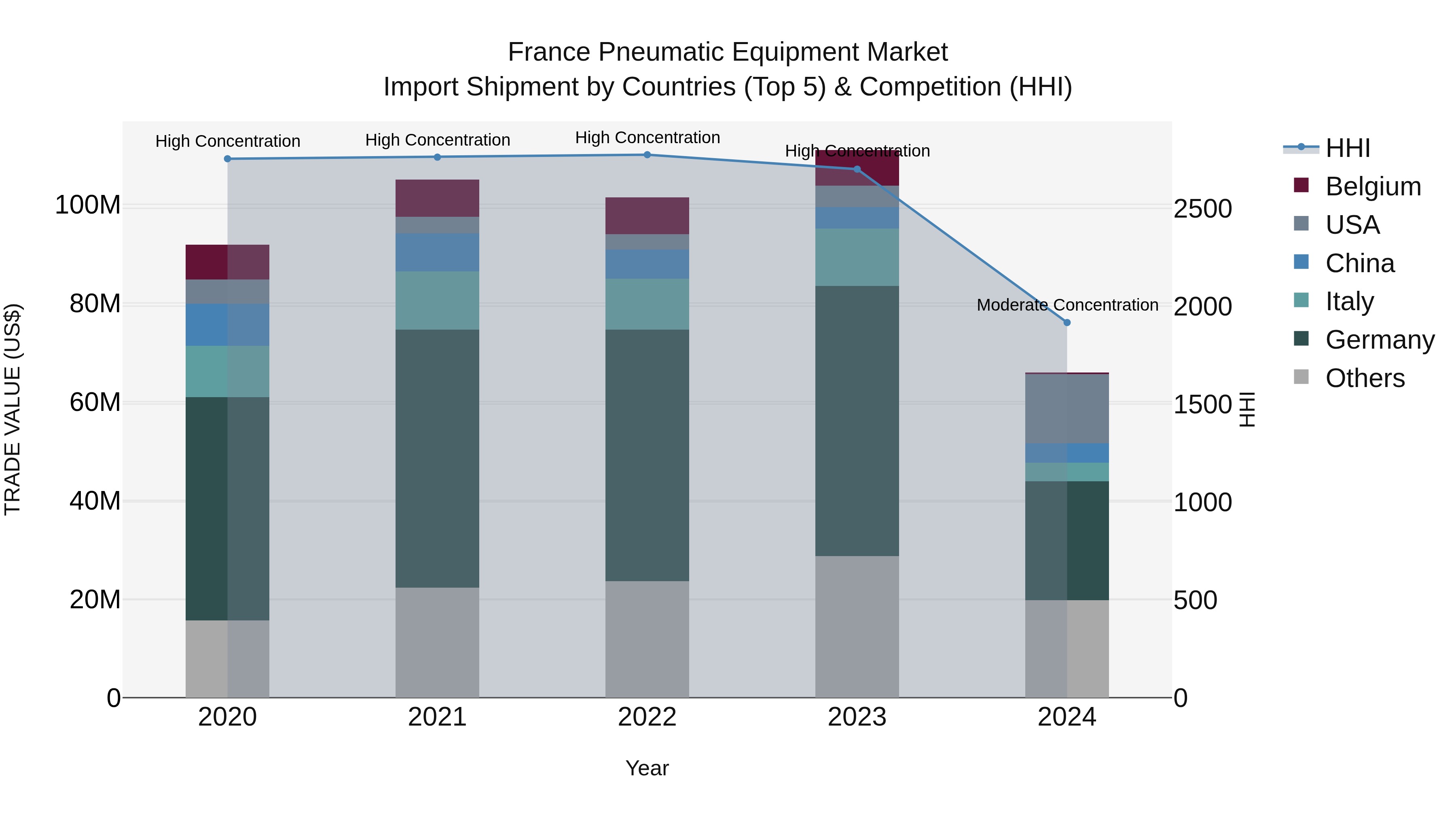
France`s import of pneumatic equipment in 2024 saw a shift in concentration levels from high to moderate compared to the previous year. Top exporting countries to France in this sector were Germany, USA, China, Italy, and Morocco. However, the industry experienced a concerning CAGR of -7.95% from 2020 to 2024, with a significant growth rate decline of -40.64% from 2023 to 2024. These figures suggest a challenging landscape for pneumatic equipment imports in France, indicating potential market shifts and dynamics that importers and manufacturers need to adapt to.
France Pneumatic Equipment Market Overview
The pneumatic equipment market in France involves the production, distribution, and utilization of pneumatic components, systems, and tools powered by compressed air for various industrial, commercial, and automotive applications such as automation, assembly, material handling, and power tools. Pneumatic equipment utilizes compressed air as a power source to generate motion, actuate valves, control processes, and perform mechanical work, offering advantages such as simplicity, reliability, and cost-effectiveness compared to hydraulic or electric systems. In France, manufacturers and suppliers of pneumatic equipment offer a wide range of products including air compressors, pneumatic cylinders, valves, fittings, hoses, and pneumatic tools, meeting industry standards and regulatory requirements for performance, safety, and efficiency. With a focus on innovation, energy efficiency, and automation, stakeholders in the pneumatic equipment market in France continually develop advanced technologies, improve product designs, and enhance system integration capabilities to meet the evolving needs of industrial automation, manufacturing processes, and sustainable energy solutions.
Drivers of the market
The pneumatic equipment market in France is influenced by industrial automation trends, manufacturing activities, and technological advancements in pneumatic systems. Pneumatic equipment, including actuators, valves, cylinders, and air compressors, play a crucial role in various industries, including automotive, aerospace, and food processing. Market growth is driven by factors such as the need for energy-efficient and reliable automation solutions, increasing demand for pneumatic tools, and advancements in sensor and control technologies. Additionally, regulatory initiatives favoring emission reduction and workplace safety contribute to market expansion.
Challenges of the market
In the France pneumatic equipment market, challenges include ensuring reliability and efficiency in pneumatic system design and operation, addressing energy efficiency and environmental sustainability concerns, and optimizing pneumatic component performance and durability. Pneumatic equipment plays a crucial role in various industrial applications such as automation, robotics, and manufacturing, but challenges arise from factors such as air leakage, system complexity, and maintenance requirements. Moreover, ensuring compatibility and interoperability among pneumatic components, integrating pneumatic systems with other automation technologies, and adapting to emerging market trends and technological innovations pose ongoing challenges for pneumatic equipment manufacturers and suppliers in this market.
Government Policy of the market
Regulatory frameworks in France govern the production, sale, and use of pneumatic equipment in manufacturing, transportation, and healthcare industries. Government policies focus on equipment safety standards, emissions controls, and workplace regulations to ensure reliability, efficiency, and safety of pneumatic systems deployed in various applications.
Key Highlights of the Report:
- France Pneumatic Equipment Market Outlook
- Market Size of France Pneumatic Equipment Market, 2024
- Forecast of France Pneumatic Equipment Market, 2031
- Historical Data and Forecast of France Pneumatic Equipment Revenues & Volume for the Period 2021-2031
- France Pneumatic Equipment Market Trend Evolution
- France Pneumatic Equipment Market Drivers and Challenges
- France Pneumatic Equipment Price Trends
- France Pneumatic Equipment Porter's Five Forces
- France Pneumatic Equipment Industry Life Cycle
- Historical Data and Forecast of France Pneumatic Equipment Market Revenues & Volume By Product Type for the Period 2021-2031
- Historical Data and Forecast of France Pneumatic Equipment Market Revenues & Volume By Camera for the Period 2021-2031
- Historical Data and Forecast of France Pneumatic Equipment Market Revenues & Volume By Lens for the Period 2021-2031
- Historical Data and Forecast of France Pneumatic Equipment Market Revenues & Volume By Others for the Period 2021-2031
- Historical Data and Forecast of France Pneumatic Equipment Market Revenues & Volume By Distribution Channel for the Period 2021-2031
- Historical Data and Forecast of France Pneumatic Equipment Market Revenues & Volume By Online Retail for the Period 2021-2031
- Historical Data and Forecast of France Pneumatic Equipment Market Revenues & Volume By Offline Retail for the Period 2021-2031
- France Pneumatic Equipment Import Export Trade Statistics
- Market Opportunity Assessment By Product Type
- Market Opportunity Assessment By Distribution Channel
- France Pneumatic Equipment Top Companies Market Share
- France Pneumatic Equipment Competitive Benchmarking By Technical and Operational Parameters
- France Pneumatic Equipment Company Profiles
- France Pneumatic Equipment Key Strategic Recommendations






































