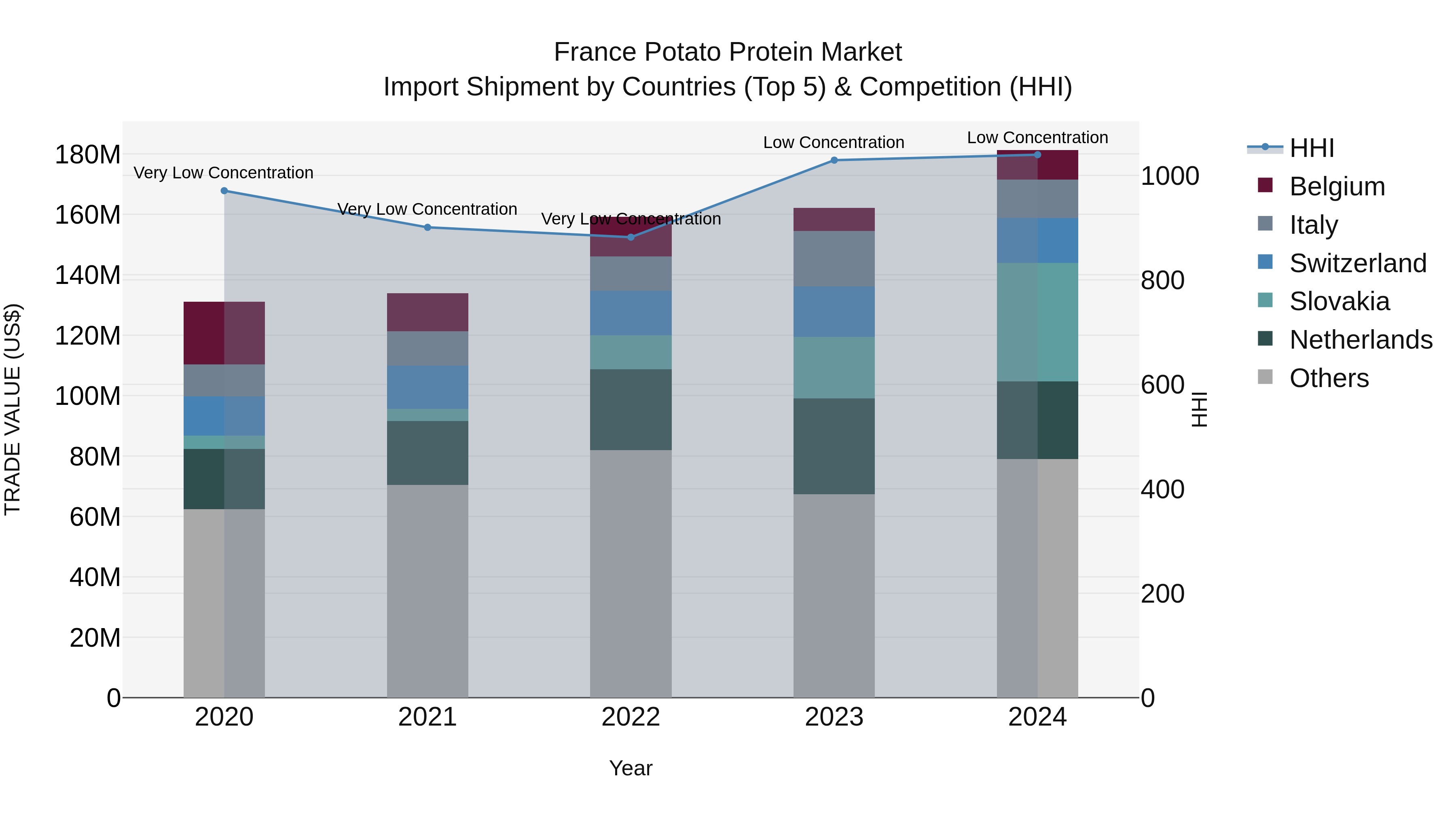
France Potato Protein Market Top 5 Importing Countries and Market Competition (HHI) Analysis
France`s potato protein import market in 2024 saw significant contributions from top exporting countries like Slovakia, Netherlands, Switzerland, Denmark, and the USA. Despite this diverse range of sources, the market exhibited low concentration with a low HHI in 2024. The compound annual growth rate (CAGR) for the period 2020-2024 stood at a healthy 8.43%, indicating sustained growth in the sector. Moreover, the growth rate from 2023 to 2024 surged to 11.75%, highlighting a rapid expansion in import shipments during that period.
France Potato Protein Market Overview
The France potato protein market has been experiencing steady growth in recent years. With increasing awareness about the health benefits of plant-based proteins, potato protein has gained traction as a viable alternative to animal-derived proteins. The market is driven by factors such as rising demand for vegetarian and vegan food products, growing health consciousness among consumers, and the expansion of the food and beverage industry. Additionally, advancements in food processing technologies have enabled the production of high-quality potato protein isolates, further boosting market growth. Key players in the France potato protein market are focusing on product innovation, strategic collaborations, and expansion of production capacities to capitalize on the growing demand.
Drivers of the market
The France Potato Protein Market is being primarily driven by the increasing consumer demand for plant-based protein sources. As awareness regarding the health benefits of plant-based diets rises, there`s a growing preference for alternatives to animal proteins. Potato protein, with its high nutritional value and functional properties, is gaining traction in various food and beverage applications such as sports nutrition, bakery, and snacks. Additionally, the rising trend of clean label and natural ingredients in food products further fuels the demand for potato protein as it is perceived as a clean, allergen-free ingredient.
Challenges of the market
The potato protein market in France faces challenges primarily due to competition from alternative protein sources and fluctuating raw material prices. Additionally, regulatory hurdles regarding food safety standards and labeling requirements pose significant challenges for market players.
Government Policy of the market
The French government has implemented policies to support the development of the potato protein market, aiming to enhance the sustainability of the agricultural sector. Initiatives include subsidies for potato farmers engaging in protein extraction processes and incentives for research and development in potato protein production technologies. Additionally, regulations ensure quality standards and traceability throughout the supply chain to maintain consumer confidence.
Key Highlights of the Report:
- France Potato Protein Market Outlook
- Market Size of France Potato Protein Market, 2024
- Forecast of France Potato Protein Market, 2031
- Historical Data and Forecast of France Potato Protein Revenues & Volume for the Period 2021-2031
- France Potato Protein Market Trend Evolution
- France Potato Protein Market Drivers and Challenges
- France Potato Protein Price Trends
- France Potato Protein Porter's Five Forces
- France Potato Protein Industry Life Cycle
- Historical Data and Forecast of France Potato Protein Market Revenues & Volume By Type for the Period 2021-2031
- Historical Data and Forecast of France Potato Protein Market Revenues & Volume By Isolates for the Period 2021-2031
- Historical Data and Forecast of France Potato Protein Market Revenues & Volume By Concentrates for the Period 2021-2031
- Historical Data and Forecast of France Potato Protein Market Revenues & Volume By Nature for the Period 2021-2031
- Historical Data and Forecast of France Potato Protein Market Revenues & Volume By Organic for the Period 2021-2031
- Historical Data and Forecast of France Potato Protein Market Revenues & Volume By Conventional for the Period 2021-2031
- Historical Data and Forecast of France Potato Protein Market Revenues & Volume By Application for the Period 2021-2031
- Historical Data and Forecast of France Potato Protein Market Revenues & Volume By Food & Beverages for the Period 2021-2031
- Historical Data and Forecast of France Potato Protein Market Revenues & Volume By Feed for the Period 2021-2031
- France Potato Protein Import Export Trade Statistics
- Market Opportunity Assessment By Type
- Market Opportunity Assessment By Nature
- Market Opportunity Assessment By Application
- France Potato Protein Top Companies Market Share
- France Potato Protein Competitive Benchmarking By Technical and Operational Parameters
- France Potato Protein Company Profiles
- France Potato Protein Key Strategic Recommendations






































