France Processed Fruit Market Size (2020-2030)
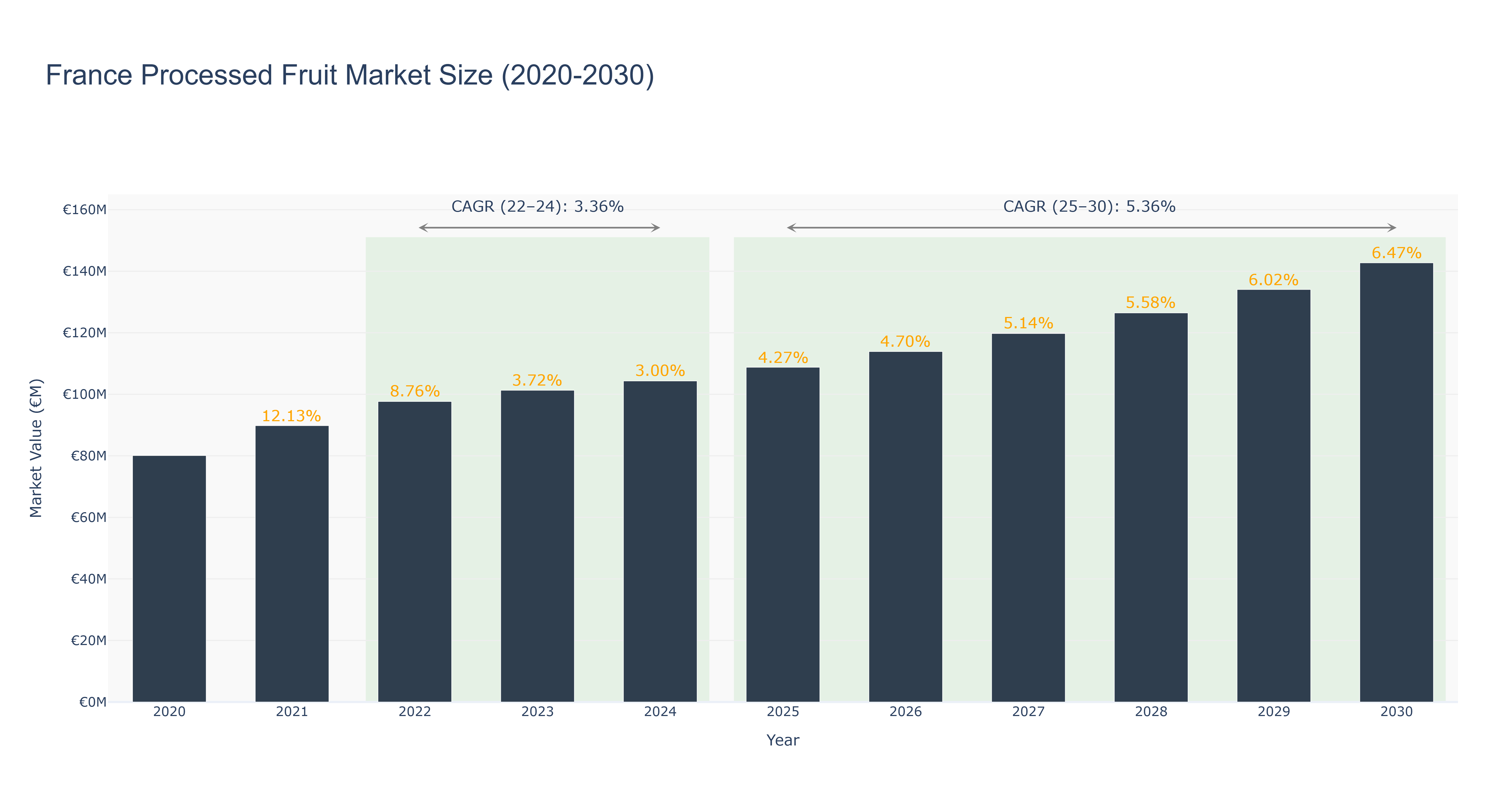
The France Processed Fruit Market experienced notable growth, peaking at €101.30 million in 2023, following a steady increase from €97.67 million in 2022 and €89.80 million in 2021. The actual market from 2022 to 2024 exhibits a modest CAGR of 3.36%, reflecting a stabilization phase influenced by changing consumer preferences towards health-conscious products and the ongoing impacts of supply chain disruptions. Looking ahead, the market is projected to gain momentum, with a forecasted CAGR of 5.36% from 2025 to 2030, culminating in an estimated market size of €142.72 million by 2030. This anticipated growth can be attributed to rising demand for convenience foods, innovations in processing techniques, and an expanding export market. Additionally, increased investments in sustainable farming practices and the introduction of new product lines are expected to further bolster market expansion in the coming years.
France Processed Fruit Market: Production & Trade Performance (2019-2025)
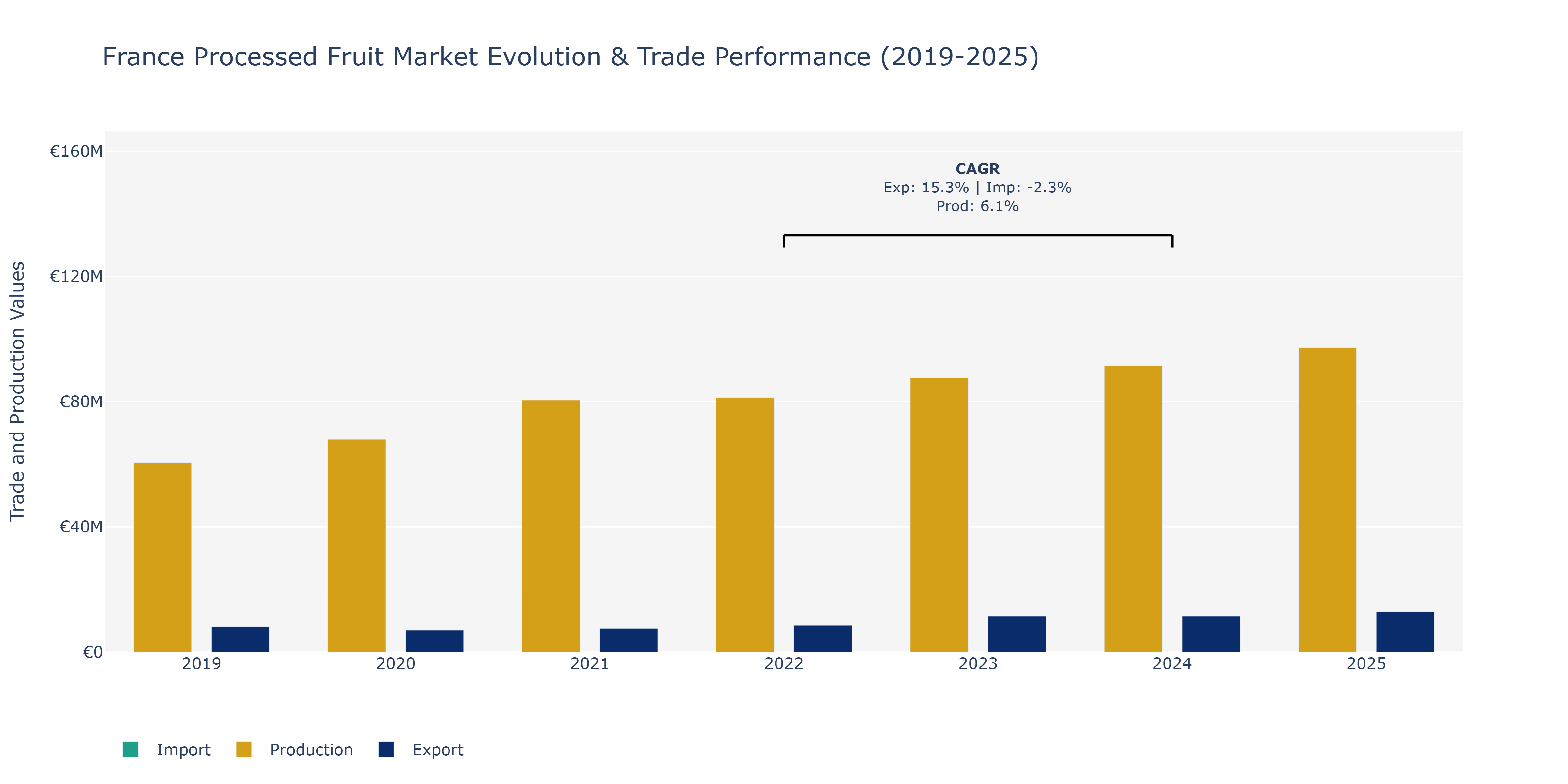
Between 2019 and 2025, France's Processed Fruit Market experienced notable shifts in Exports, Imports, and Production. Exports saw a steady rise from €8.25 million in 2019 to around €13.0 million in 2025, indicating consistent growth in foreign demand for French processed fruits. Conversely, Imports remained relatively stable, fluctuating around €19.71 million annually. Production showed a continuous upward trajectory, increasing from €60.51 million in 2019 to approximately €97.29 million in 2025. The surge in production can be attributed to technological advancements in fruit processing, leading to increased efficiencies and output. The growth in Exports can be linked to expanding global markets and a growing preference for quality French processed fruits. Despite slight fluctuations, Imports remained relatively constant, possibly due to stable domestic demand and strategic supply chain management within the industry. These trends suggest a competitive and resilient processed fruit market in France, poised for further expansion through innovation and market diversification strategies.
Key Highlights of the Report:
- France Processed Fruit Market Outlook
- Market Size of France Processed Fruit Market, 2025
- Forecast of France Processed Fruit Market, 2032
- Historical Data and Forecast of France Processed Fruit Revenues & Volume for the Period 2022 - 2032F
- France Processed Fruit Market Trend Evolution
- France Processed Fruit Market Drivers and Challenges
- France Processed Fruit Price Trends
- France Processed Fruit Porter's Five Forces
- France Processed Fruit Industry Life Cycle
- Historical Data and Forecast of France Processed Fruit Market Revenues & Volume By Product for the Period 2022 - 2032F
- Historical Data and Forecast of France Processed Fruit Market Revenues & Volume By Fresh for the Period 2022 - 2032F
- Historical Data and Forecast of France Processed Fruit Market Revenues & Volume By Fresh- Cut for the Period 2022 - 2032F
- Historical Data and Forecast of France Processed Fruit Market Revenues & Volume By Canned for the Period 2022 - 2032F
- Historical Data and Forecast of France Processed Fruit Market Revenues & Volume By Frozen for the Period 2022 - 2032F
- Historical Data and Forecast of France Processed Fruit Market Revenues & Volume By Drying &Dehydration for the Period 2022 - 2032F
- Historical Data and Forecast of France Processed Fruit Market Revenues & Volume By Processing Equipment for the Period 2022 - 2032F
- Historical Data and Forecast of France Processed Fruit Market Revenues & Volume By Pre-processing for the Period 2022 - 2032F
- Historical Data and Forecast of France Processed Fruit Market Revenues & Volume By Processing for the Period 2022 - 2032F
- Historical Data and Forecast of France Processed Fruit Market Revenues & Volume By Washing for the Period 2022 - 2032F
- Historical Data and Forecast of France Processed Fruit Market Revenues & Volume By Filling for the Period 2022 - 2032F
- Historical Data and Forecast of France Processed Fruit Market Revenues & Volume By Seasoning for the Period 2022 - 2032F
- Historical Data and Forecast of France Processed Fruit Market Revenues & Volume By Packaging for the Period 2022 - 2032F
- France Processed Fruit Import Export Trade Statistics
- Market Opportunity Assessment By Product
- Market Opportunity Assessment By Processing Equipment
- France Processed Fruit Top Companies Market Share
- France Processed Fruit Competitive Benchmarking By Technical and Operational Parameters
- France Processed Fruit Company Profiles
- France Processed Fruit Key Strategic Recommendations






































