France Small Mammal and Reptile Food Market Size, Share & Growth Rate
The France Small Mammal and Reptile Food Market was estimated at USD 100 Million in 2025 and is projected to reach USD 111 Million by 2032, growing at a CAGR of 1.5% from 2026 to 2032. This growth is largely propelled by an upward trend in pet ownership, particularly among small mammals and reptiles, as well as an increasing awareness among owners regarding the nutritional needs of their pets. The push towards premium, species-specific food solutions is a significant factor contributing to the market's positive trajectory.
France Small Mammal and Reptile Food Market Year-wise Growth Rate and Key Drivers
This graph highlights how the France Small Mammal and Reptile Food Market has steadily grown over the years, supported by major growth factors.
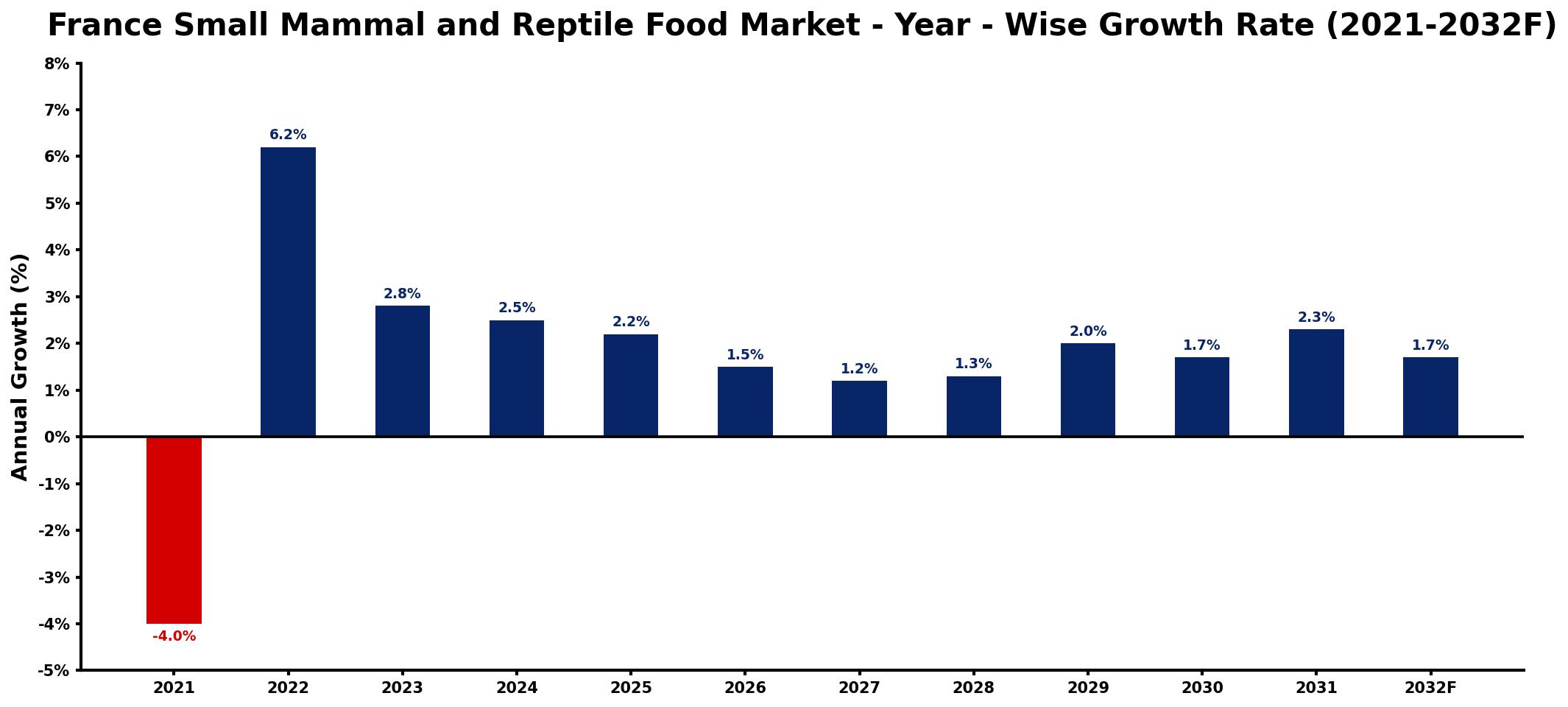
The table below presents the year‑wise growth rates along with the key drivers influencing the market
| Year | Growth Rate | Major Drivers |
| 2021 | -4.0% | Supply chain disruptions impact availability |
| 2022 | 6.2% | Increased consumer interest in pets |
| 2023 | 2.8% | Rise in pet ownership trends |
| 2024 | 2.5% | Expansion of specialty pet stores |
| 2025 | 2.2% | Growth of online retail channels |
| 2026 | 1.5% | Surge in premium product offerings |
| 2027 | 1.2% | Innovations in sustainable packaging |
| 2028 | 1.3% | Increase in pet care education |
| 2029 | 2.0% | Development of subscription services |
| 2030 | 1.7% | Focus on health and nutrition |
| 2031 | 2.3% | Emergence of new consumer brands |
| 2032 | 1.7% | Strengthening of community pet events |
Note: Market size estimations and growth projections presented in this report are based on 6Wresearch's proprietary forecasting methodology, utilizing the latest available industry data, government publications, and primary research inputs.
France Small Mammal and Reptile Food Market Synopsis
The market offers a diverse range of products tailored to the dietary requirements of various small mammals and reptiles, from specialized dry food formulations to live insects and frozen rodents. This variety reflects a growing understanding among consumers about the unique nutritional needs of different pet species, emphasizing the importance of proper diets in pet health.
Moreover, the rise of e-commerce platforms has transformed how pet owners access these products, enabling them to explore a wider selection and find niche offerings that suit their pets. This convenience aligns with the ongoing humanization of pets, which drives demand for more sophisticated and health-conscious food choices.
France Small Mammal and Reptile Food Market Key Takeaways
- The market is witnessing a shift towards natural and organic food options, driven by consumer awareness of pet nutrition.
- Online retail is emerging as a preferred channel for pet owners, providing broader access to specialty products.
- There is a marked preference for sustainable and ethically sourced ingredients in pet food formulations.
- Education on the dietary needs of small mammals and reptiles remains essential to drive market growth.
- Investment in product innovation is critical to meet evolving consumer preferences for premium offerings.
Evaluation of Restraints in France Small Mammal and Reptile Food Market
While the France Small Mammal and Reptile Food Market is positioned for growth, certain constraints must be acknowledged. The competitive landscape is challenging, with larger pet food brands dominating significant market share and limiting visibility for smaller companies. Furthermore, there is a general lack of consumer awareness regarding the specific dietary needs of small mammals and reptiles, which can hinder informed purchasing decisions. Stringent regulations on pet food ingredients also impose additional operational hurdles for manufacturers, complicating product development and compliance.
France Small Mammal and Reptile Food Market Trends
The current trends in the France Small Mammal and Reptile Food Market are indicative of shifting consumer priorities. An increasing emphasis on natural ingredients free from artificial additives reflects a demand for transparency and quality in pet nutrition. Additionally, specialized diets catering to specific species needs are gaining traction. For example, formulations designed for herbivores, omnivores, and insectivores are becoming more prevalent, showcasing an understanding of the unique dietary requirements of these pets.
France Small Mammal and Reptile Food Market Opportunities
The landscape of the France Small Mammal and Reptile Food Market is ripe with investment opportunities. Companies can capitalize on the growing interest in premium and specialized food products by developing innovative, nutritionally balanced offerings that cater to specific species' needs. Expanding distribution channels, particularly through digital platforms, can enhance market reach. There is also a clear opportunity for brands to invest in eco-friendly packaging solutions, appealing to environmentally conscious consumers.
Government Initiatives in the France Small Mammal and Reptile Food Market
The French government has instituted several policies aimed at safeguarding the quality and safety of small mammal and reptile food products. These regulations enforce strict standards on ingredient sourcing, manufacturing processes, and labeling practices to ensure consumer health and safety. Moreover, there is a concerted effort to promote ethical practices within the industry, alongside guidelines that support animal welfare and transparency throughout the supply chain. Such initiatives underscore the government's commitment to a responsible and sustainable pet food market.
Future Insights of the France Small Mammal and Reptile Food Market
Looking ahead to 2026-2032, the France Small Mammal and Reptile Food Market is set to flourish. The trend towards pet humanization will continue to elevate the demand for high-quality, specialized diets, steering consumers toward premium product options. As pet owners increasingly seek out sustainable and ethically sourced ingredients, manufacturers will need to adapt their offerings accordingly. This dynamic environment is likely to foster innovation and new product developments, positioning the market for robust growth in the coming years.
France Small Mammal and Reptile Food Market Latest Developments (2025 - 2026)
In recent months, the France Small Mammal and Reptile Food Market has seen notable shifts as manufacturers respond to emerging consumer preferences. A growing number of brands have begun to launch product lines that focus on sustainability, including biodegradable packaging and ethically sourced ingredients. Additionally, collaborations between pet nutritionists and food manufacturers are becoming more common, aimed at enhancing the nutritional profiles of offerings tailored for specific small mammal and reptile species. This focus on quality and specialization is indicative of broader trends shaping the market landscape.
France Small Mammal and Reptile Food Market - Key Attractiveness of the Report
- 10 Years of Market Numbers
- Historical Data Starting from 2022 to 2025
- Base Year: 2025
- Forecast Data until 2032
- Key Performance Indicators Impacting the Market
- Major Upcoming Developments and Projects
Key Highlights of the Report:
- France Small Mammal and Reptile Food Market Outlook
- Market Size of France Small Mammal and Reptile Food Market, 2025
- Forecast of France Small Mammal and Reptile Food Market, 2032
- Historical Data and Forecast of France Small Mammal and Reptile Food Revenues & Volume for the Period 2022-2032F
- France Small Mammal and Reptile Food Market Trend Evolution
- France Small Mammal and Reptile Food Market Drivers and Challenges
- France Small Mammal and Reptile Food Price Trends
- France Small Mammal and Reptile Food Porter's Five Forces
- France Small Mammal and Reptile Food Industry Life Cycle
- Historical Data and Forecast of France Small Mammal and Reptile Food Market Revenues & Volume By Type for the Period 2022-2032F
- Historical Data and Forecast of France Small Mammal and Reptile Food Market Revenues & Volume By Rabbits Food for the Period 2022-2032F
- Historical Data and Forecast of France Small Mammal and Reptile Food Market Revenues & Volume By Rodents Food for the Period 2022-2032F
- Historical Data and Forecast of France Small Mammal and Reptile Food Market Revenues & Volume By Small Reptiles Food for the Period 2022-2032F
- Historical Data and Forecast of France Small Mammal and Reptile Food Market Revenues & Volume By Other for the Period 2022-2032F
- Historical Data and Forecast of France Small Mammal and Reptile Food Market Revenues & Volume By Application for the Period 2022-2032F
- Historical Data and Forecast of France Small Mammal and Reptile Food Market Revenues & Volume By Pet-Speciality Stores for the Period 2022-2032F
- Historical Data and Forecast of France Small Mammal and Reptile Food Market Revenues & Volume By Supermarkets and Hypermarkets for the Period 2022-2032F
- Historical Data and Forecast of France Small Mammal and Reptile Food Market Revenues & Volume By Convenience Stores for the Period 2022-2032F
- Historical Data and Forecast of France Small Mammal and Reptile Food Market Revenues & Volume By Other for the Period 2022-2032F
- France Small Mammal and Reptile Food Import Export Trade Statistics
- Market Opportunity Assessment By Type
- Market Opportunity Assessment By Application
- France Small Mammal and Reptile Food Top Companies Market Share
- France Small Mammal and Reptile Food Competitive Benchmarking By Technical and Operational Parameters
- France Small Mammal and Reptile Food Company Profiles
- France Small Mammal and Reptile Food Key Strategic Recommendations






































