France Smart Nanomaterials Market Size, Share & Growth Rate
The France Smart Nanomaterials Market was estimated at USD 200 Million in 2025 and is projected to reach USD 247 Million by 2032, growing at a CAGR of 3.1% from 2026 to 2032. This steady growth trajectory is fueled by an increasing focus on research and development activities across key sectors such as electronics and healthcare. Additionally, the rising demand for innovative, eco-friendly materials in these industries plays a significant role in accelerating market expansion.
France Smart Nanomaterials Market Year-wise Growth Rate and Key Drivers
This graph highlights how the France Smart Nanomaterials Market has steadily grown over the years, supported by major growth factors.
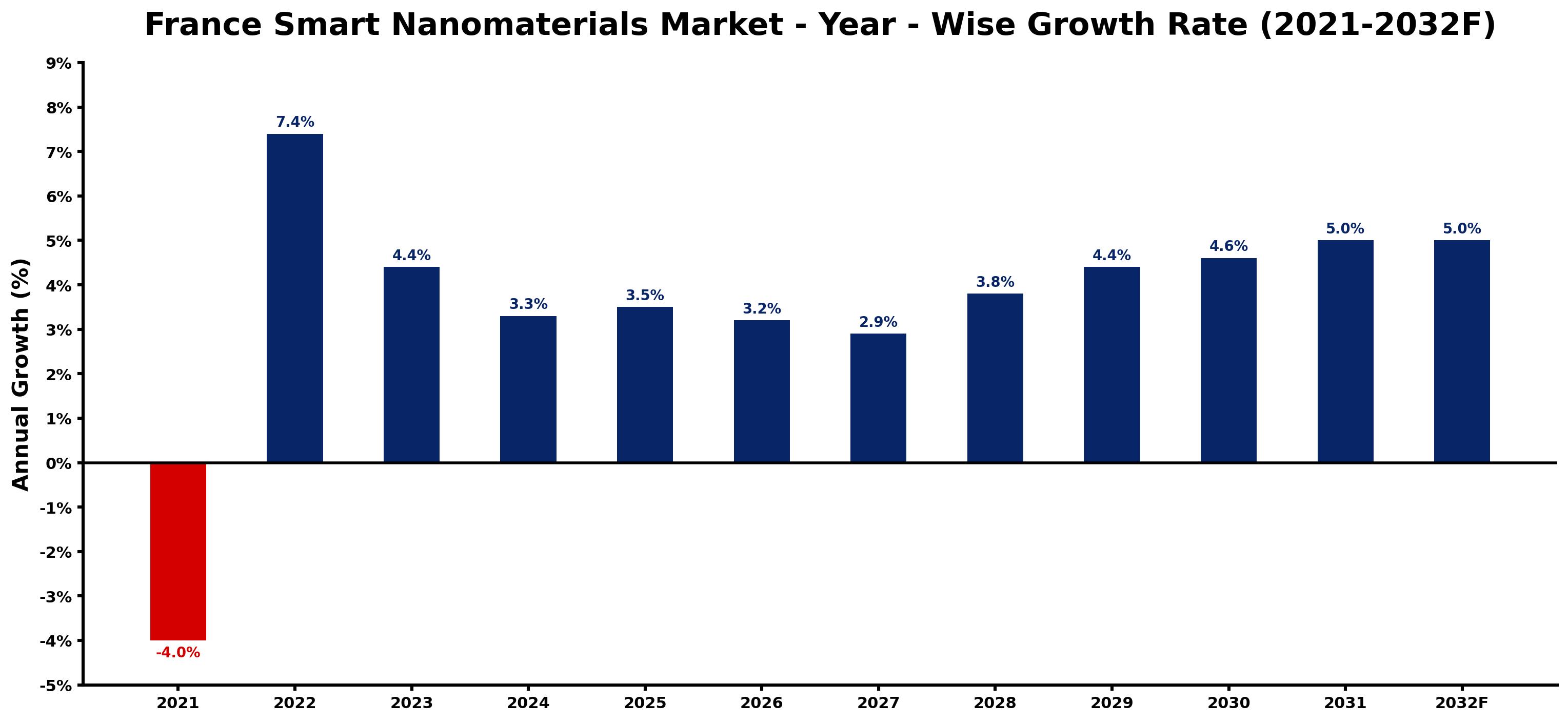
The table below presents the year‑wise growth rates along with the key drivers influencing the market
| Year | Growth Rate | Major Drivers |
| 2021 | -4.0% | Increasing industrial automation investments |
| 2022 | 7.4% | Increasing adoption of advanced technologies |
| 2023 | 4.4% | Increasing smart city development projects |
| 2024 | 3.3% | Growing urbanization and commercial development |
| 2025 | 3.5% | Growing renewable energy integration projects |
| 2026 | 3.2% | Expansion of manufacturing activities |
| 2027 | 2.9% | Growing renewable energy integration projects |
| 2028 | 3.8% | Government infrastructure modernization initiatives |
| 2029 | 4.4% | Increasing adoption of advanced technologies |
| 2030 | 4.6% | Government infrastructure modernization initiatives |
| 2031 | 5.0% | Expansion of commercial construction activities |
| 2032 | 5.0% | Growing urbanization and commercial development |
Note - Market size estimations and growth projections presented in this report are based on 6Wresearch’s advanced forecasting approach, validated with industry datasets as of June 2026.
France Smart Nanomaterials Market Synopsis
The France Smart Nanomaterials Market has witnessed robust momentum in recent years, primarily driven by advancements in nanotechnology and its applications. As the landscape evolves, the market is poised for transformative growth, underpinned by a surge in collaborative efforts between industry players and research institutions aimed at innovation.
Looking ahead, the market anticipates substantial enhancements in product offerings, specifically tailored to address the growing demands for high-performance materials. The commitment to sustainability and government support for nanotechnology research suggests a promising horizon for stakeholders invested in this dynamic sector.
France Smart Nanomaterials Market Key Takeaways
- The market is positioned for significant growth fueled by R&D investments across multiple industries.
- Enhanced properties of smart nanomaterials are driving applications in healthcare, electronics, and automotive sectors.
- Government initiatives are fostering innovation and sustainable practices in nanotechnology.
- Collaborative efforts between academia and industry are essential for market expansion.
- Growing consumer awareness and demand for eco-friendly materials are shaping market dynamics.
Evaluation of Restraints in France Smart Nanomaterials Market
Despite the positive growth outlook, the France Smart Nanomaterials Market faces several restraints that could limit its full potential. Regulatory uncertainties regarding the safe use of nanomaterials in various applications pose significant challenges for market participants. Additionally, the absence of standardized testing methods hinders the assessment of these materials' safety and efficacy. Other concerns, such as high production costs and the limited awareness among end-users about the benefits of smart nanomaterials, may further restrict market adoption. Addressing these issues is vital for unlocking the market's growth opportunities.
France Smart Nanomaterials Market Trends
Several current and emerging trends are shaping the France Smart Nanomaterials Market. A notable trend is the development of nanocomposites that exhibit superior properties, paving the way for innovative applications. Moreover, the integration of nanotechnology in wearable devices and IoT sensors is gaining traction, reflecting the increasing relevance of smart materials in everyday technology.
Furthermore, the healthcare sector is witnessing the rise of nanomaterial-based drug delivery systems that offer precision in treatment. The demand for sustainable materials continues to push for innovations in production methods and applications, driving the evolution of this promising market.
France Smart Nanomaterials Market Opportunities
Investment opportunities abound in the France Smart Nanomaterials Market, primarily due to increasing demand for unique, high-performance materials. Companies focusing on the development of innovative smart nanomaterials stand to benefit from collaborations with academic institutions and government agencies, fostering technological advancements. Additionally, partnerships with end-users in industries such as healthcare and energy can yield strategic growth avenues, catering to the evolving needs of various sectors keen on incorporating smart materials into their products.
Government Initiatives in the France Smart Nanomaterials Market
The French government actively promotes the Smart Nanomaterials Market through various initiatives aimed at enhancing research and development. Regulations have been established to ensure the safe and responsible use of nanomaterials, protecting public health and the environment. Furthermore, funding programs and partnerships with industry stakeholders are encouraging innovation and commercialization of advanced materials. The government's commitment to sustainable practices in the nanomaterials sector helps minimize potential risks associated with their use, fostering a conducive environment for growth.
Future Insights of the France Smart Nanomaterials Market
The future of the France Smart Nanomaterials Market looks promising, driven by escalating investments in R&D and an upsurge in demand for advanced materials across various industries. As innovative applications continue to emerge, particularly in healthcare and renewable energy, the market is expected to expand significantly. Additionally, supportive government policies advocating for the adoption of nanotechnology will likely propel market growth, creating a myriad of opportunities for businesses poised to capitalize on this evolving landscape.
France Smart Nanomaterials Market Latest Developments (May 2025 - June 2026)
Recent developments in the France Smart Nanomaterials Market indicate a shift towards more collaborative research efforts, enhancing innovation in product development. Key industry stakeholders are increasingly focusing on sustainability, integrating eco-friendly practices into their operations. Moreover, advancements in nanomaterial applications, particularly in drug delivery and renewable energy, are paving the way for exciting new technologies, further invigorating market dynamics.
France Smart Nanomaterials Market - Key Attractiveness of the Report
- 10 Years of Market Numbers
- Historical Data Starting from 2022 to 2025
- Base Year: 2025
- Forecast Data until 2032
- Key Performance Indicators Impacting the Market
- Major Upcoming Developments and Projects
Key Highlights of the Report:
- France Smart Nanomaterials Market Outlook
- Market Size of France Smart Nanomaterials Market, 2025
- Forecast of France Smart Nanomaterials Market, 2032
- Historical Data and Forecast of France Smart Nanomaterials Revenues & Volume for the Period 2022-2032F
- France Smart Nanomaterials Market Trend Evolution
- France Smart Nanomaterials Market Drivers and Challenges
- France Smart Nanomaterials Price Trends
- France Smart Nanomaterials Porter's Five Forces
- France Smart Nanomaterials Industry Life Cycle
- Historical Data and Forecast of France Smart Nanomaterials Market Revenues & Volume By Type for the Period 2022-2032F
- Historical Data and Forecast of France Smart Nanomaterials Market Revenues & Volume By Metal-Based for the Period 2022-2032F
- Historical Data and Forecast of France Smart Nanomaterials Market Revenues & Volume By Carbon Based for the Period 2022-2032F
- Historical Data and Forecast of France Smart Nanomaterials Market Revenues & Volume By Polymeric for the Period 2022-2032F
- Historical Data and Forecast of France Smart Nanomaterials Market Revenues & Volume By Others for the Period 2022-2032F
- Historical Data and Forecast of France Smart Nanomaterials Market Revenues & Volume By Industry Downstream for the Period 2022-2032F
- Historical Data and Forecast of France Smart Nanomaterials Market Revenues & Volume By Pharmaceuticals for the Period 2022-2032F
- Historical Data and Forecast of France Smart Nanomaterials Market Revenues & Volume By Electronics for the Period 2022-2032F
- Historical Data and Forecast of France Smart Nanomaterials Market Revenues & Volume By Consumer Goods for the Period 2022-2032F
- Historical Data and Forecast of France Smart Nanomaterials Market Revenues & Volume By Construction for the Period 2022-2032F
- Historical Data and Forecast of France Smart Nanomaterials Market Revenues & Volume By Transportation for the Period 2022-2032F
- Historical Data and Forecast of France Smart Nanomaterials Market Revenues & Volume By Others for the Period 2022-2032F
- France Smart Nanomaterials Import Export Trade Statistics
- Market Opportunity Assessment By Type
- Market Opportunity Assessment By Industry Downstream
- France Smart Nanomaterials Top Companies Market Share
- France Smart Nanomaterials Competitive Benchmarking By Technical and Operational Parameters
- France Smart Nanomaterials Company Profiles
- France Smart Nanomaterials Key Strategic Recommendations






































