France Ultra Thin Glass Market Size, Share & Growth Rate
The France Ultra Thin Glass Market was estimated at USD 153 Million in 2025 and is projected to reach USD 171 Million by 2032, growing at a CAGR of 1.6% from 2026 to 2032. This growth trajectory is primarily fueled by the surging demand for high-resolution displays and advanced touchscreen technologies across various sectors including electronics and automotive. Additionally, the continuous innovations in manufacturing processes are further enhancing the application potential of ultra-thin glass, catering to evolving consumer preferences for lightweight and durable products.
France Ultra Thin Glass Market Year-wise Growth Rate and Key Drivers
This graph highlights how the France Ultra Thin Glass Market has steadily grown over the years, supported by major growth factors.
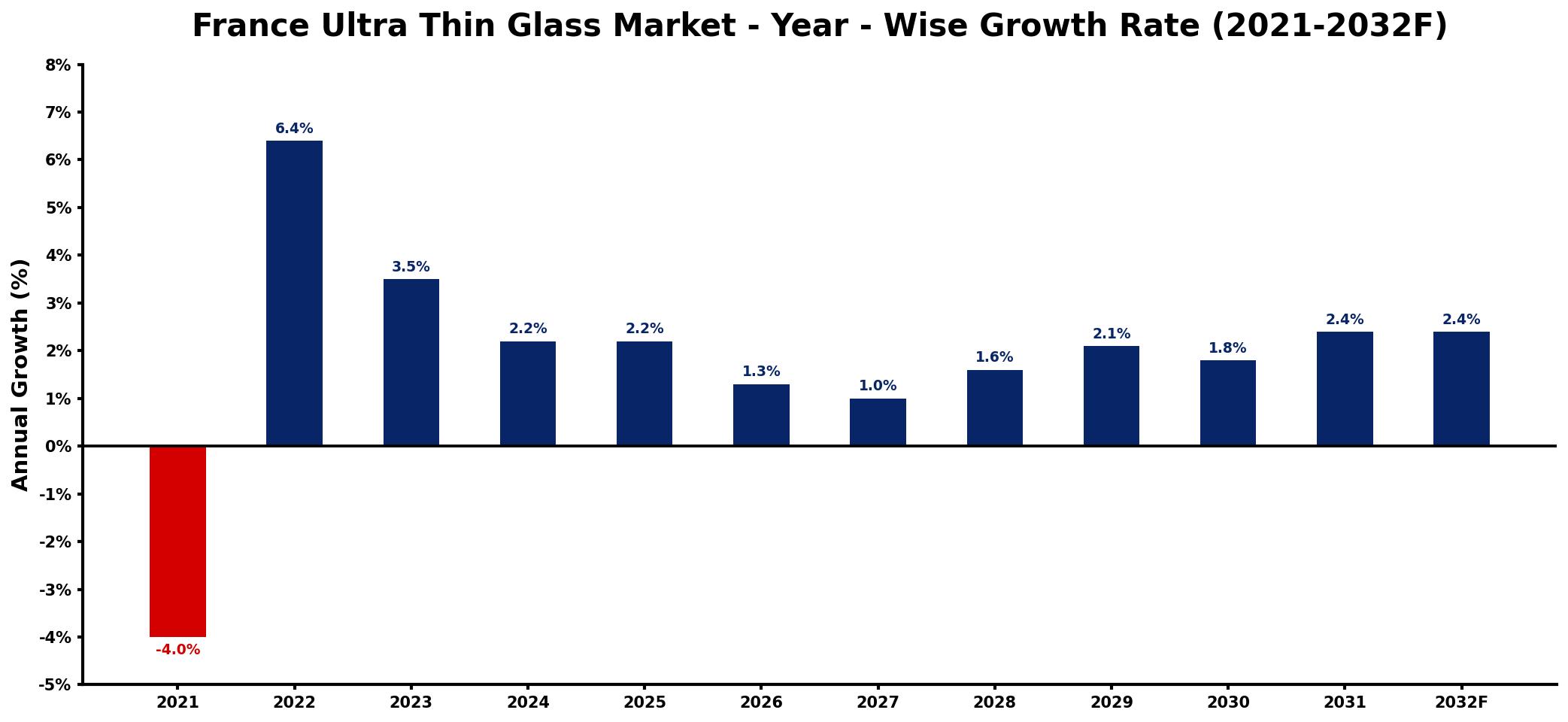
The table below presents the year‑wise growth rates along with the key drivers influencing the market
| Year | Growth Rate | Major Drivers |
| 2021 | -4.0% | decreased demand in construction sector |
| 2022 | 6.4% | rising investment in electronics sector |
| 2023 | 3.5% | growing popularity of renewable energy |
| 2024 | 2.2% | expansion of automotive industry applications |
| 2025 | 2.2% | increased demand from consumer electronics |
| 2026 | 1.3% | surge in architectural design projects |
| 2027 | 1.0% | growth in home improvement initiatives |
| 2028 | 1.6% | rising adoption in packaging solutions |
| 2029 | 2.1% | enhanced demand for mobile devices |
| 2030 | 1.8% | increased focus on sustainable materials |
| 2031 | 2.4% | rising end-use demand growth |
| 2032 | 2.4% | growing need for advanced optics |
Note: Market size estimations and growth projections presented in this report are based on 6Wresearch's proprietary forecasting methodology, utilizing the latest available industry data, government publications, and primary research inputs.
France Ultra Thin Glass Market Synopsis
In France, ultra-thin glass is increasingly recognized for its crucial role in the production of high-performance electronics. The demand for these products is being driven by consumer electronics manufacturers striving to deliver sleeker devices with superior functionality. Furthermore, automotive displays are also leveraging ultra-thin glass, leading to enhanced design aesthetics and functionality in modern vehicles.
The expansion of solar panel technologies is another pivotal factor propelling the ultra-thin glass market in France. As sustainability becomes a major focus, the adoption of lightweight glass in solar applications not only improves energy efficiency but also aligns with the countrys environmental goals, presenting a lucrative opportunity for market participants.
France Ultra Thin Glass Market Key Takeaways
- The market is experiencing robust growth driven by demand across electronics, automotive, and solar industries.
- Technological advancements in glass manufacturing are enabling the production of thinner, more durable glass products.
- Increased adoption of ultra-thin glass is aligned with the trend towards miniaturization and lightweighting in consumer products.
- Regulatory compliance and quality standards are shaping market dynamics and influencing manufacturer strategies.
- Investment in R&D is critical for market players to stay competitive amid evolving customer needs.
Evaluation of Restraints in France Ultra Thin Glass Market
While the France ultra-thin glass market is poised for growth, it faces significant engineering challenges, particularly in achieving uniform thickness and strength while maintaining optical clarity. The costs associated with specialized manufacturing equipment can deter smaller players from entering the market or expanding their production capabilities. Moreover, competition from alternative materials like flexible substrates poses a constant challenge, compelling manufacturers to emphasize the advantages of ultra-thin glass in terms of performance and cost-efficiency. Furthermore, logistical complexities and raw material sourcing challenges may disrupt production and delay market responsiveness, adding layers of difficulty to an otherwise promising landscape.
France Ultra Thin Glass Market Trends
The demand for ultra-thin glass is increasingly being shaped by the trend towards smart devices, where clarity and durability are paramount. Manufacturers are integrating advanced coating technologies to enhance product performance, facilitating the creation of ultra-thin glass with superior scratch resistance and optical clarity. Furthermore, sustainability trends are pushing manufacturers to explore eco-friendly production methods, aligning with Frances broader environmental initiatives.
France Ultra Thin Glass Market Opportunities
Growth opportunities abound in sectors such as renewable energy and wearable technology. The increasing emphasis on sustainable energy solutions suggests a rising demand for ultra-thin glass in solar panel applications. Additionally, as wearables and smart home devices gain traction, manufacturers have the chance to innovate and introduce new products that leverage the lightweight and durable characteristics of ultra-thin glass.
Government Initiatives in the France Ultra Thin Glass Market
The French government is committed to fostering innovation within the glass manufacturing sector, particularly through policies aimed at sustainability and technological advancement. Supportive initiatives include investment in research and development programs, alongside incentives for eco-friendly production practices. Furthermore, regulations focused on product quality and environmental impact are influencing market dynamics, prompting manufacturers to adhere to rigorous standards while capitalizing on government-led sustainability efforts.
Future Insights of the France Ultra Thin Glass Market
Looking ahead to 2026-2032, the France ultra-thin glass market is expected to evolve significantly. The continued integration of ultra-thin glass in emerging technologies, particularly in the automotive and electronics sectors, will further solidify its market position. Additionally, as consumer preferences shift towards eco-friendly and innovative solutions, manufacturers who prioritize sustainability and technological advancement are likely to gain a competitive edge. Strategic collaborations and investments in R&D will be pivotal in addressing market challenges and capitalizing on new growth opportunities.
France Ultra Thin Glass Market Latest Developments (2025 - 2026)
In recent months, the French ultra-thin glass market has seen noteworthy movements, particularly concerning technological advancements in glass processing techniques. Companies are increasingly focusing on enhancing their manufacturing capabilities to produce even thinner glass sheets without compromising durability. Additionally, collaborations between academic institutions and industry players are on the rise, aimed at driving innovation in sustainable manufacturing practices, ultimately influencing market dynamics and product offerings.
France Ultra Thin Glass Market - Key Attractiveness of the Report
- 10 Years of Market Numbers
- Historical Data Starting from 2022 to 2025
- Base Year: 2025
- Forecast Data until 2032
- Key Performance Indicators Impacting the Market
- Major Upcoming Developments and Projects
Key Highlights of the Report:
- France Ultra Thin Glass Market Outlook
- Market Size of France Ultra Thin Glass Market, 2025
- Forecast of France Ultra Thin Glass Market, 2032
- Historical Data and Forecast of France Ultra Thin Glass Revenues & Volume for the Period 2022-2032F
- France Ultra Thin Glass Market Trend Evolution
- France Ultra Thin Glass Market Drivers and Challenges
- France Ultra Thin Glass Price Trends
- France Ultra Thin Glass Porter's Five Forces
- France Ultra Thin Glass Industry Life Cycle
- Historical Data and Forecast of France Ultra Thin Glass Market Revenues & Volume By Thickness for the Period 2022-2032F
- Historical Data and Forecast of France Ultra Thin Glass Market Revenues & Volume By <0.1mm for the Period 2022-2032F
- Historical Data and Forecast of France Ultra Thin Glass Market Revenues & Volume By 0.1mm-0.5mm for the Period 2022-2032F
- Historical Data and Forecast of France Ultra Thin Glass Market Revenues & Volume By 0.5mm-1.0mm for the Period 2022-2032F
- Historical Data and Forecast of France Ultra Thin Glass Market Revenues & Volume By Manufacturing Process for the Period 2022-2032F
- Historical Data and Forecast of France Ultra Thin Glass Market Revenues & Volume By Float for the Period 2022-2032F
- Historical Data and Forecast of France Ultra Thin Glass Market Revenues & Volume By Fusion for the Period 2022-2032F
- Historical Data and Forecast of France Ultra Thin Glass Market Revenues & Volume By Down-Draw for the Period 2022-2032F
- Historical Data and Forecast of France Ultra Thin Glass Market Revenues & Volume By Application for the Period 2022-2032F
- Historical Data and Forecast of France Ultra Thin Glass Market Revenues & Volume By Semiconductor Substrate for the Period 2022-2032F
- Historical Data and Forecast of France Ultra Thin Glass Market Revenues & Volume By Touch Panel Display for the Period 2022-2032F
- Historical Data and Forecast of France Ultra Thin Glass Market Revenues & Volume By Fingerprint Sensor for the Period 2022-2032F
- Historical Data and Forecast of France Ultra Thin Glass Market Revenues & Volume By Others for the Period 2022-2032F
- Historical Data and Forecast of France Ultra Thin Glass Market Revenues & Volume By End-use Industry for the Period 2022-2032F
- Historical Data and Forecast of France Ultra Thin Glass Market Revenues & Volume By Consumer Electronics for the Period 2022-2032F
- Historical Data and Forecast of France Ultra Thin Glass Market Revenues & Volume By Automotive & Transportation for the Period 2022-2032F
- Historical Data and Forecast of France Ultra Thin Glass Market Revenues & Volume By Medical & Healthcare for the Period 2022-2032F
- Historical Data and Forecast of France Ultra Thin Glass Market Revenues & Volume By Others for the Period 2022-2032F
- France Ultra Thin Glass Import Export Trade Statistics
- Market Opportunity Assessment By Thickness
- Market Opportunity Assessment By Manufacturing Process
- Market Opportunity Assessment By Application
- Market Opportunity Assessment By End-use Industry
- France Ultra Thin Glass Top Companies Market Share
- France Ultra Thin Glass Competitive Benchmarking By Technical and Operational Parameters
- France Ultra Thin Glass Company Profiles
- France Ultra Thin Glass Key Strategic Recommendations






































