France Wooden Furniture Market Top 5 Importing Countries and Market Competition (HHI) Analysis
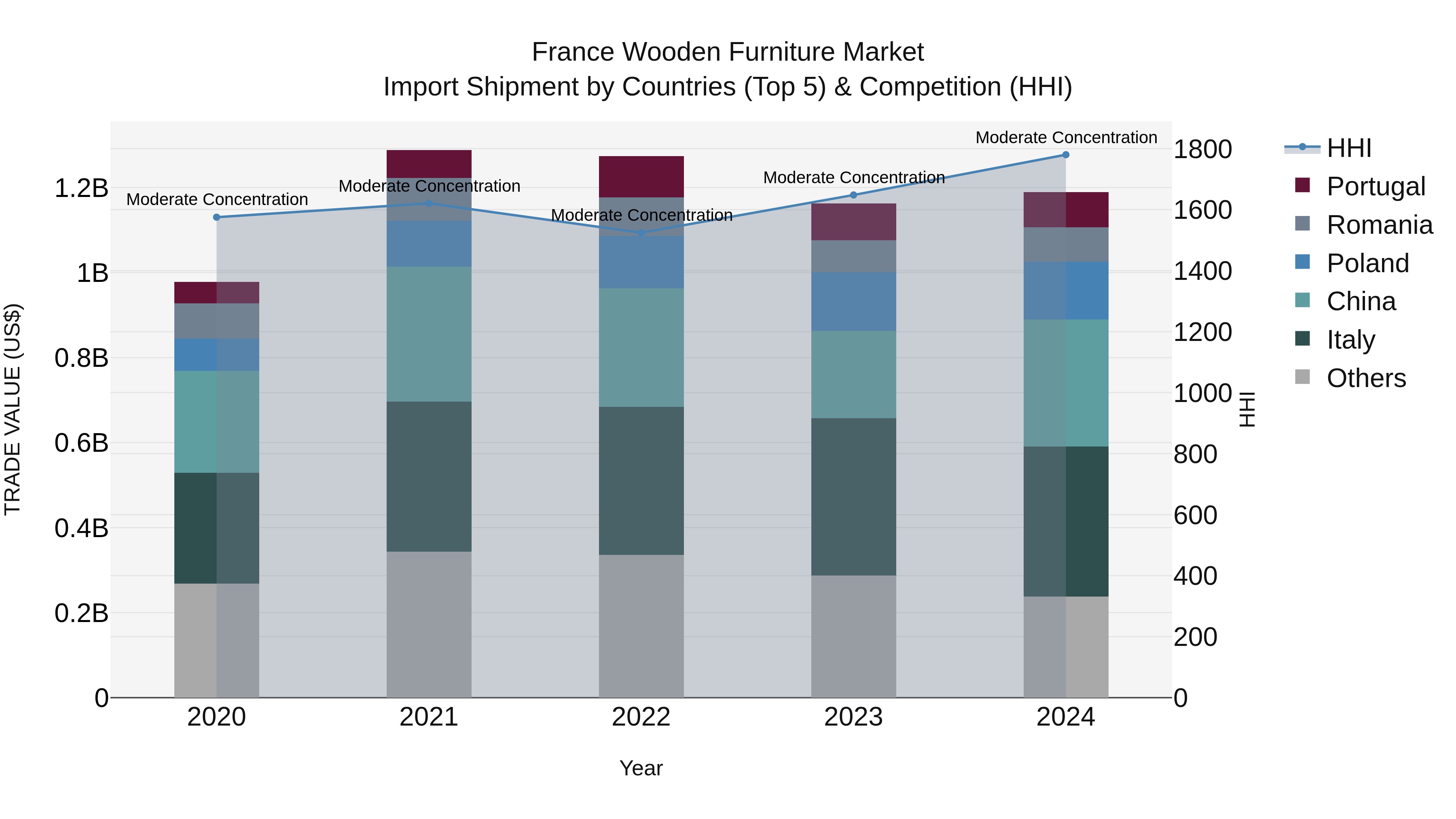
The wooden furniture import market in France continued to show steady growth in 2024, with top exporting countries being Italy, China, Poland, Portugal, and Romania. Despite moderate concentration levels indicated by the HHI, the industry saw a healthy Compound Annual Growth Rate (CAGR) of 5.02% from 2020 to 2024. The growth momentum remained strong in 2024, with a growth rate of 2.3% compared to the previous year, showcasing sustained demand for wooden furniture imports in the French market.
France Wooden Furniture Market Overview
The France Wooden Furniture market is witnessing robust growth driven by the enduring popularity of wood as a versatile and timeless material for furniture manufacturing and the increasing demand for high-quality and customizable furniture products. Wooden furniture offers durability, aesthetic appeal, and natural warmth, making it a preferred choice for residential, commercial, and hospitality applications. With the growing emphasis on sustainable and eco-friendly design, there is a growing market for wooden furniture sourced from responsibly managed forests and manufactured using environmentally friendly processes. The market is characterized by a diverse range of furniture styles, designs, and finishes catering to diverse consumer preferences and lifestyle trends, driving innovation and market competition.
Drivers of the market
In France, the wooden furniture market is propelled by the enduring popularity of wood as a versatile, durable, and aesthetically pleasing material for interior furnishings, home decor, and commercial fit-outs. With a growing emphasis on craftsmanship, heritage, and sustainability, there is a rising demand for high-quality wooden furniture pieces that combine timeless design with eco-friendly materials and manufacturing processes.
Challenges of the market
In France, the wooden furniture market faces challenges such as changing consumer preferences, competition from alternative materials, and supply chain disruptions. Meeting consumer demand for sustainable, high-quality wooden furniture products while addressing cost pressures and operational challenges remains a key challenge for furniture manufacturers and retailers.
Government Policy of the market
France government policies regarding the wooden furniture market focus on promoting craftsmanship, design innovation, and sustainable forest management. Regulatory oversight of furniture manufacturing falls under the purview of agencies such as the Ministry of Culture and the Ministry of Ecological Transition. These agencies may establish regulations and standards to ensure the quality and safety of wooden furniture products, promote eco-labeling schemes for sustainable wood sourcing and production practices, and support artisanal industries through training programs and financial incentives. The French government may also collaborate with industry associations and trade unions to promote French furniture design and craftsmanship internationally and protect cultural heritage associated with woodworking traditions.
Key Highlights of the Report:
- France Wooden Furniture Market Outlook
- Market Size of France Wooden Furniture Market, 2021
- Forecast of France Wooden Furniture Market, 2028
- Historical Data and Forecast of France Wooden Furniture Revenues & Volume for the Period 2018 - 2028
- France Wooden Furniture Market Trend Evolution
- France Wooden Furniture Market Drivers and Challenges
- France Wooden Furniture Price Trends
- France Wooden Furniture Porter's Five Forces
- France Wooden Furniture Industry Life Cycle
- Historical Data and Forecast of France Wooden Furniture Market Revenues & Volume By Type for the Period 2018 - 2028
- Historical Data and Forecast of France Wooden Furniture Market Revenues & Volume By Hardwood for the Period 2018 - 2028
- Historical Data and Forecast of France Wooden Furniture Market Revenues & Volume By Softwood for the Period 2018 - 2028
- Historical Data and Forecast of France Wooden Furniture Market Revenues & Volume By Material for the Period 2018 - 2028
- Historical Data and Forecast of France Wooden Furniture Market Revenues & Volume By Plywood for the Period 2018 - 2028
- Historical Data and Forecast of France Wooden Furniture Market Revenues & Volume By Laminates for the Period 2018 - 2028
- Historical Data and Forecast of France Wooden Furniture Market Revenues & Volume By MDF for the Period 2018 - 2028
- Historical Data and Forecast of France Wooden Furniture Market Revenues & Volume By Other Materials for the Period 2018 - 2028
- Historical Data and Forecast of France Wooden Furniture Market Revenues & Volume By Product for the Period 2018 - 2028
- Historical Data and Forecast of France Wooden Furniture Market Revenues & Volume By Bedroom for the Period 2018 - 2028
- Historical Data and Forecast of France Wooden Furniture Market Revenues & Volume By Seating for the Period 2018 - 2028
- Historical Data and Forecast of France Wooden Furniture Market Revenues & Volume By Kitchen for the Period 2018 - 2028
- Historical Data and Forecast of France Wooden Furniture Market Revenues & Volume By Other Products for the Period 2018 - 2028
- Historical Data and Forecast of France Wooden Furniture Market Revenues & Volume By Application for the Period 2018 - 2028
- Historical Data and Forecast of France Wooden Furniture Market Revenues & Volume By Residential for the Period 2018 - 2028
- Historical Data and Forecast of France Wooden Furniture Market Revenues & Volume By Commercial for the Period 2018 - 2028
- Historical Data and Forecast of France Wooden Furniture Market Revenues & Volume By Distribution Channel for the Period 2018 - 2028
- Historical Data and Forecast of France Wooden Furniture Market Revenues & Volume By Offline for the Period 2018 - 2028
- Historical Data and Forecast of France Wooden Furniture Market Revenues & Volume By Online for the Period 2018 - 2028
- France Wooden Furniture Import Export Trade Statistics
- Market Opportunity Assessment By Type
- Market Opportunity Assessment By Material
- Market Opportunity Assessment By Product
- Market Opportunity Assessment By Application
- Market Opportunity Assessment By Distribution Channel
- France Wooden Furniture Top Companies Market Share
- France Wooden Furniture Competitive Benchmarking By Technical and Operational Parameters
- France Wooden Furniture Company Profiles
- France Wooden Furniture Key Strategic Recommendations






































