Gambia Building Thermal Insulation Market Size Growth Rate
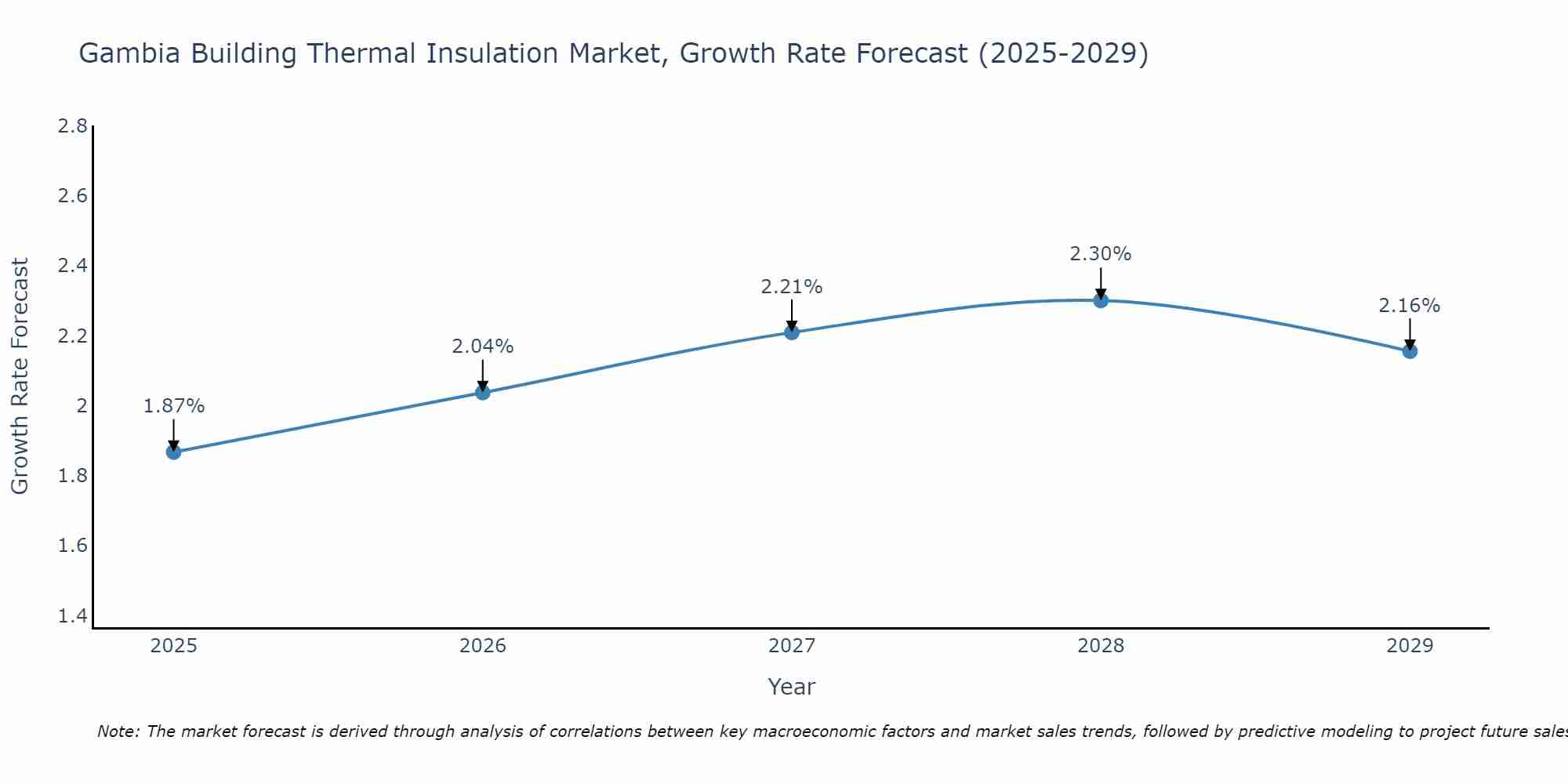
The Gambia Building Thermal Insulation Market is projected to witness mixed growth rate patterns during 2025 to 2029. Starting at 1.87% in 2025, the market peaks at 2.30% in 2028, and settles at 2.16% by 2029.
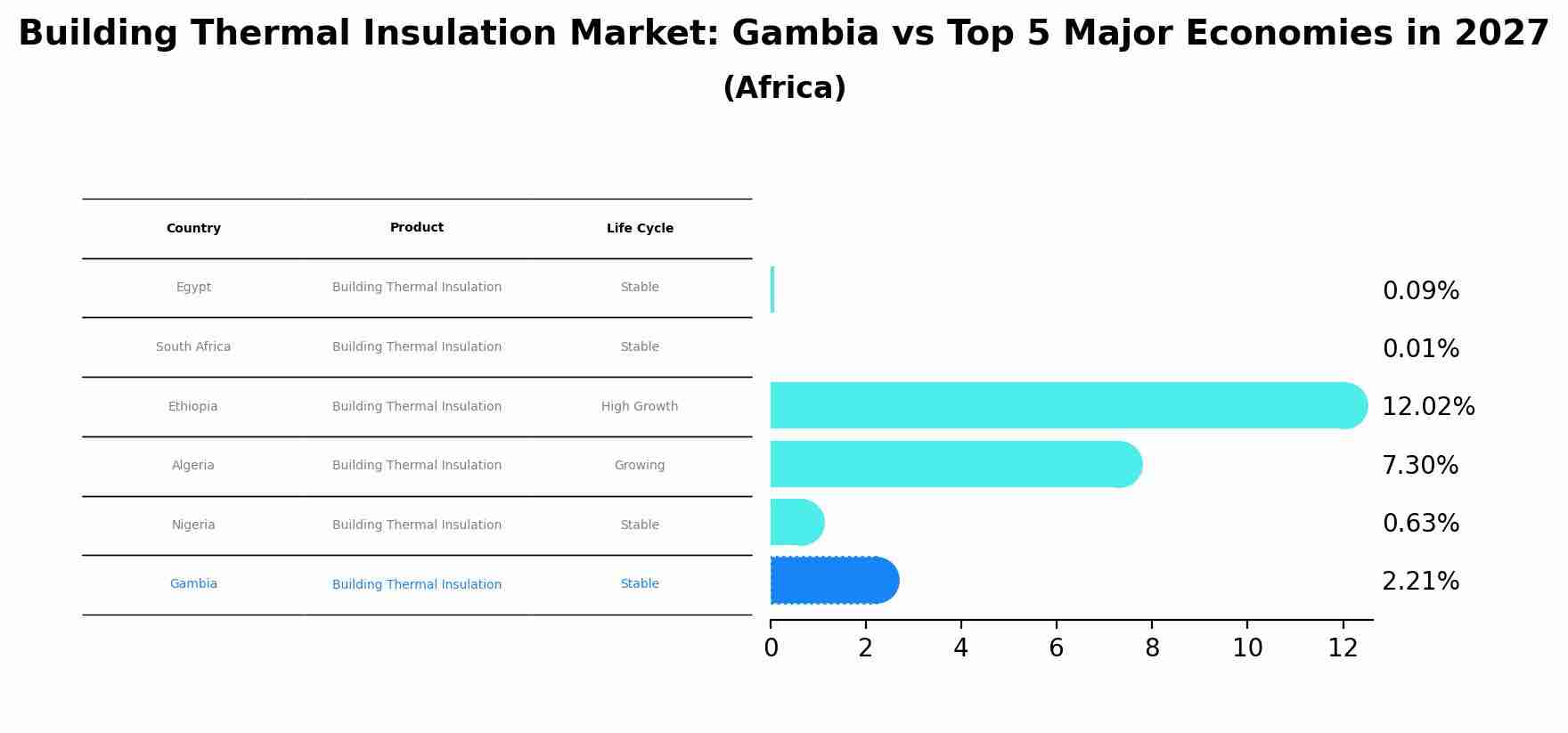
Building Thermal Insulation Market: Gambia vs Top 5 Major Economies in 2027 (Africa)
By 2027, the Building Thermal Insulation market in Gambia is anticipated to reach a growth rate of 2.21%, as part of an increasingly competitive Africa region, where Egypt remains at the forefront, supported by South Africa, Ethiopia, Algeria and Nigeria, driving innovations and market adoption across sectors.
Gambia Building Thermal Insulation Market Overview
The building thermal insulation market in Gambia is driven by the rising demand for energy-efficient buildings and the need for better climate control in residential and commercial buildings. Thermal insulation materials help reduce energy consumption by maintaining consistent indoor temperatures. With the country experiencing hot climatic conditions, there is an increasing preference for insulation solutions that can provide both heat resistance and cost savings. The growing construction sector, supported by urbanization, is fueling the demand for innovative thermal insulation solutions.
Drivers of the market
The demand for building thermal insulation in Gambia is growing due to the rising need for energy-efficient buildings. As construction activities increase in the country, the focus on reducing energy consumption and enhancing indoor comfort levels becomes more prominent. Insulation solutions help to regulate temperature, reduce energy costs, and improve the overall energy efficiency of buildings. Government regulations promoting sustainability in the construction sector, along with the growing awareness of environmental concerns, are also key drivers for the thermal insulation market.
Challenges of the market
In the Gambia, the Building Thermal Insulation Market is faced with the challenge of a lack of proper regulations and standards for insulation materials, which can lead to subpar products being used in construction. Moreover, the initial costs of thermal insulation materials are often viewed as a barrier for local builders and homeowners. This is compounded by a general lack of awareness regarding the benefits of insulation, such as energy savings and improved indoor comfort.
Government Policy of the market
Thermal insulation in buildings is crucial for reducing energy consumption and maintaining comfortable indoor climates. The government of The Gambia has policies in place to encourage the use of thermal insulation materials in construction projects. These policies focus on promoting energy efficiency and cost savings in the long term, especially in response to the countrys rising energy costs and growing interest in sustainable building practices.
Key Highlights of the Report:
- Gambia Building Thermal Insulation Market Outlook
- Market Size of Gambia Building Thermal Insulation Market, 2025
- Forecast of Gambia Building Thermal Insulation Market, 2032
- Historical Data and Forecast of Gambia Building Thermal Insulation Revenues & Volume for the Period 2022-2032F
- Gambia Building Thermal Insulation Market Trend Evolution
- Gambia Building Thermal Insulation Market Drivers and Challenges
- Gambia Building Thermal Insulation Price Trends
- Gambia Building Thermal Insulation Porter`s Five Forces
- Gambia Building Thermal Insulation Industry Life Cycle
- Historical Data and Forecast of Gambia Building Thermal Insulation Market Revenues & Volume By Material for the Period 2022-2032F
- Historical Data and Forecast of Gambia Building Thermal Insulation Market Revenues & Volume By Glasswool for the Period 2022-2032F
- Historical Data and Forecast of Gambia Building Thermal Insulation Market Revenues & Volume By Stonewool for the Period 2022-2032F
- Historical Data and Forecast of Gambia Building Thermal Insulation Market Revenues & Volume By Plastic Foam for the Period 2022-2032F
- Historical Data and Forecast of Gambia Building Thermal Insulation Market Revenues & Volume By Application for the Period 2022-2032F
- Historical Data and Forecast of Gambia Building Thermal Insulation Market Revenues & Volume By Roof Insulation for the Period 2022-2032F
- Historical Data and Forecast of Gambia Building Thermal Insulation Market Revenues & Volume By Floor Insulation for the Period 2022-2032F
- Historical Data and Forecast of Gambia Building Thermal Insulation Market Revenues & Volume By Wall Insulation for the Period 2022-2032F
- Historical Data and Forecast of Gambia Building Thermal Insulation Market Revenues & Volume By Building Type for the Period 2022-2032F
- Historical Data and Forecast of Gambia Building Thermal Insulation Market Revenues & Volume By Residential for the Period 2022-2032F
- Historical Data and Forecast of Gambia Building Thermal Insulation Market Revenues & Volume By Non-Residential for the Period 2022-2032F
- Gambia Building Thermal Insulation Import Export Trade Statistics
- Market Opportunity Assessment By Material
- Market Opportunity Assessment By Application
- Market Opportunity Assessment By Building Type
- Gambia Building Thermal Insulation Top Companies Market Share
- Gambia Building Thermal Insulation Competitive Benchmarking By Technical and Operational Parameters
- Gambia Building Thermal Insulation Company Profiles
- Gambia Building Thermal Insulation Key Strategic Recommendations






































