Georgia Auto Parts And Accessories Market Size, Share & Growth Rate
The Georgia Auto Parts And Accessories Market was estimated at USD 249 Million in 2025 and is projected to reach USD 344 Million by 2032, growing at a CAGR of 4.7% from 2026 to 2032. This growth trajectory is driven by a robust automotive presence in Georgia, increased consumer interest in vehicle personalization, and a significant shift towards e-commerce channels. As digital platforms expand their reach and consumers demand more sustainable options, the market is poised for substantial transformation.
Georgia Auto Parts And Accessories Market Year-wise Growth Rate and Key Drivers
This graph highlights how the Georgia Auto Parts And Accessories Market has steadily grown over the years, supported by major growth factors.
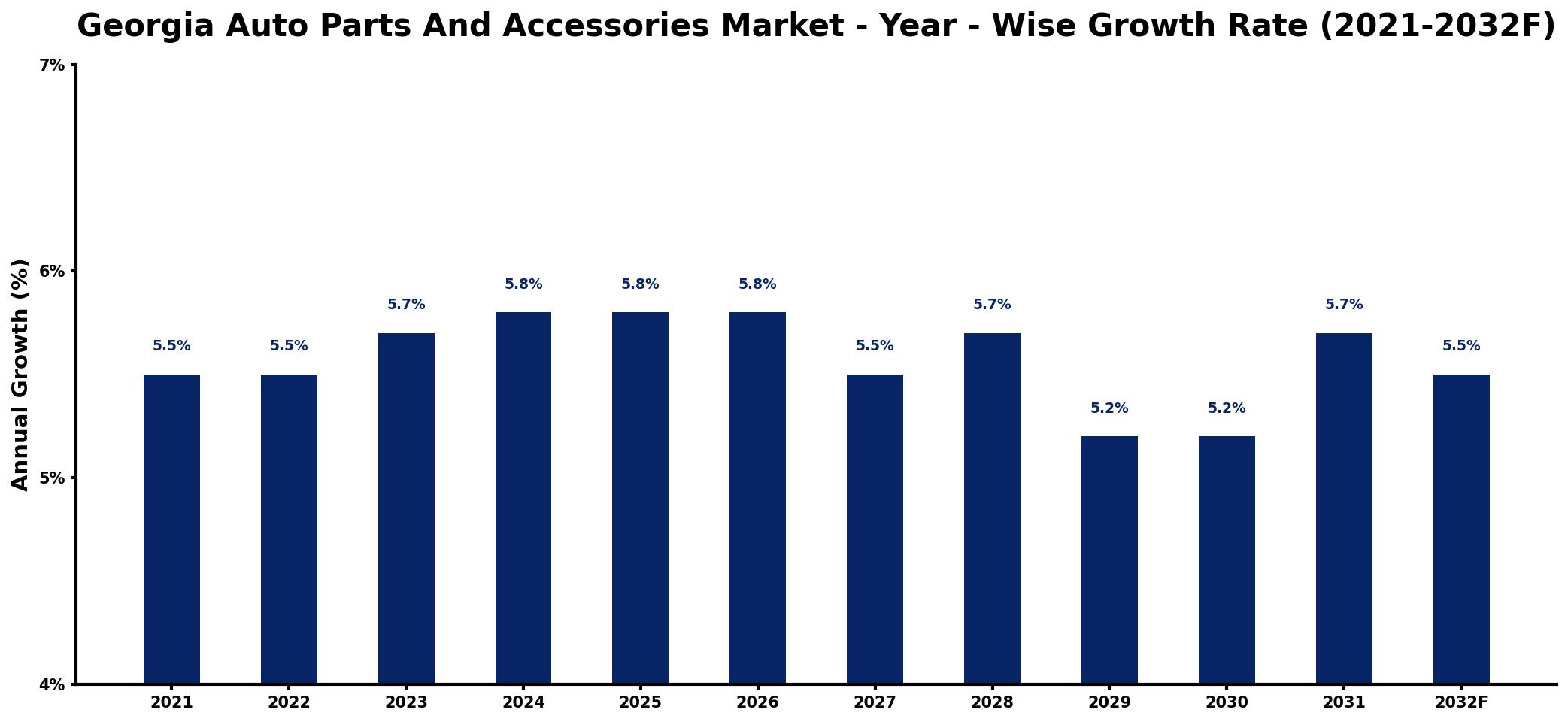
The table below presents the year‑wise growth rates along with the key drivers influencing the market
| Year | Growth Rate | Major Drivers |
| 2021 | 5.5% | Increased consumer vehicle ownership rates |
| 2022 | 5.5% | Rising demand for online purchases |
| 2023 | 5.7% | Growth in vehicle maintenance services |
| 2024 | 5.8% | Expansion of e-commerce platforms |
| 2025 | 5.8% | Increase in DIY repair trends |
| 2026 | 5.8% | Investment in sustainable technologies |
| 2027 | 5.5% | Focus on vehicle performance enhancements |
| 2028 | 5.7% | growing emerging market penetration |
| 2029 | 5.2% | rising procurement volume requirements |
| 2030 | 5.2% | Reduction in new vehicle sales |
| 2031 | 5.7% | Renewed interest in vintage restorations |
| 2032 | 5.5% | Shift towards electric vehicle components |
Note: Market size estimations and growth projections presented in this report are based on 6Wresearch's proprietary forecasting methodology, utilizing the latest available industry data, government publications, and primary research inputs.
Georgia Auto Parts And Accessories Market Synopsis
Currently, the Georgia auto parts and accessories market is thriving, characterized by an extensive range of products that cater to diverse consumer needs, from basic replacements to premium upgrades. However, as the market continues to evolve, trends toward sustainability and technological advancements are shaping its future direction.
Major urban centers, particularly Atlanta and Savannah, are seeing increased competition not just from local brick-and-mortar stores but also from dynamic online retailers. This competitive landscape is forcing businesses to innovate and adapt to the changing preferences of car owners, ensuring a responsive approach to service and product offerings.
Georgia Auto Parts And Accessories Market Key Takeaways
- The market is projected to grow from USD 249 Million in 2025 to USD 344 Million by 2032.
- Environmental sustainability is becoming a significant driver for consumer choices, leading to increased demand for eco-friendly products.
- Technological advancements, particularly in smart car accessories, are reshaping product offerings within the market.
- E-commerce is rapidly growing, with consumers favoring online shopping for convenience and variety.
- The market faces challenges such as rising operational costs and the need for enhanced customer service from traditional retailers.
Evaluation of Restraints in Georgia Auto Parts And Accessories Market
The Georgia Auto Parts and Accessories Market encounters several notable restraints that could hinder growth. Increasing competition from online retailers is prompting traditional retailers to reconsider their operational strategies and customer engagement practices. Additionally, economic uncertainties often influence consumer spending on automotive needs, leading to fluctuating demand. Retailers must also navigate regulatory changes, particularly those related to environmental standards, which can alter product availability and pricing. Adapting to these challenges necessitates investment in innovative solutions and strong supplier relationships to ensure ongoing market competitiveness.
Georgia Auto Parts And Accessories Market Trends
There are several key trends reshaping the Georgia auto parts and accessories market. The push towards eco-friendly products is gaining momentum, driven by consumers' growing awareness of environmental issues. Furthermore, the rise of electric vehicles (EVs) is generating demand for specific components tailored for these models. Smart technology integration in vehicles is another trend, with consumers increasingly interested in advanced features such as connectivity and automation. As a result, businesses must adapt their product lines to meet the growing demand for innovative and sustainable automotive solutions.
Georgia Auto Parts And Accessories Market Opportunities
Investment opportunities abound within the Georgia auto parts and accessories market, especially in areas aligned with the ongoing shifts towards e-commerce and sustainability. Developing manufacturing facilities or distribution centers can leverage the state's strong automotive presence, providing high-quality parts to a burgeoning market. Moreover, as online retail continues to expand, establishing partnerships with local auto shops can create synergies for providing specialized products and services. This strategic focus on convenience and quality is likely to yield significant returns for investors.
Government Initiatives in the Georgia Auto Parts And Accessories Market
Government policies play a pivotal role in shaping the Georgia auto parts and accessories market. Regulatory frameworks surrounding product safety and emissions standards are vital for ensuring the sustainability of the industry. Additionally, state incentives and tax breaks are often designed to promote the growth of local automotive industries. Policies that support the recycling and safe disposal of auto parts contribute to environmental goals while reinforcing consumer confidence. Keeping abreast of these governmental initiatives is crucial for businesses operating within the market.
Future Insights of the Georgia Auto Parts And Accessories Market
The outlook for the Georgia auto parts and accessories market appears promising through 2026-2032. As the automotive industry in Georgia continues to expand, consumer demand for vehicle customization and technological enhancements will likely drive market growth. The increased prevalence of electric vehicles and smart technologies presents unique opportunities for innovative products. Companies that embrace e-commerce strategies and prioritize sustainability will be well-positioned to capture emerging market segments, ensuring continued success in this evolving landscape.
Georgia Auto Parts And Accessories Market Latest Developments (2025 - 2026)
In recent months, the Georgia auto parts and accessories market has witnessed a notable increase in the introduction of eco-friendly product lines, reflecting a commitment to sustainability. Retailers are enhancing their e-commerce platforms to meet growing consumer preferences for online shopping, emphasizing convenience and variety. Collaboration between local manufacturers and tech startups has also been observed, aimed at integrating smart technology into traditional auto parts. Such movements indicate a proactive approach within the industry to adapt to changing market dynamics.
Georgia Auto Parts And Accessories Market - Key Attractiveness of the Report
- 10 Years of Market Numbers
- Historical Data Starting from 2022 to 2025
- Base Year: 2025
- Forecast Data until 2032
- Key Performance Indicators Impacting the Market
- Major Upcoming Developments and Projects
Key Highlights of the Report:
- Georgia Auto Parts And Accessories Market Outlook
- Market Size of Georgia Auto Parts And Accessories Market, 2025
- Forecast of Georgia Auto Parts And Accessories Market, 2032
- Historical Data and Forecast of Georgia Auto Parts And Accessories Revenues & Volume for the Period 2022-2032F
- Georgia Auto Parts And Accessories Market Trend Evolution
- Georgia Auto Parts And Accessories Market Drivers and Challenges
- Georgia Auto Parts And Accessories Price Trends
- Georgia Auto Parts And Accessories Porter's Five Forces
- Georgia Auto Parts And Accessories Industry Life Cycle
- Historical Data and Forecast of Georgia Auto Parts And Accessories Market Revenues & Volume By Product for the Period 2022-2032F
- Historical Data and Forecast of Georgia Auto Parts And Accessories Market Revenues & Volume By Driveline & Powertrain for the Period 2022-2032F
- Historical Data and Forecast of Georgia Auto Parts And Accessories Market Revenues & Volume By Interiors & Exteriors for the Period 2022-2032F
- Historical Data and Forecast of Georgia Auto Parts And Accessories Market Revenues & Volume By Electronics for the Period 2022-2032F
- Historical Data and Forecast of Georgia Auto Parts And Accessories Market Revenues & Volume By Bodies & Chassis for the Period 2022-2032F
- Historical Data and Forecast of Georgia Auto Parts And Accessories Market Revenues & Volume By Wheel & Tires for the Period 2022-2032F
- Historical Data and Forecast of Georgia Auto Parts And Accessories Market Revenues & Volume By Others for the Period 2022-2032F
- Historical Data and Forecast of Georgia Auto Parts And Accessories Market Revenues & Volume By Application for the Period 2022-2032F
- Historical Data and Forecast of Georgia Auto Parts And Accessories Market Revenues & Volume By OEMs for the Period 2022-2032F
- Historical Data and Forecast of Georgia Auto Parts And Accessories Market Revenues & Volume By Aftermarket for the Period 2022-2032F
- Georgia Auto Parts And Accessories Import Export Trade Statistics
- Market Opportunity Assessment By Product
- Market Opportunity Assessment By Application
- Georgia Auto Parts And Accessories Top Companies Market Share
- Georgia Auto Parts And Accessories Competitive Benchmarking By Technical and Operational Parameters
- Georgia Auto Parts And Accessories Company Profiles
- Georgia Auto Parts And Accessories Key Strategic Recommendations






































